Hello! Welcome back to our journey through the anatomy of the human arm.
In our last session, we focused on the upper arm, breaking down the biceps and triceps. We saw how these two groups work as an antagonistic pair to create the main contours of the upper arm, and how their shapes are influenced by flexion, extension, and rotation.
Today, we move down to one of the most anatomically complex areas of the body: the forearm. But don't worry, we're going to simplify it. Our goal is to identify and draw the major forearm muscle groups (flexors and extensors) and their effect on the arm's overall shape. Instead of getting lost in the nearly 20 muscles located here, we'll group them into three manageable, functional units that are key for artists.
This approach is similar to how you might structure a complex application in your work as a developer. By grouping related functions into modules or components, you make the entire system easier to understand and manage. We'll do the same with muscles.
1. The Three Foundational Groups
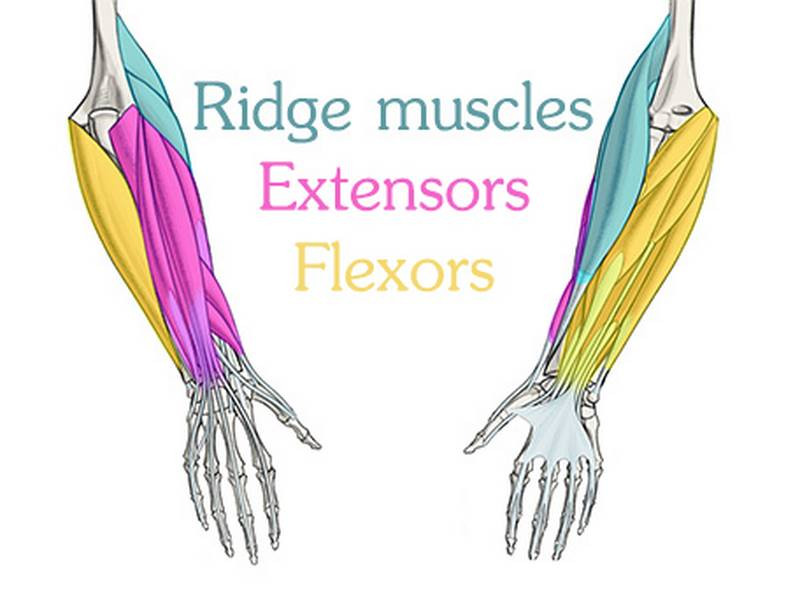
The key to drawing the forearm is to stop seeing it as a simple tapered cylinder and start seeing it as a collection of three distinct muscle masses.
- The Flexor Group: Located on the anterior side (the palm side) of the forearm. These muscles are responsible for "flexing" or curling the wrist and fingers.
- The Extensor Group: Located on the posterior side (the back of the hand side). These muscles "extend" or straighten the wrist and fingers.
- The Ridge Muscles: A crucial group for artists, located on the top/thumb-side of the forearm. They form a bridge from the upper arm bone (humerus) down toward the thumb.
Let's get a clear visual of this grouping.
To get a dynamic introduction to these groups and their functions, let's turn to a video from Proko.
How To Draw Forearms - Arm Anatomy for Artists
In this segment from 'How To Draw Forearms,' Stan Prokopenko provides a fantastic overview of the three muscle groups, their locations, and their primary functions.
Watch from 01:25 to 02:42. Pay close attention to the origin points he mentions: Flexors originate from the medial epicondyle (the bony bump on the inside of your elbow). Extensors originate from the lateral epicondyle (the bony bump on the outside of your elbow). These bony landmarks are the anchors for the entire forearm structure.
2. The Shape and Form of Each Group
Now that we have the basic layout, let's analyze the characteristic shape, or form, of each group. This is what truly defines the contours of the forearm.
The Extensors: The Bullet Shape
The extensor muscles on the back of the forearm often appear as a series of smaller, striated muscles. However, as a group, they create a cohesive form that artists can simplify.
How To Draw Forearms - Arm Anatomy for Artists
Let's continue with the Proko video to see how he simplifies the complex extensor group.
Watch from 02:42 to 04:30. The key takeaway here is the simplification of the extensors into a 'bullet shape' that originates from the lateral epicondyle. Also, make note of the ulnar furrow, the visible groove along the ulna bone that separates the extensors from the flexors. This is a critical landmark for artists.
The concept of simplifying a complex anatomical structure into a basic geometric form is a powerful tool.

The Flexors: The Egg or Drumstick Shape
The flexor group, on the palm side, tends to blend into one large, fleshy mass. It's generally rounder and less defined than the extensors.
How To Draw Forearms - Arm Anatomy for Artists
Now for the flexors. This part of the Proko video describes their form and highlights a common drawing mistake to avoid.
Watch from 06:53 to 08:30. Note the 'chicken drumstick' analogy for the flexor mass. Crucially, observe the asymmetry: the peak of the flexor muscle mass is lower (closer to the wrist) than the peak of the extensor mass. Avoiding symmetrical, 'snowman' arms is key to a natural look.
The Ridge Muscles: The Connecting Bridge
This group, which includes the prominent brachioradialis, is arguably the most important for defining the arm's silhouette. It creates a flowing S-curve from the upper arm down to the thumb side.
How To Draw Forearms - Arm Anatomy for Artists
Finally, let's look at the ridge muscles. This group is responsible for much of the forearm's shape and dynamism.
Watch from 09:48 to 11:20. Focus on how this group emerges from between the biceps and triceps, crosses the elbow, and creates an overlapping form. This overlap is a great tool for showing depth in your drawings. It also contributes to the 'chain' design of the arm, where the wide parts of the arm alternate orientation.
To solidify your understanding of these shapes, let's consult a text-based resource that breaks them down clearly.
How to Draw Forearms with Anatomical Detail, a Step-by-Step Guide
The article 'How to Draw Forearms' by Gvaat offers a concise summary of these groups. Reading through these descriptions will help reinforce what you saw in the video.
Read the sections titled 'Brachioradialis Group of the Forearm,' 'Extensors Muscle Group of the Forearm,' and 'Flexors Muscle Group of the Forearm.' This will reinforce the origin points and general shapes of the three groups.
3. Practice: Block-in and Construct
It's time to apply this grouping method. The goal of this exercise is not to render a finished drawing, but to train your eye to see these three masses in a reference and use them to construct the arm's shape.
Exercise: Forearm Muscle Block-in (25 minutes)
- Find a Reference: Find a clear photo of a forearm. A three-quarter view is ideal, as it will show all three muscle groups. You can search for "forearm anatomy reference" or "climber forearm" for good examples.
- Set Up in Procreate: Import your reference photo.
- Identify and Block In (Layer 1):
- Create a new layer.
- Using a large, soft brush, choose three distinct colors (e.g., red for ridge muscles, blue for extensors, green for flexors).
- Roughly paint over the photo, blocking in the general shape and location of each of the three muscle groups. Don't worry about details; focus on capturing the mass and flow of each group. Where is the highest point of the contour? Which group is creating it?
- Construct (Layer 2):
- Lower the opacity of your reference photo and your color block-in layer.
- On a new layer, use simple lines to define the contours of the arm. Use your color blocks as a guide. Think about the 'bullet' shape, the 'egg' shape, and the flowing 'S-curve' of the ridge muscles. Try to feel how these underlying forms push outwards to create the silhouette of the arm.
- Analyze: Compare your line drawing to the original photo. Does your construction capture the main rhythms and asymmetries of the forearm? This process of analysis and simplification is the core of constructive anatomy.
Conclusion
Excellent work today! You've taken one of the most intimidating parts of the body and broken it down into a simple, three-part system. This approach allows you to manage complexity and build a drawing from a solid foundation.
Key Takeaways:
- The forearm's complex anatomy can be simplified for artists into three groups: Flexors, Extensors, and Ridge Muscles.
- The Extensors form a "bullet shape" on the back/top of the forearm, originating from the outer elbow.
- The Flexors form a round, "egg shape" on the palm/bottom side, originating from the inner elbow. Their mass peaks lower than the extensors.
- The Ridge Muscles, particularly the brachioradialis, create a critical "S-curve" silhouette, connecting the upper arm to the thumb side of the wrist.
- Identifying these three masses is the key to constructing a believable and dynamic forearm.
In our next lesson, we will put everything together. We'll explore drawing the arm in a bent position, analyzing how the biceps, triceps, and forearm muscles interact, bulge, and compress at the elbow joint.