Hello! Welcome to the next stage of your digital art journey.
In the previous modules, you built a fantastic foundation. You've mastered the essential tools in Procreate and learned the fundamentals of rendering form with light and shadow. Now, you get to apply all of that to the subject you're most excited about: the human figure. You mentioned you're eager to get to anatomy, and this lesson marks the official start of that path.
Your goal for today is to learn how to capture the 'line of action' to convey the energy and primary direction of a human pose. This is the very first, and arguably most important, step in figure drawing. Think of it as the foundational algorithm for a pose; it's the simplest possible abstraction that captures the entire story of the figure's movement and energy. It's a core concept not just in drawing, but also in animation, which aligns with your interest in web animations.
1. Understanding the Line of Action
Before you can draw a figure, you need to see its essence. What is the main thrust of the pose? What story is it telling? The line of action is a single, flowing line that captures this information. It's what separates a stiff, lifeless drawing from one that feels dynamic and alive.
Let's start with a video that explains this concept visually.
This video by Josh Papaleo on his YouTube channel provides an excellent introduction to the line of action. It clearly explains what it is and why it's so important for creating dynamic drawings.
Please watch from 00:34 to 02:27. Pay attention to the contrast between a 'static' pose and a pose with a strong line of action. Notice the emphasis on keeping it simple and using it to tell a story.
As the video explains, the line of action is all about adding energy and liveliness. A static figure stands straight up, but a figure with a line of action has movement and a natural feel.
The key principles are:
- It captures the main force or curve of the pose. Often, this line follows the general curve of the spine through the torso and down through a weight-bearing leg.
- Simplicity is key. A single, powerful C-curve is usually more effective than a complex S-curve or a series of wiggles. The goal is to find the primary direction of energy.
Look at this image for a clear visual distinction between effective and ineffective lines.
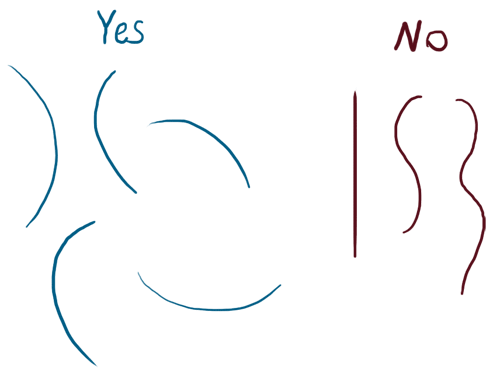
To solidify this definition, here is a quick read.
Learn how to draw poses and gestures from references - Line of Action
The website Line-of-Action.com, which we'll use for practice later, has a great, concise text description of this concept.
Please read the section titled 'Draw the line of action'. It's a short text that effectively summarizes the concept and its purpose.
2. How to Identify the Line of Action
Knowing what the line of action is and being able to find it in a pose are two different skills. Finding the line requires you to look at the whole figure and make a decision about its primary flow.
This can be tricky at first. Let's return to the video from Josh Papaleo, as he demonstrates how to analyze different reference photos.
In this next segment, the instructor analyzes several poses and shows his thought process for choosing the most effective line of action.
Watch from 05:37 to 08:22. Notice how he looks for the longest curve and sometimes identifies secondary lines of action. Importantly, he points out that for a single pose, there can be more than one 'correct' answer, but the goal is to choose the line that best captures the energy.
The key is to look for the longest, unbroken curve that travels through the body. It often starts near the head or shoulders, flows through the torso, and exits through the leg that is carrying the most weight or thrust.

Another artist, Kristian Nee, has a slightly different but complementary approach, focusing on simplifying the pose into basic line types. Seeing this will help reinforce the idea of simplification.
Gesture Drawing Doesn’t Work… Unless You Do This
This short clip from Kristian Nee offers another perspective on simplifying the figure. He focuses on finding the 'big sweeping shapes' and breaking them down into simple C, S, and straight lines.
Watch from 00:20 to 01:19. Focus on how he immediately looks for the 'general sweep of what the body is doing'—that's the line of action—before adding any other shapes.
3. Practical Exercise: Capturing the Line
Now it's time to put this into practice. For this exercise, your only goal is to look at a pose and draw a single line representing the line of action. Don't worry about drawing the figure, the limbs, or any details. Just the line. The goal is to train your eye to see the overall flow and to do it quickly.
We will use the excellent free tool from Line-of-Action.com.
Estimated time: 20 minutes
-
Set up the tool:
- Navigate to the Line-of-Action drawing tool.
- Models: For now, select "Clothed" to keep the focus purely on the pose's gesture.
- Class Mode: Select this option.
- Session Length: Set it to 10 minutes.
- Intervals: Choose "30 seconds". This forces you to make a quick decision.
- Click "Start Drawing".
-
Drawing Exercise (Phase 1 - 30 seconds):
- Open Procreate on your iPad.
- For each image that appears on the website, your task is to draw only the line of action.
- Use a single, confident stroke. Try to feel the energy of the pose. Is it a graceful C-curve? A powerful reverse C-curve?
- When the 30 seconds are up, move to a new spot on your canvas for the next pose.
- Fill a canvas with these lines for the full 10-minute session.
-
Drawing Exercise (Phase 2 - 15 seconds):
- Go back to the tool's settings.
- Change the Intervals to "15 seconds".
- Start another 10-minute session.
- You'll find that 15 seconds is more than enough time once you get the hang of it. This part of the exercise builds speed and intuition. Your brain will learn to see the essential information without getting bogged down.
The Brighter Craft article on gesture drawing has an exercise list that perfectly describes what you are doing. You are focusing on "01. The Line of Action – Draw only the main curve that runs through the pose."
At the end of this exercise, you should have a canvas full of dynamic, curving lines. Each one represents the core energy of a human pose.
Conclusion
Great work today! You've taken the first and most critical step into the world of figure drawing. By focusing on this single concept, you are building a foundation that will make all subsequent learning in anatomy and posing much more intuitive.
Key Takeaways:
- The line of action is the primary, simple curve that captures the energy, flow, and story of a pose.
- It's the first mark you should make in a figure drawing to ensure your final work is dynamic and not static.
- The most effective lines of action are often simple C-curves that follow the spine and transfer weight through the body.
- Identifying the line of action is a skill of rapid, holistic observation, which can be trained through quick, timed exercises.
In our next lesson, we'll build directly on this foundation. You will learn to take your line of action and construct a quick, simplified figure around it. This is the beginning of creating gesture sketches, which are essential for capturing movement and weight.