Hello! Welcome back to your Hindi lessons.
In our last session, you did a great job learning how to describe people's appearance and qualities using adjectives. You learned the all-important rule of making adjectives agree with the gender of the noun.
Today, we're going to expand on that skill. Our goal is to describe the setting of a scene using simple adjectives. This is a perfect next step for you, as it moves us closer to your goal of being able to discuss movie scenes in your live streams. We'll learn how to say "a big house" or "a beautiful city," building on the sentence structures you already know.
1. Two Ways to Use Adjectives
So far, you've been using adjectives in this pattern:
- Subject + Adjective + Verb:
Ghar bada hai.(The house is big.)
Here, the adjective bada (big) comes after the noun ghar (house) and describes it with the help of the verb hai (is).
Now, we will learn the second, very common way to use adjectives, which is placing them directly before the noun they describe. This is very similar to English.
- Adjective + Noun:
bada ghar(a big house)
Let's see this in a full sentence:
Yeh ek ghar hai.(This is a house.)Yeh ek **bada ghar** hai.(This is a big house.)
The rule you learned about gender agreement still applies. The adjective must match the noun it's attached to.
bada ghar(big house) -gharis masculine.badi gaadi(big car) -gaadi(car) is feminine.
To understand this word order rule more formally, you can review the following resource.
The Basics of Hindi Sentence Structure & Word Order
This article, 'The Basics of Hindi Sentence Structure & Word Order,' explains where adjectives fit into a sentence. This is the key new piece of grammar for today's lesson.
Please read the short section titled '6 – Adjective'. The main takeaway is that in Hindi, adjectives are placed just before the object they describe, as shown in the examples like 'taaze phal' (fresh fruits).
2. Vocabulary for Describing Settings
To describe a scene, you need the right words. Let's build a vocabulary toolkit focused on places and objects. We'll pull from a helpful resource that lists many common adjectives.
First, a quick refresher on how adjectives change for gender is always useful.
The Adjective in Hindi Grammar: 100 ...
The article 'The Adjective in Hindi Grammar' has a great introduction that reviews the gender agreement rules we've been practicing.
Quickly review the sections '1- Masculine Adjectives' and '2- Feminine Adjectives' to refresh your memory on the '-aa' and '-ii' endings.
Now, let's learn some new words for describing settings from the same article.
The Adjective in Hindi Grammar: 100 ...
This article is packed with useful adjectives. We'll focus on the ones most relevant to describing scenes: dimensions, colors, and shapes.
Please study the tables in these sections: Describing Dimensions, Distance, and Frequency: Look for pairs like 'chotaa'/'badaa' (small/big), 'uunchaa'/'niichaa' (high/low), and 'patlaa'/'chaudaa' (narrow/wide). Shades and Colors: This section is essential. Note down words like 'kaalaa' (black), 'safed' (white), 'laal' (red), 'niilaa' (blue), and 'haraa' (green). Describing Various Shapes & Textures: Words like 'gol' (round) and 'chaukor' (square) are very helpful for describing objects in a scene. As you read, pay attention to which adjectives end in '-aa' (and will therefore change for gender) and which ones are invariable.
Here’s a summary of key vocabulary for describing settings. I’ve also added a couple of essential words, naya (new) and purana (old).
| English | Hindi (Masc. Form) | Hindi (Fem. Form) | Example Phrase (Masc. Noun) | Example Phrase (Fem. Noun) |
|---|---|---|---|---|
| Big | bada |
badi |
bada kamra (big room) |
badi gali (big street) |
| Small | chhota |
chhoti |
chhota ghar (small house) |
chhoti dukaan (small shop) |
| Tall / High | uuncha |
uunchi |
uuncha pahaad (high mountain) |
uunchi imaarat (tall building) |
| New | naya |
nayi |
naya sheher (new city) |
nayi sadak (new road) |
| Old | purana |
purani |
purana mandir (old temple) |
purani haveli (old mansion) |
| Beautiful | sundar |
sundar |
sundar sheher (beautiful city) |
sundar jagah (beautiful place) |
| Blue | niila |
niili |
niila aasmaan (blue sky) |
niili gaadi (blue car) |
| Black | kaala |
kaali |
kaala darwaaza (black door) |
kaali raat (black night) |
Test your understanding!
Combine the noun and adjective to form a correct phrase. For example, if given (sundar, sheher), the answer is sundar sheher. Remember to change the adjective ending if needed!
(bada, kamra)(room, masc.)(chhoti, gali)(street, fem.)(purana, ghar)(house, masc.)(niila, aasmaan)(sky, masc.)
Now, put one into a full sentence: "This is an old house."
Show answer
bada kamrachhoti gali(The adjectivechhotiis already in its feminine form)purana gharniila aasmaan
Full sentence: Yeh ek purana ghar hai.
3. Let's Describe a Movie Scene
Now for the fun part! Let's apply what you've learned to describe actual movie scenes. Your experience with English studies has likely given you a sharp eye for analyzing settings and moods, which will be a great asset here.
Look at the image below, which shows two contrasting scenes from Indian films.
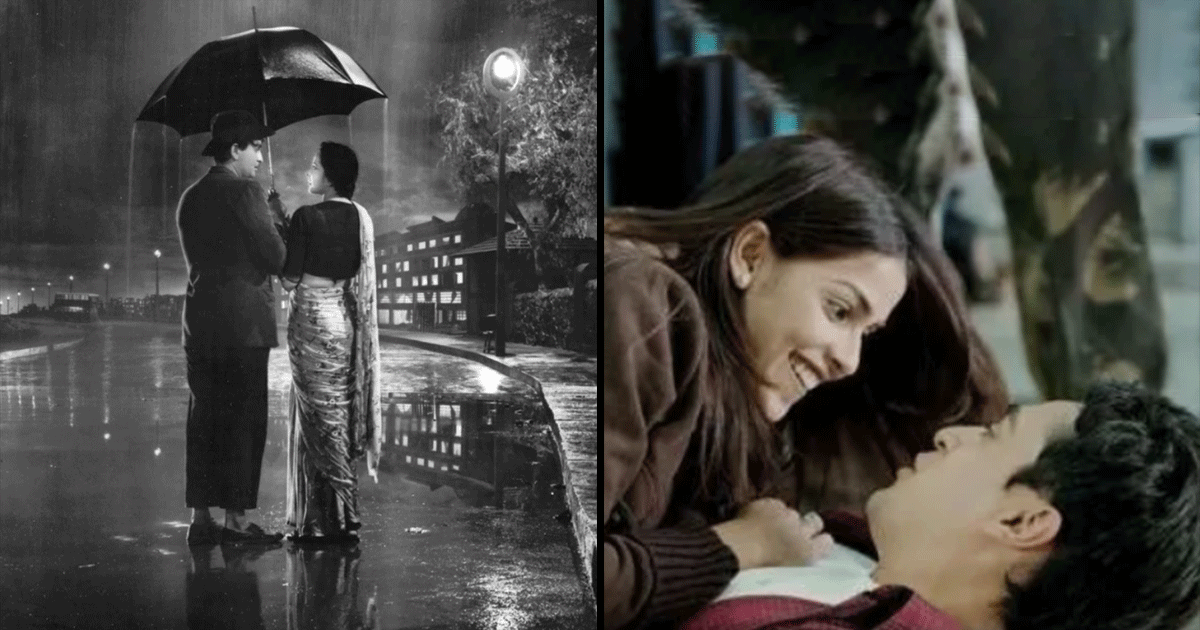
Let's describe the scene on the left together.
- First, a simple observation: "The scene is old."
Scene purana hai.
- We can also say: "This is an old scene."
Yeh ek purana scene hai.
- The street looks wide.
Sadak(street) is feminine.Sadak chaudi hai.(The street is wide.)Yeh ek chaudi sadak hai.(This is a wide street.)
- Let's talk about the building (
imaarat, fem.). It looks tall.Imaarat uunchi hai.(The building is tall.)
- The sky is dark.
Raat(night) is feminine.Raat kaali hai.(The night is black/dark.)
Now, let's try the scene on the right.
- It's not an old scene. It's new.
Yeh ek naya scene hai.
- The room (
kamra, masc.) seems small.Kamra chhota hai.
- The atmosphere (
maahol, masc.) is happy.Maahol khush hai.
- The woman's shirt (
kameez, fem.) is red.Laalis an adjective that often doesn't change.Uski kameez laal hai.(Her shirt is red.)
Your turn! How would you say "The sky is blue" (aasmaan, masc.)? Or "The house is beautiful" (ghar, masc.)? Think about the adjective forms.
Conclusion
Fantastic work today. You've taken a crucial grammatical rule—adjective agreement—and applied it in a new, more flexible way. Learning to place adjectives before nouns is a significant step toward creating more detailed and descriptive sentences, which is essential for talking about films.
Key Takeaways:
- Adjectives in Hindi can go before the noun they describe (e.g.,
bada ghar), just like in English. - Even in this position, the adjective must agree in gender with the noun (
bada gharvs.badi gaadi). - You have expanded your vocabulary with essential words for describing settings, including size (
bada/chhota), age (purana/naya), quality (sundar), and colors (niila,laal). - You practiced combining these elements to describe actual movie stills, a core skill for your streaming goal.
Preview of the Next Lesson:
In our next lesson, we will wrap up this module by combining all the skills you've learned: using hona, possessives, and adjectives. You will learn to introduce yourself and others with name, origin, and profession. This will be a great chance to consolidate everything into practical, conversational introductions.