Welcome to the first lesson of our fifth module, "Core RAG: Assembling the Pipeline." Over the past four modules, you have built a strong foundation. You've learned to interact with LLMs programmatically, represent text as semantic vectors, process and chunk raw documents, and, most recently, index and efficiently retrieve those chunks from a vector store using powerful algorithms like HNSW. Now, it's time to connect these individual components into a cohesive, end-to-end system.
In this lesson, you will learn to describe the complete architecture of a Retrieval-Augmented Generation (RAG) system. We will move from the individual parts you've mastered to a holistic, architectural view, understanding how data and logic flow from a user's query to a final, context-grounded response. This blueprint will serve as our guide for the hands-on implementations in the lessons to come.
The Motivation for RAG
Before we dive into the architecture, let's solidify our understanding of why RAG is such a critical pattern in modern AI engineering. As you know, large language models, despite their power, have inherent limitations. They can "hallucinate" when uncertain, their knowledge is frozen at the time of training, and they have no access to your private, domain-specific data.
Directly fine-tuning an LLM to incorporate new knowledge is one possible solution, but as you can imagine, it's a computationally expensive and slow process, ill-suited for rapidly changing information. RAG offers a more flexible and cost-effective alternative.
The following video provides an excellent overview of these challenges and introduces how RAG is designed to overcome them.
Introduction To Undertsanding RAG(Retrieval-Augmented Generation)
This video from Krish Naik's channel clearly explains the core problems with using LLMs in isolation and sets the stage for why RAG is necessary.
Watch the initial segment, from the beginning, where the presenter discusses the disadvantages of standalone LLMs, such as hallucination, stale knowledge, and the inability to use private data without expensive fine-tuning.
At its heart, RAG decouples the knowledge base from the LLM's internal parameters. Instead of trying to bake knowledge into the model itself, we provide it with relevant information on-the-fly, at the moment it's needed. This is the essence of retrieval-augmented generation: Answer = LLM( Query + Retrieved_Knowledge ).
The Two Halves of a RAG System: Indexing and Querying
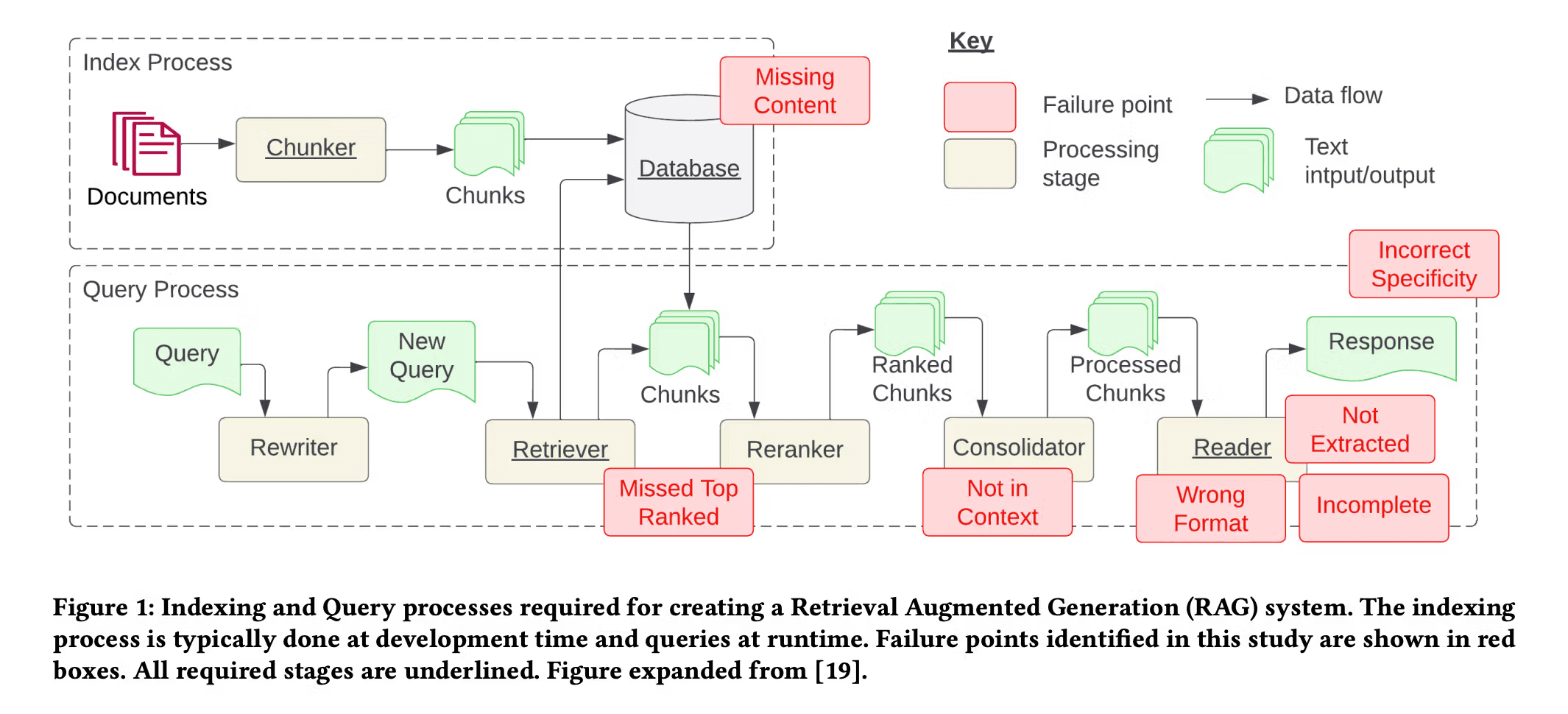
From a system design perspective, a RAG application can be split into two primary processes: an Indexing Process and a Query Process.
- Indexing Process (Offline/Build-Time): This is the preparatory stage where you build your knowledge base. You take your collection of documents, process them into retrievable chunks, and store their vector embeddings in a database. This is typically done offline and can be re-run whenever your source documents change.
- Query Process (Online/Run-Time): This is the real-time stage that happens whenever a user submits a query. The system retrieves relevant information from the indexed knowledge base, combines it with the user's query to create an augmented prompt, and sends it to the LLM to generate a response.
This separation is fundamental. The heavy lifting of processing and embedding your entire document library is done ahead of time, ensuring that the run-time query process is as fast and efficient as possible.
The following diagram clearly illustrates this two-part structure.
A Step-by-Step Architectural Breakdown
Now, let's zoom in and examine the specific stages within these two processes. A standard RAG workflow can be broken down into four key stages: Ingestion, Retrieval, Augmentation, and Generation.
The following reading from a Microsoft developer resource provides a concise, high-level overview of these four stages.
RAG Use Cases for Developers | Software Development Companies
This article clearly defines the four main stages of a typical RAG workflow.
Please read the section titled The architecture of RAG implementation. As you read, focus on the purpose of each of the four stages: Ingestion, Retrieval, Augmentation, and Generation.
Having established this four-stage framework, let's dive deeper into the engineering details of each step, connecting them to the concepts you've learned in previous modules.
Stage 1: Ingestion (The Indexing Process)
This stage corresponds to the "Index Process" and involves everything needed to create your searchable knowledge base. It's a pipeline of its own, often called the "data injection pipeline."
- Document Loading: The process begins by loading your raw data from various sources (e.g., PDFs, text files, web pages, database records).
- Preprocessing & Chunking: The raw text is cleaned and then split into smaller, semantically meaningful chunks. As you learned in Module 3, the chunking strategy (e.g., fixed-size, recursive) is a critical decision that directly impacts retrieval quality.
- Embedding Generation: Each chunk is passed through an embedding model (like the ones you used in Module 2) to convert its semantic meaning into a numerical vector.
- Vector Store Indexing: Finally, these embeddings, along with the original text chunks and any associated metadata, are loaded into a vector store (like ChromaDB from Module 4). The store uses an ANN algorithm (like HNSW) to build an efficient index for fast searching.
Stages 2, 3 & 4: Retrieval, Augmentation, & Generation (The Query Process)
This is the real-time pipeline that executes when a user interacts with the system.
- Query Processing: The user's query, which is a string of text, is first converted into a vector embedding using the same embedding model that was used during ingestion.
- Retrieval: This vector is used to search the vector store. The store performs a similarity search to find the top-k most similar document chunks from the knowledge base. This is the "Retrieval" in RAG. This step may also involve applying metadata filters, as you practiced in Module 4.
- Augmentation: The retrieved chunks of text (the "context") are then combined with the original user query. This is typically done by formatting them into a carefully constructed prompt. The prompt instructs the LLM to use the provided context to answer the user's question. This is the "Augmentation" step.
- Generation: The final augmented prompt is sent to the LLM. The model then generates a response that is "grounded" in the retrieved information, leading to a more factual and relevant answer. This is the "Generation" part of RAG.
- (Optional) Post-Processing: The LLM's raw output can be further processed to format citations, check for safety issues, or structure the output (e.g., into JSON).
The following article offers a fantastic, engineering-focused deep dive that aligns perfectly with our breakdown.
An Engineering-grade breakdown of RAG Pipeline - DEV Community
This article provides a detailed, step-by-step walkthrough of a production-grade RAG architecture, covering both the ingestion and query pipelines with excellent technical detail.
Read the section HOW — RAG Pipeline Architecture. Notice how its nine steps (Ingestion, Chunking, Embeddings, etc.) map directly onto the four-stage model and the concepts you've already learned.
To see all these pieces in motion, the following video segment provides a clear whiteboard walkthrough of the entire end-to-end flow.
Introduction To Undertsanding RAG(Retrieval-Augmented Generation)
This part of the video visually connects the data injection pipeline and the retrieval pipeline, showing how a user query interacts with the pre-built vector database to generate a final answer.
Watch the segment from this point, which draws out the complete architecture, including the vector DB, the ingestion process, and the query process.
From Naive to Advanced: Types of RAG
The architecture we have just described is often called Naive RAG. It represents the simplest, most direct implementation of the pattern. While powerful, it serves as a baseline. As you move toward more complex, production-grade systems, you'll encounter more sophisticated architectures. It's useful to be aware of this landscape.
RAG Use Cases for Developers | Software Development Companies
This final reading categorizes RAG systems into three levels of complexity, giving you a roadmap of where our "naive" implementation fits and what advanced techniques lie ahead.
Read the section on RAG implementation types. Focus on understanding the distinction between Naive, Advanced, and Modular RAG.
In Module 7, we will explore several techniques that fall under Advanced RAG, such as query rewriting and re-ranking, to further improve the quality of your system. For now, our focus in this module will be on mastering the implementation of the core, or "naive," RAG pipeline.
Conclusion
In this lesson, you've assembled all the individual concepts from the previous modules into a complete architectural blueprint for a RAG system. You now have a mental model of how data flows through the system, from raw documents to a contextually-aware AI response.
Here are the key takeaways:
- RAG's Purpose: To overcome LLM limitations by grounding them in external, up-to-date, or private knowledge without expensive retraining.
- The Two Core Processes: RAG architecture is split into an offline Indexing Process (preparing the knowledge base) and an online Query Process (answering user questions).
- The Four Key Stages: The end-to-end workflow consists of Ingestion (loading, chunking, embedding, indexing), Retrieval (searching the vector store), Augmentation (building the prompt with context), and Generation (getting the final answer from the LLM).
- Architectural Spectrum: The architecture we've described is a "Naive RAG," the foundational pattern upon which more advanced and modular systems are built.
You now have the complete map. In our next lesson, we will take the first step in building this system: you will implement the retrieval step that fetches relevant context for a user's query, putting your vector store knowledge into practice.