Hello! Welcome back to our journey into the principles of quantum computing.
In our last lesson, we established that all quantum gates must be represented by unitary matrices. This mathematical requirement ensures that the total probability is always conserved and leads to a profound practical consequence: all quantum computations are reversible.
Today, we transition from the mathematical rules governing quantum operations to the conceptual heart of the qubit itself. We will tackle one of the most famous—and often misunderstood—ideas in all of quantum mechanics: superposition.
Our learning outcome for this lesson is to describe how a qubit differs from a classical bit, focusing on superposition. We'll explore what superposition means, why it's fundamentally different from classical probability, and how it gives quantum computers their unique character.
1. From Classical Bits to Quantum Bits
As an electronics and electrical engineering student, you're intimately familiar with the classical bit. It's the fundamental unit of information, physically realized by a transistor acting as a switch, representing either a low voltage state (0) or a high voltage state (1). It's always one or the other.
A quantum bit, or qubit, is also a binary system, but its physical basis is entirely different. It leverages the quantum properties of an object, such as the spin of an electron or two energy levels of an atom.
To explore this contrast from an engineer's perspective, let's watch a segment from a video featuring Professor Andrea Morello, a quantum engineer.
EEVblog #1316 - Quantum Computing for Electrical Engineers
In this clip from EEVblog, Prof. Morello explains the physical basis of classical bits (transistors) and contrasts it with two examples of physical qubits: an electron's position and an electron's spin.
Watch from 01:44 to 05:13. Pay attention to how he maps the classical '0' and '1' to specific, distinct quantum states.
The key idea is that we designate two distinct quantum states to be our |0⟩ and |1⟩. So far, this seems like a direct analog to a classical bit. The crucial difference, however, lies in what else the qubit can do.
2. The Power of Superposition
A classical bit must be in a state of 0 or 1. A qubit, however, can be in a state of 0, 1, or a combination of both simultaneously. This is called superposition.
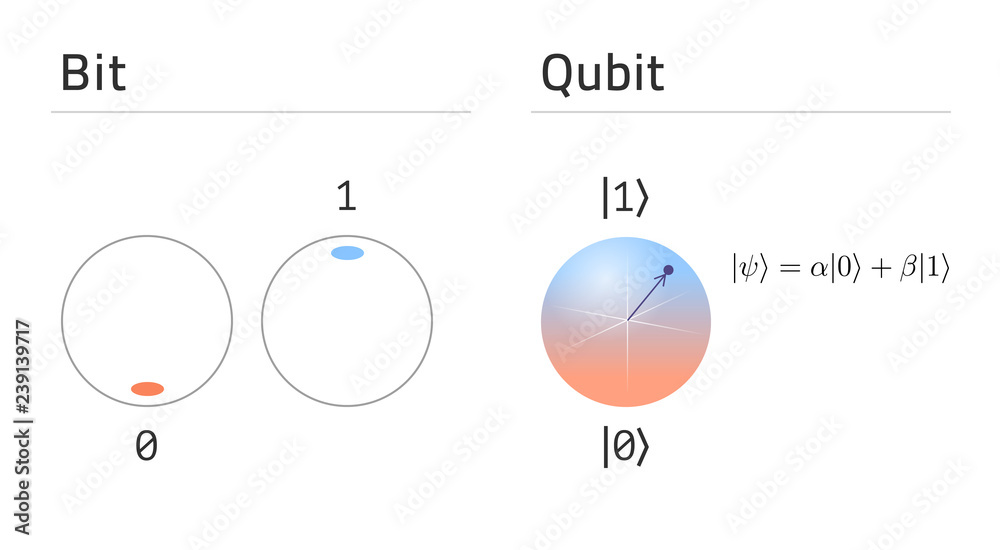
Mathematically, we represent a qubit's state as a linear combination (a weighted sum) of its two basis states, |0⟩ and |1⟩:
Here, and are complex numbers called amplitudes. They are not probabilities themselves, but they determine the probability of what we'll find when we measure the qubit. Specifically, is the probability of measuring 0, and is the probability of measuring 1. As we know, we must always have .
Let's return to the EEVblog video, where Prof. Morello explains why superposition isn't some strange, "counter-intuitive" idea, but a logical consequence of a symmetric quantum system.
EEVblog #1316 - Quantum Computing for Electrical Engineers
This segment explains the concept of superposition using the example of an electron shared between two identical atoms. It also addresses and debunks the common misconception that superposition is the same as an analog circuit.
Watch from 05:13 to 06:59. Focus on the logical argument for why the electron would 'choose both' atoms and how this differs from a simple analog voltage range.
3. Superposition vs. Classical Probability: The Coin Flip Analogy
A common analogy for measuring a superposition is flipping a coin. Before it lands, you don't know the outcome; it could be heads or tails. After it lands (the "measurement"), it's definitively one or the other.
This analogy is a useful starting point, but it's also dangerously misleading. A spinning coin's state is unknown, but it's not fundamentally in both states at once. We are simply ignorant of the definite outcome. A qubit in superposition is in a fundamentally different kind of state.
The following video and its companion article explore this analogy, first building it up and then showing its critical flaws.
Superposition: The Quantum Principle That Changes Everything
This Qiskit video introduces superposition using the classical coin flip analogy and shows how to create an equivalent probabilistic state with a qubit using the Hadamard gate.
Watch the first part of the video from 00:29 to 05:08. Notice how measuring a qubit in an equal superposition looks statistically identical to flipping a coin.
To see the underlying code and mathematical notation, you can review the first part of the companion learning module from IBM Quantum.
Superposition with Qiskit | IBM Quantum Learning
This reading covers the same ground as the video, comparing the classical coin to a 'quantum coin' created with a Hadamard gate. It introduces the state vector notation and the rule for calculating probabilities from the amplitudes.
Read the 'Introduction', 'Classical coin', and 'Quantum coin' sections. This will reinforce what you saw in the video and show you the basic Qiskit code.
4. The Real Difference: Phase and Interference
So, if a 50/50 superposition gives the same measurement statistics as a fair coin, what's the big deal? The difference is phase.
The amplitudes and are complex numbers, which means they have both a magnitude and a phase. While the magnitude determines the probability, the phase is what allows quantum states to interfere with each other, like waves.
- Constructive Interference: When parts of the state are in phase, they add up.
- Destructive Interference: When parts of the state are out of phase, they cancel out.
This has no classical parallel. You can't flip a coin, do something to it mid-air, and guarantee it always lands on heads. But with a qubit, you can. The next segment of the Qiskit video demonstrates this beautifully by applying a second Hadamard gate.
Superposition: The Quantum Principle That Changes Everything
This is the most critical part of the video. It demonstrates how a second Hadamard gate causes the qubit's state to interfere with itself, leading to a deterministic outcome. This reveals the role of phase, a purely quantum property.
Watch from 07:08 to 10:20. Focus on how applying the H-gate twice doesn't create more randomness, but instead cancels it out, resulting in a definite '0' state. This is a direct result of interference.
The companion article walks through the mathematics of this interference, showing exactly how the |1⟩ components cancel out.
Superposition with Qiskit | IBM Quantum Learning
Let's dig into the math behind the interference effect you just saw. This section explains how the phase of the amplitudes leads to constructive and destructive interference.
Read the section 'The quantum phase'. Follow the calculation showing how H(H|0⟩) results in |0⟩. This is a concrete example of the reversibility we discussed in the last lesson.
This phenomenon shows that quantum operations are not random. They are precise, deterministic rotations (as we learned from unitarity). The randomness only enters at the moment of measurement.
5. A Better Model: The Bloch Sphere
The flipping coin analogy is broken because it focuses on randomness. A better analogy is a stationary coin balanced on its edge. More formally, we visualize a single qubit's state as a vector on a 3D sphere called the Bloch Sphere.
Quantum Computing Basics With Qiskit - Real Python
This short article from Real Python provides a concise introduction to the Bloch Sphere as a visualization tool for qubit states.
Read the section 'Visualizing Qubits: The Bloch Sphere'. Note how the poles represent the classical states |0⟩ and |1⟩, while all other points on the surface represent superpositions.
In this model:
- The North Pole is the state
|0⟩. - The South Pole is the state
|1⟩. - Any other point on the sphere's surface is a superposition of
|0⟩and|1⟩. - The latitude determines the amplitudes (probabilities). The equator represents a 50/50 superposition.
- The longitude determines the relative phase between
|0⟩and|1⟩.
This connects perfectly to our last lesson! A single-qubit gate is simply a rotation of the state vector on the Bloch sphere. The Hadamard gate, for example, is a specific rotation that takes a vector at the north pole (|0⟩) and moves it to the equator. Applying it a second time rotates it back to the north pole.
Conclusion
Today we've uncovered the true nature of a qubit. It's not just a classical bit with some uncertainty; it is a fundamentally different object that obeys the strange and powerful rules of quantum mechanics.
Key Takeaways:
- A classical bit is always either 0 or 1.
- A qubit can be in a superposition of
|0⟩and|1⟩, meaning it is in a combination of both states at once. - A superposition is described by complex amplitudes which have both a magnitude and a phase.
- The squared magnitude of an amplitude gives the probability of measuring that state.
- The phase is what distinguishes quantum superposition from classical probability. It allows for interference, where parts of a quantum state can cancel each other out or reinforce each other.
- Randomness only enters the picture upon measurement, which forces the qubit to "choose" a classical state. The operations themselves (gates) are deterministic and reversible rotations on the Bloch Sphere.
Preview of the Next Lesson:
We've now conceptually introduced the qubit state |\psi⟩ = \alpha|0\rangle + \beta|1\rangle and the Bloch sphere. In our next lesson, we will formalize this. We will learn to properly use Dirac (ket) notation to represent any single-qubit state and explore the mathematics of the Bloch sphere in more detail, connecting the angles of the sphere directly to the amplitudes and .