Hello! In our last lesson, you did an excellent job building and simulating a Bell state circuit. By analyzing the histogram, you verified entanglement by observing that the measurement outcomes were perfectly correlated—only 00 and 11 appeared.
That exercise highlighted a fundamental question: what actually happens when we measure a qubit that's in a superposition? Today, we will explore this crucial process. Our goal is to explain how measurement collapses a quantum superposition into a definite classical state. We'll move from observing the results of measurement to understanding the mechanism of measurement itself.
1. The Concept of State Collapse
When we say a qubit is in a superposition, like , it's not that the qubit is both 0 and 1 at the same time. Rather, it exists in a single, well-defined quantum state that has the potential to become either 0 or 1 upon measurement. The act of measurement is what forces this potential to resolve into a definite outcome. This process is often called the collapse of the state vector (or wavefunction).
This animation provides a great visual intuition for the idea. The blended state represents the superposition, and the measurement forces it into a single, definite classical state.
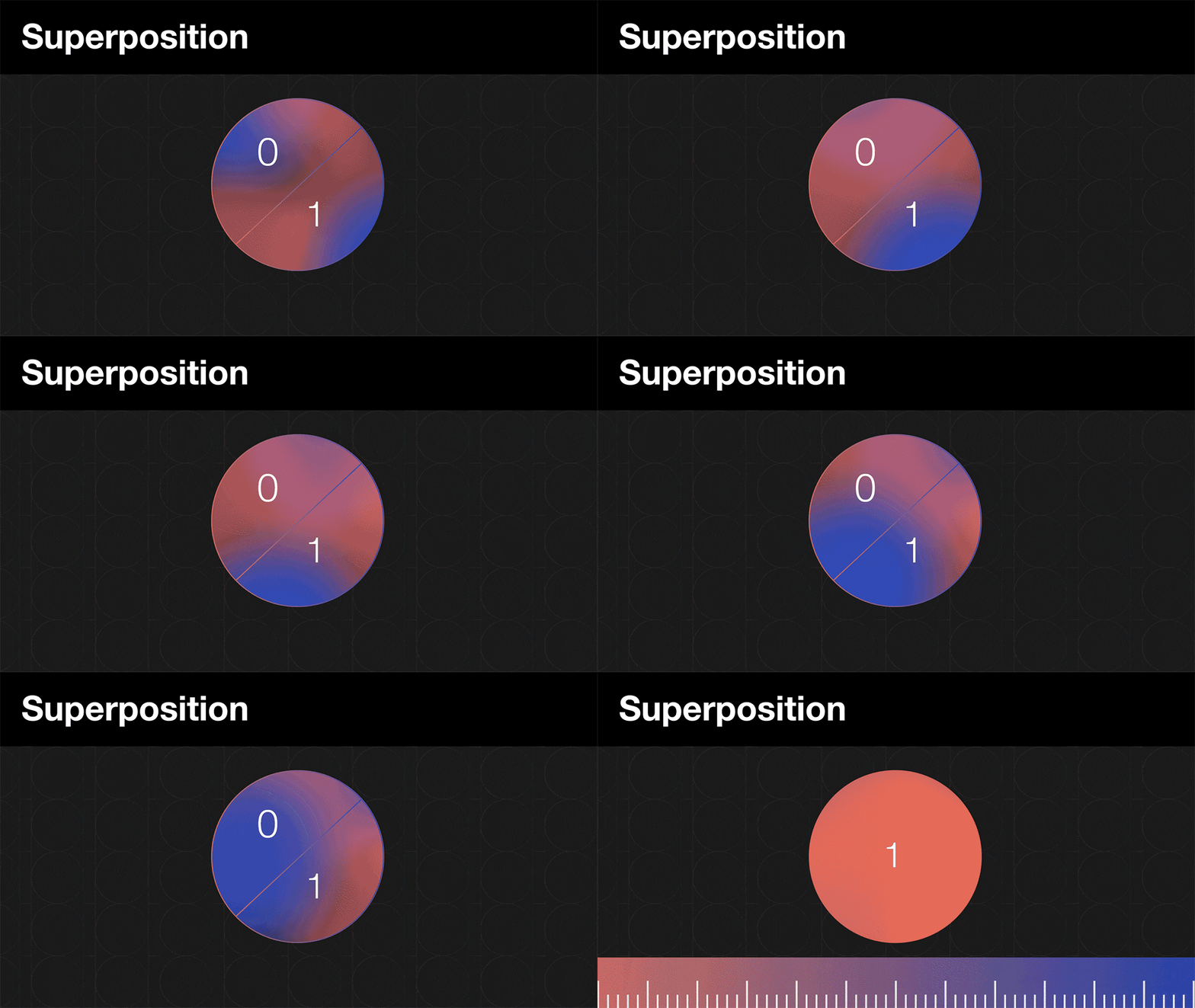
To get a more precise conceptual handle on this, the following video offers a clear analogy.
Quantum Superposition, Explained Without Woo Woo
Watch this segment from "Quantum Superposition, Explained Without Woo Woo" by The Science Asylum. It explains how a measurement device interacts with a quantum state.
Focus on the part explaining the "texture detector" from this timestamp. Notice the key takeaway: "The act of measuring the state of the orb changes the state of the orb." The detector is designed to sort based on specific properties ('smooth' or 'rough', analogous to |0⟩ and |1⟩), and in doing so, it forces the superposition state into one of those categories.
The key idea is that measurement isn't a passive observation. It's an active interaction that fundamentally alters the quantum state, destroying the superposition in the process.
2. The Measurement Postulate
In the formal language of quantum mechanics, this behavior is captured by the measurement postulate. The following reading from IBM's Qiskit documentation states it clearly.
Get started with Qiskit in the classroom: Measurements
This section of the Qiskit documentation provides a concise, formal definition of what happens during a quantum measurement.
Read the section titled "Measurements." Pay close attention to the paragraph that begins, "In particular, given an NNN-bit quantum state..." This is the rule that connects the state vector's amplitudes to the probabilities of measurement outcomes.
As the text explains, for a general N-qubit state:
A measurement will collapse the state into one of the basis states with a probability of .
This is why, for the state , the probabilities of measuring 0 or 1 are:
- Probability of
0: - Probability of
1:
The circuit for this process is straightforward, combining a gate to create superposition with a measurement operation.

3. Experimental Proof: Repeated Measurements
If measurement truly changes the state, we should be able to prove it experimentally. Consider this hypothesis:
- We prepare a qubit in a superposition state.
- We measure it. The result should be random (either 0 or 1).
- We immediately measure it a second time.
If the first measurement collapsed the state, the qubit is no longer in a superposition. It's now in the definite state we just measured (e.g., ). Therefore, the second measurement should yield the same result with 100% certainty (ignoring device errors).
The following tutorial from IBM Quantum Learning walks through exactly this experiment.
Stern-Gerlach measurements with Qiskit: Repeated Measurements
This tutorial demonstrates state collapse by performing two consecutive measurements on a qubit.
Read and execute the code in the section titled "Fourth experiment: Repeated measurements." The code first prepares a qubit in an equal superposition using a Hadamard gate. It then adds two consecutive measurement operations. Finally, it runs the circuit and plots a histogram of the outcomes. Focus on the resulting histogram. You should see large counts for 00 and 11, and very small (ideally zero) counts for 01 and 10. This shows that the outcome of the second measurement is almost always the same as the first, providing clear evidence that the first measurement collapsed the state.
The contrast with classical systems is stark. In your electronics work, you can measure the voltage across a resistor multiple times without changing the circuit's state. In quantum computing, the very act of "looking" at a qubit in superposition irrevocably changes it.
4. Measurement vs. Gate Operations
It's important to distinguish the irreversible act of measurement from the reversible action of a quantum gate. Applying a gate like CNOT or Hadamard corresponds to multiplying the state vector by a unitary matrix. This is a deterministic, reversible mathematical transformation.
Measurement is fundamentally different. It is a probabilistic, irreversible process. The following reading clarifies this distinction and includes a great check-for-understanding exercise.
Operator action is not the same as measurement
This section from the same tutorial explains the crucial difference between applying a gate (an operator) and performing a measurement.
Read the section starting with the bolded text "Operator action is not the same as measurement." Then, work through the "Check your understanding" exercise. The exercise asks you to consider a state |\psi\rangle = \sqrt{\frac{3}{5}}|0\rangle + \sqrt{\frac{2}{5}}|1\rangle. It challenges you to predict the outcome of: (a) Applying an operator (a mathematical calculation). (b) Making a single measurement (a probabilistic collapse). (c) Making thousands of measurements (observing the probability distribution). The tutorial provides Qiskit code to verify your answers for (b) and (c). I encourage you to run this code to see the concepts in action.
This exercise neatly ties together the mathematical representation of a state with the physical process of measurement, showing they are two distinct ideas.
Conclusion
In this lesson, we demystified the process of quantum measurement. You've seen that it's not a passive observation but an active process that forces a quantum state to abandon its superposition and commit to a single classical outcome.
Key Takeaways:
- Measurement is destructive: It collapses a quantum superposition into one of the definite basis states (e.g., or ).
- Measurement is probabilistic: The outcome of the collapse is not predetermined. The probability of collapsing to a particular state is given by the square of that state's complex amplitude in the superposition.
- Collapse is irreversible: Once a qubit is measured and collapses to a state like , it is no longer in a superposition. Immediate subsequent measurements will yield the same result.
- Measurement is not a gate: Applying a gate is a reversible, deterministic matrix operation, while measurement is an irreversible, probabilistic process.
Preview of the Next Lesson:
Today, we focused on the rule for calculating probabilities for a single qubit: . In our next lesson, "Calculate measurement outcome probabilities for a multi-qubit circuit," we'll extend this principle to systems with multiple qubits, like the Bell state you've already worked with. You'll learn how to take a multi-qubit state vector and predict the probability of measuring any given combination of classical bits.