Hello! Welcome to the first lesson in our final module, "Monitoring, Optimization, and Critical Thinking."
In our last session, you designed a robust weekly meal planning system to ensure consistent and convenient adherence to your nutritional goals. That system represents the input. Today, we focus on measuring the output to verify that the system is performing as expected. As someone who appreciates technology and data, you'll understand the principle: you can't manage what you don't measure.
This lesson directly addresses the learning outcome: to compare methods for measuring ketosis (blood, breath, and urine) and their practical applications. We will build a framework for understanding these tools so you can select and use them effectively to monitor your metabolic state and optimize for your goals of mental sharpness and longevity.
1. The Three Ketones and the Three Tests
Before comparing the tests, it's crucial to understand that they each measure a different type of ketone body. The three main ketone bodies produced during ketogenesis are:
- Beta-hydroxybutyrate (BHB): The most abundant ketone body in the blood. It's the primary energy currency transported from the liver to be used by other tissues like the brain and heart.
- Acetoacetate (AcAc): The "parent" ketone from which both BHB and acetone are formed. It is also used for energy but is less stable than BHB.
- Acetone: A volatile byproduct of acetoacetate metabolism. It's the least abundant and is quickly cleared from the body, primarily through the breath.
Each testing method targets one of these specific ketones:
- Blood Meters measure Beta-hydroxybutyrate (BHB).
- Urine Strips measure Acetoacetate (AcAc).
- Breath Meters measure Acetone.
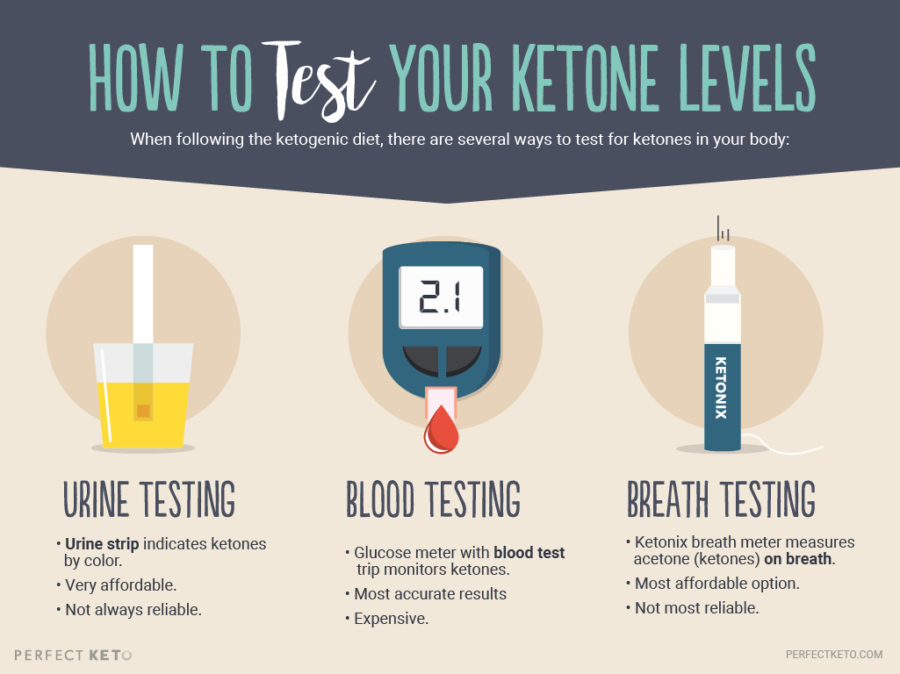
This image gives a high-level summary of the trade-offs for each testing method, which we will now explore in detail.
Because they measure different molecules, their readings are not directly interchangeable. Think of it as measuring a company's financial health: you might look at cash flow (BHB), accounts receivable (AcAc), or even non-financial metrics like employee satisfaction (Acetone). Each tells you something different but related.
2. A Framework for Comparing the Methods
To build a clear mental model, let's analyze each method across several practical criteria. The following article provides an excellent, detailed breakdown of a head-to-head comparison.
The best way to test ketones in blood, breath or urine
The article 'The best way to test ketones in blood, breath or urine' from Diet Doctor provides a comprehensive and practical evaluation. It will serve as our primary reference for comparing the methods.
Please read through the following sections of the article: Start with 'The three types of ketone testing' to reinforce the concept we just covered. Read the descriptions under 'Testing ketones in blood,' 'Testing ketones in breath,' and 'Testing ketones in urine' to understand the mechanics of each. Review the tables under 'Price' to get a sense of the financial commitment. Skim 'Qualitative factors' to understand the user experience differences. Finally, read the 'Pros and cons' section, which provides a concise summary for each method.
Now, let's synthesize that information and add expert context to create a decision-making framework. For a deeper scientific perspective, the next video features Dr. Dominic D'Agostino, a leading researcher in ketone metabolism.
What is the best way to measure ketones | Dr. Dominic D'Agostino
In this clip, Dr. Dominic D'Agostino discusses the nuances of each measurement method and for whom each is best suited. He also introduces a powerful metric for optimization.
Watch the entire clip (about 4 minutes). Pay close attention to his distinction between the methods and his explanation of the Glucose Ketone Index (GKI).
Based on these resources, here is a structured comparison:
| Criterion | Blood Testing (BHB) | Breath Testing (Acetone) | Urine Testing (AcAc) |
|---|---|---|---|
| What it tells you | A precise, real-time snapshot of the ketones available in your blood for energy use. The "gold standard." | An indirect measure of your rate of fat oxidation over the last several hours. | The amount of excess or "spilled" ketones being excreted. |
| Accuracy | High. Considered the most accurate reflection of your current state of ketosis. | Moderate. Correlates well with fat burning but has a time lag and can be affected by alcohol. | Low. Becomes unreliable after keto-adaptation as the body gets better at using ketones and spills less. |
| Cost | High initial cost for the meter, plus a significant ongoing cost per strip (~$1/test). | High initial cost for the device, but no ongoing costs per test. | Very Low. Inexpensive strips, minimal cost per test. |
| Convenience | Low to Moderate. Invasive (finger prick), requires carrying supplies. | High. Non-invasive, quick, can be done anywhere. | Moderate. Can be inconvenient/messy, especially outside of your home. |
3. Choosing the Right Tool for Your Goals
As Dr. D'Agostino states, "it depends." The best method is context-dependent. Given your goals of cognitive optimization and longevity, here's a strategic approach.
Stage 1: Initial Confirmation (First 1-2 weeks)
- Tool: Urine Strips
- Purpose: A simple, low-cost way to confirm you are producing ketones and have entered ketosis. A "yes/no" check.
- Limitation: Once you become keto-adapted, your body will become more efficient at using acetoacetate, meaning less will be excreted. The strips may show little to no color even when you are in a deep state of ketosis. Continuing to use them can be misleading.
Stage 2: Optimization and Data Tracking (Ongoing)
-
Tool: Blood Meter
-
Purpose: To get precise, actionable data. This is essential for fine-tuning your system. It allows you to see the direct impact of specific meals, exercise, or fasting protocols on your metabolic state.
-
Key Application: The Glucose Ketone Index (GKI)
As mentioned by Dr. D'Agostino, the GKI is a more powerful metric than just ketones alone. It represents the ratio of glucose to ketones and is thought to be a better indicator of your overall metabolic health and the depth of your ketosis.The formula is:
(Note: If your glucose meter reads in mg/dL, divide the value by 18 to convert to mmol/L).A GKI of 1.0 or below is associated with a deep therapeutic state of ketosis, which is hypothesized to be optimal for inducing processes like autophagy. For your goals, tracking your GKI could be a key performance indicator.
Stage 3: Convenient Daily Monitoring (Optional/Ongoing)
- Tool: Breath Meter
- Purpose: For frequent, non-invasive check-ins. If you want to monitor trends throughout the day without constant finger pricks, a breath meter is an excellent tool. Dr. D'Agostino notes it's a good correlate of fat oxidation.
- Practical Note: As researcher Dr. Joe Anderson explains, breath acetone is more of an integrative measure, reflecting your fat metabolism over the preceding 12 hours. It won't show the immediate spike after a meal like a blood meter might, but it gives a good sense of your overall trend. He's found a reading of 7-8 parts per million (PPM) on a breath device generally correlates to the nutritional ketosis threshold of 0.5 mmol/L in blood.
Test your understanding!
You have been on a ketogenic diet for three months. You feel energetic and mentally clear. Your blood meter shows a ketone level of 0.8 mmol/L. However, your old urine strips, which used to turn dark purple, are now barely changing color. Should you be concerned that you've "fallen out of ketosis"?
Show answer
No, you should not be concerned. This is a classic sign of keto-adaptation. Your blood ketone level of 0.8 mmol/L confirms you are in nutritional ketosis. The light-colored urine strip simply means your body has become more efficient at utilizing acetoacetate for energy, so it is no longer "spilling" as much excess into the urine. This is a sign of metabolic efficiency, not a failure of the diet. This highlights why urine strips are not a reliable long-term monitoring tool.
4. Best Practices for Measurement
Whichever device you choose, how and when you measure is as important as what you measure.
- Be Consistent: To get a reliable baseline, measure at the same time each day, ideally first thing in the morning in a fasted state. This controls for variables like food and exercise.
- Don't Chase High Numbers: Higher is not necessarily better. As you become more "fat-adapted," your muscles and other tissues become more efficient at using ketones for fuel. This increased uptake can actually lead to lower levels of circulating ketones in the blood. The goal is an efficient engine, not a full fuel tank.
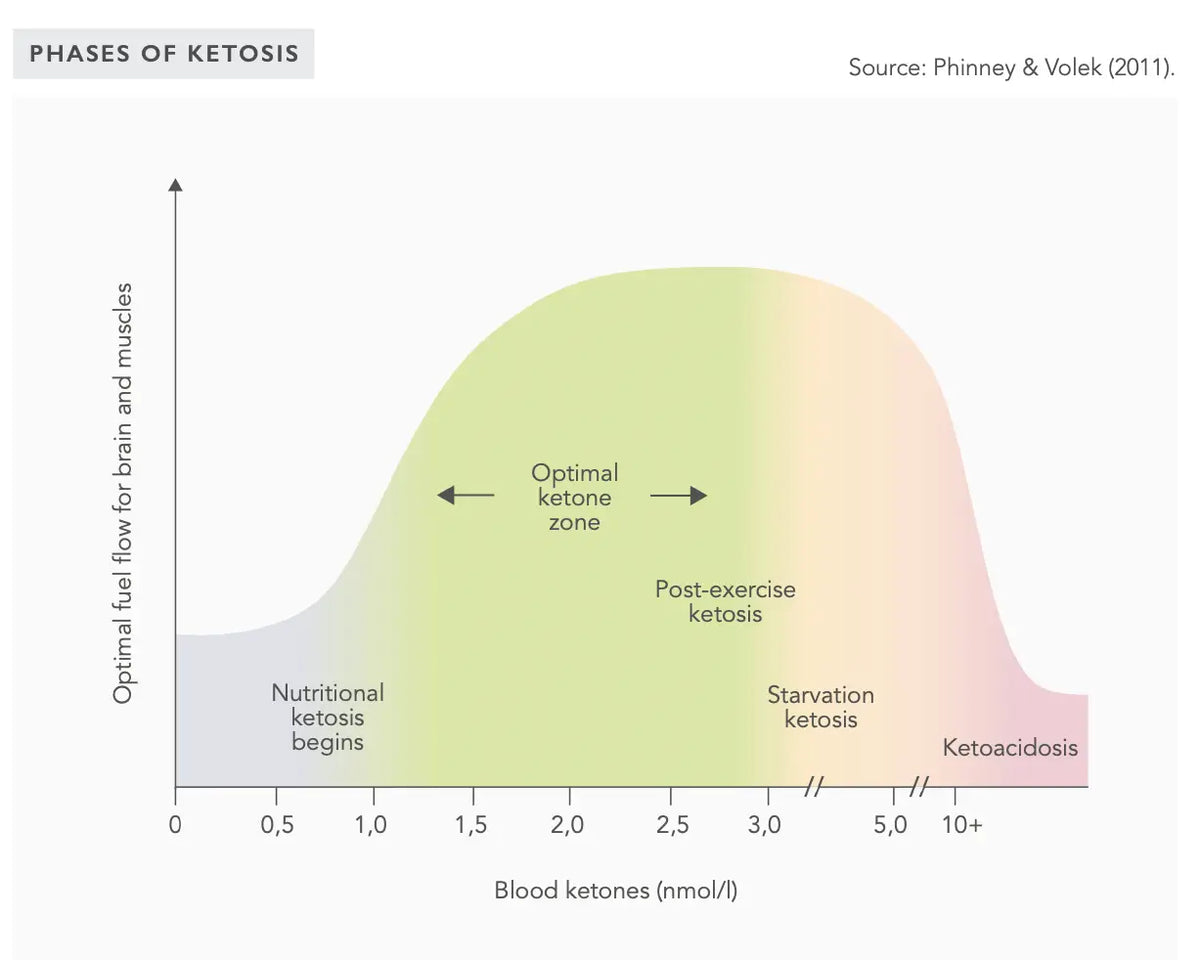
*This graph from Phinney & Volek illustrates the spectrum of ketosis. For your goals, the "Optimal Ketone Zone" (around 1.5 - 3.0 mmol/L) is a good target, but levels as low as 0.5 mmol/L still constitute nutritional ketosis and can be perfectly effective, especially once adapted.*
3. Look for Trends: A single reading is just one data point. The real value comes from observing trends over days and weeks and correlating them with your diet, fasting schedule, exercise, and subjective feelings of well-being and mental clarity.
Conclusion
You now have a complete framework for measuring and interpreting your state of ketosis. This is the feedback loop for the nutritional system you've designed, allowing you to move from guesswork to data-driven optimization.
Key Takeaways:
- Three Tests, Three Ketones: Blood (BHB), Breath (Acetone), and Urine (AcAc) measure different things and are not directly interchangeable.
- Blood is the Gold Standard: For precise, real-time data and for calculating advanced metrics like the Glucose Ketone Index (GKI), blood testing is superior.
- Breath is for Convenience: For frequent, non-invasive tracking of fat oxidation trends, breath meters are a practical choice.
- Urine is for Beginners: Use urine strips only for the initial confirmation of ketosis, as they become unreliable with adaptation.
- Context is King: The goal is not the highest possible ketone number but a state of metabolic efficiency that supports your goals of cognitive performance and healthspan.
Preview of the next lesson:
Measuring ketones is a powerful way to monitor your metabolic state. However, it's only one piece of the puzzle. To get a complete picture of how this diet is impacting your overall health—particularly with respect to longevity—we need to look at a broader set of markers. In our next lesson, we will identify key health biomarkers (e.g., lipids, inflammation markers, glucose) to monitor for health optimization. This will equip you to have informed discussions with your physician and truly manage your long-term health.