Hello! Welcome to the third lesson in our course.
In our last session, we built a crucial mental model based on oxidative priority, understanding why your body burns certain fuels before others. We saw that in the presence of carbohydrates, fat burning is suppressed, and that prolonged fasting forces a switch to fat and ketone metabolism. You now have the "rules of the game" for fuel partitioning.
Today, we're going to meet the master regulators who enforce these rules: the hormones insulin and glucagon. The learning outcome for this lesson is to describe their specific roles in regulating nutrient storage and mobilization. Understanding how this hormonal duo works is the key to intentionally shifting your metabolism, which is the foundational principle behind both the ketogenic diet and intermittent fasting.
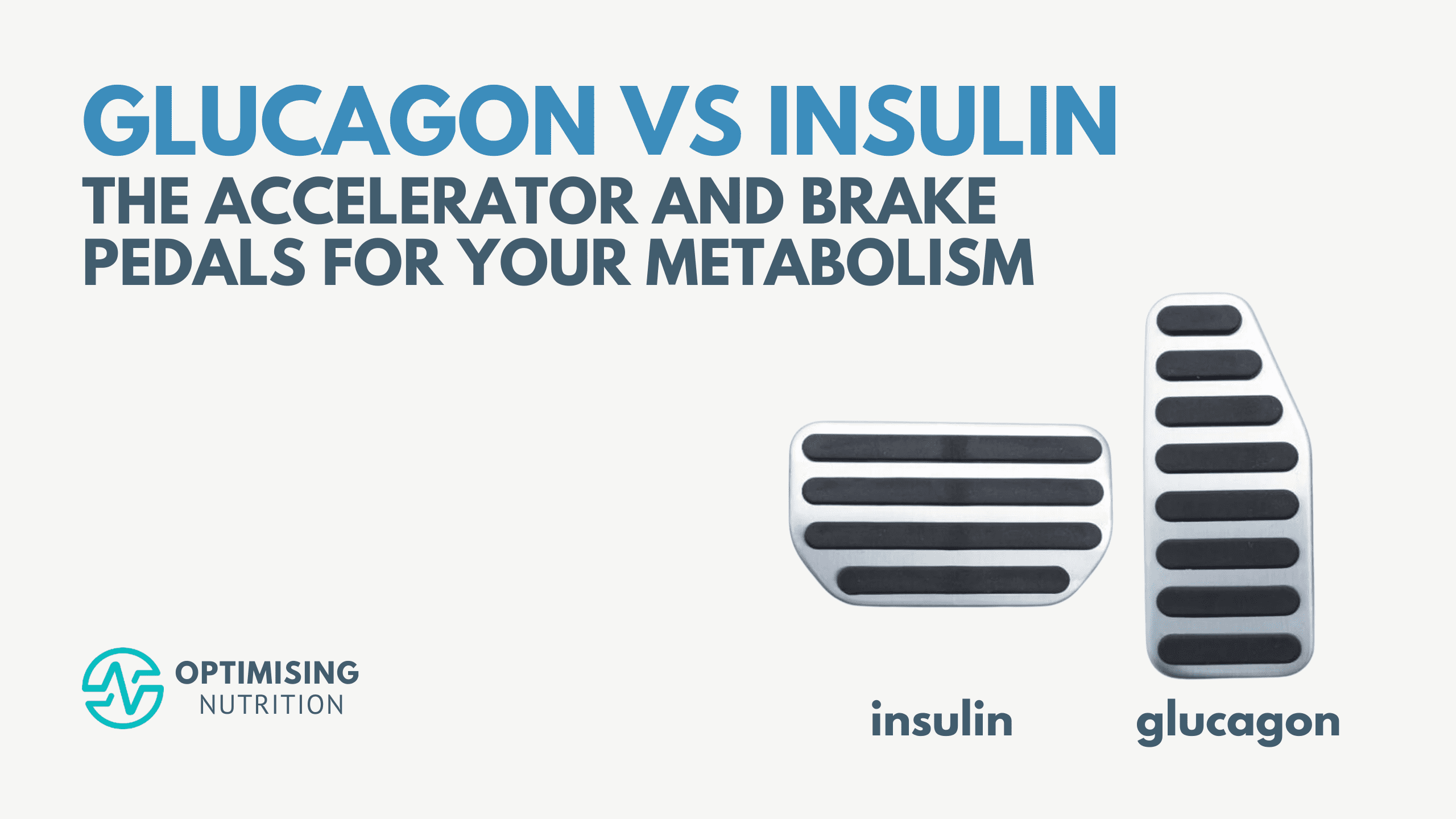
The Accelerator and the Brake
Think of your metabolism as having an accelerator and a brake pedal. These are controlled by two opposing hormones produced in your pancreas:
- Glucagon: The accelerator. It signals the body to mobilize and burn stored energy.
- Insulin: The brake. It signals the body to store energy and put a stop to mobilization.
To formalize this concept, let's watch a brief introduction from Dr. Benjamin Bikman, a leading researcher on this topic. He'll introduce these hormones as catabolic (breaking down) and anabolic (building up), respectively.
Dr. Benjamin Bikman - 'Insulin vs. Glucagon: The relevance of dietary protein'
In this clip, Dr. Benjamin Bikman introduces insulin and glucagon as antagonistic hormones produced by the pancreas, setting the stage for their opposing roles.
Watch from 03:07 to 04:40. Focus on the core distinction: insulin as the anabolic 'hormone of feeding and storing,' and glucagon as the catabolic 'hormone of fasting and burning.'
This anabolic/catabolic relationship is the central theme of today's lesson. A high insulin level tells your body, "Energy is abundant, store it." A high glucagon level says, "Energy is scarce, release it from storage."
The following reading provides a concise, structured summary of their opposing biochemical effects.
The Insulin:Glucagon Ratio and the Choice of Glucose- ...
This table from a scientific review in the journal Metabolism provides a clear, side-by-side comparison of how insulin and glucagon affect key metabolic processes. This will give you a solid, logical framework.
Read the section 'The Insulin:Glucagon Bipolar Axis' and pay close attention to Table 1. You don't need to memorize every biochemical term, but notice the pattern: where one says 'Increased,' the other often says 'Inhibited.'
How Insulin and Glucagon Direct Key Tissues
Now let's examine how these hormonal signals are received and acted upon by the body's main metabolic tissues: the liver, muscle, and fat (adipose) tissue.

Dr. Bikman provides a clear explanation of how each tissue responds to these two hormones.
Dr. Benjamin Bikman - 'Insulin vs. Glucagon: The relevance of dietary protein'
This segment details the specific effects of insulin and glucagon on the liver, muscle, and adipose tissue. This is the core of today's learning outcome.
Watch from 04:40 to 06:56. Note the distinct response of each tissue. Pay special attention to insulin's powerful effect on fat cells and the fact that glucagon has no effect on muscle.
Let's summarize those crucial points:
- In the Liver: This is a battleground. Insulin promotes the storage of glucose as glycogen. Glucagon does the opposite, breaking down glycogen and creating new glucose to send into the blood.
- In Muscle: Insulin is the dominant player. It signals muscles to take up glucose for immediate energy or to store as glycogen. Glucagon has no direct effect here.
- In Adipose (Fat) Tissue: Insulin is the absolute gatekeeper. It has two main jobs:
- Promote fat storage (Lipogenesis): It tells fat cells to take up fatty acids and store them as triglycerides.
- Inhibit fat release (Anti-lipolysis): This is its most powerful effect. When insulin is high, it effectively locks fat inside the fat cells, preventing it from being burned.
This last point is so critical it's worth exploring further. The idea that you cannot burn significant amounts of body fat when insulin is elevated is a cornerstone of low-carbohydrate and ketogenic dietary strategies.
Dr. Ben Bikman: How To Reverse Insulin Resistance ...
Here, Dr. Bikman explains why insulin is the absolute gatekeeper of the fat cell. His analogies of fat cells in a petri dish and the clinical condition of 'diabulemia' provide powerful, logical evidence that calories are not stored as fat without an insulin signal.
Read the section starting from Rhonda Patrick's question, '...beyond, you know...talk about some of the other roles insulin plays, for example, in fat accumulation.' Continue down to the part where he explains how ketones are formed as a 'metabolic release valve' of fat burning. Focus on the core argument: you need both energy (calories) and the hormonal signal (insulin) to store fat.
Test your understanding!
You've just finished a workout and are looking to maximize fat burning. Someone offers you a sports drink high in sugar. From a hormonal perspective, why might you decline it?
Show answer
The sugary drink would cause a rapid spike in your blood glucose, leading to a significant insulin release. High insulin powerfully inhibits lipolysis (the breakdown of fat from your fat cells). This would effectively shut down the fat-burning process you are aiming for and switch your body back to storing energy.
The Insulin-to-Glucagon Ratio: A Unifying Framework
So far, we've treated insulin and glucagon as separate forces. However, a more powerful way to understand your metabolic state is to look at their relative balance—the Insulin-to-Glucagon (I:G) Ratio. This ratio acts as the ultimate "metabolic switch."
- A High I:G Ratio (high insulin, low glucagon) signals an anabolic (storage) state.
- A Low I:G Ratio (low insulin, high glucagon) signals a catabolic (mobilization) state.
This concept neatly ties together what happens after a standard meal versus during fasting or a low-carb diet.
Dr. Benjamin Bikman - 'Insulin vs. Glucagon: The relevance of dietary protein'
This final clip synthesizes everything we've learned by introducing the Insulin-to-Glucagon ratio. Dr. Bikman compares the I:G ratio in three states: fasted, after a standard high-carb meal, and after a low-carb meal. The results provide a fundamental insight into why a ketogenic diet works.
Watch from 12:53 to 18:20. First, grasp the concept of the I:G ratio as the 'underlying metabolic tone.' Then, pay close attention to the numerical comparison between the different dietary states. This is a key insight.
The numbers from that video reveal a profound point:
- Fasted State I:G Ratio: ~0.8 (Catabolic: burning stored fuel)
- Standard High-Carb Diet Fed State I:G Ratio: ~4.0 (Anabolic: storing fuel)
- Low-Carb Diet Fed State I:G Ratio: ~1.3 (Catabolic: burning stored fuel)
The major takeaway here is that a low-carbohydrate, high-fat diet allows you to remain in a catabolic, fat-burning hormonal state even while eating. You are achieving a hormonal profile that is remarkably similar to fasting, without the starvation. This is the central mechanism behind nutritional ketosis.
Conclusion
Today, we've pulled back the curtain on the two master hormones that conduct your body's metabolic orchestra. You now have a robust framework for understanding how your body decides whether to store or burn energy.
Key Takeaways:
- Insulin is the primary anabolic hormone of the "fed state." It responds to rising blood glucose by directing tissues to store energy as glycogen and fat.
- Glucagon is the primary catabolic hormone of the "fasted state." It responds to falling blood glucose by signaling the liver and fat cells to release stored energy.
- Insulin's most powerful effect on fat cells is the inhibition of lipolysis, effectively locking fat away and preventing it from being burned.
- The Insulin-to-Glucagon Ratio provides a unifying framework. A low ratio promotes catabolism (fat burning, ketogenesis), while a high ratio promotes anabolism (storage).
- A ketogenic diet's primary mechanism is to maintain a low I:G ratio, creating a hormonal state similar to fasting, even in a fed state.
In our next lesson, we will introduce the concept of Metabolic Flexibility. This refers to your body's ability to efficiently switch between burning carbohydrates and burning fats. We will see how maintaining chronically high insulin levels can impair this flexibility and why restoring it is fundamental to achieving your goals of cognitive sharpness and long-term health.