Welcome to your first lesson. Your goal is to understand the ketogenic diet and its effects on cognitive optimization and longevity. Before we can explore how to change your metabolism, we first need to build a solid framework for how it operates by default. This lesson provides that foundational layer.
Today, we will describe the three primary metabolic states your body cycles through every day: the fed state, the post-absorptive state, and the fasted state. Understanding this natural rhythm of storing and using energy is the first principle for intelligently applying strategies like ketogenic diets and intermittent fasting. Think of it as learning the fundamental rules of a system before you attempt to engineer a specific outcome.
The Body's Energy Management System
Your body is a dynamic system that must manage a continuous demand for energy, especially for organs like the brain, even though you only eat periodically. To solve this, it has evolved a sophisticated process of switching between using energy from food and drawing on stored energy. This process can be divided into distinct phases or "states."
1. The Fed State (Absorptive State): Storing the Surplus
The fed state, also known as the absorptive state, begins as you eat and continues for about 4 hours afterward. During this period, your digestive system is breaking down food and absorbing nutrients into your bloodstream.
The key player in this state is the hormone insulin, which is released by your pancreas in response to rising blood glucose (sugar) from the carbohydrates in your meal.
Think of insulin as a logistics manager for a warehouse that has just received a large shipment. Its main job is to direct the incoming goods (nutrients) to their proper places for immediate use or storage.
Specifically, insulin does the following:
- It signals muscle and fat cells to open their gates and take in glucose from the blood for immediate energy needs.
- It directs your liver to take up excess glucose and store it in a compact form called glycogen. This liver glycogen is a crucial short-term energy reserve.
- It promotes the storage of excess fats and the synthesis of proteins.
In short, the fed state is an anabolic phase, meaning the body is focused on building up and storing energy.
To get a more detailed picture of the fed state, please read the following section from an online textbook.
This reading from Lumen Learning's 'Anatomy and Physiology II' provides a clear, concise description of what happens metabolically right after you eat.
Please read the section titled 'The Absorptive State'. Focus on the role of insulin and where the different nutrients (carbohydrates, fats, proteins) go after being absorbed.
This diagram provides a great visual summary of the processes occurring during the fed state.

2. The Post-Absorptive State (Early Fasting): Tapping the Reserves
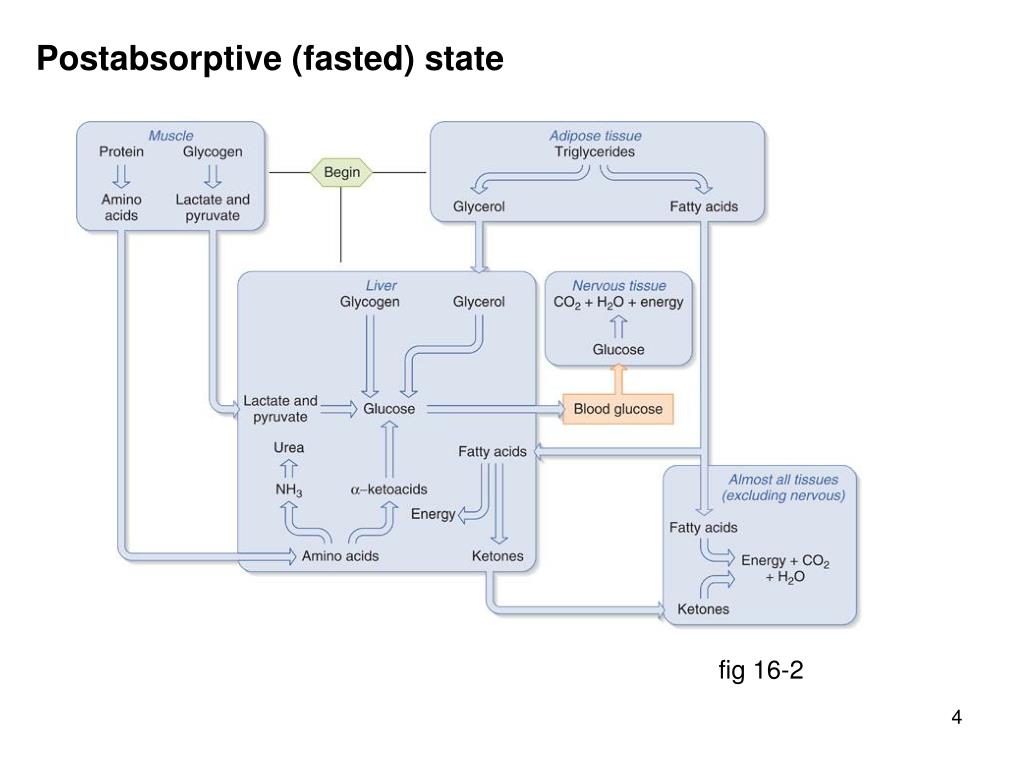
Roughly 4 to 18 hours after your last meal, you enter the post-absorptive state, also known as the early fasting state. This is the state your body is in overnight while you sleep. By now, the nutrients from your last meal have been absorbed and either used or stored.
As blood glucose levels naturally fall, two key things happen:
- Insulin levels decrease. The "storage manager" clocks out.
- Glucagon levels increase. The pancreas releases this hormone, which acts as the "mobilization manager."
Glucagon's primary job is the opposite of insulin's. It signals the liver to start breaking down its stored glycogen and release it back into the bloodstream as glucose. This process is called glycogenolysis.
The purpose of this is to maintain a stable level of glucose in the blood, which is critical for tissues that rely heavily on it, like the brain and red blood cells.
To understand this transition in more detail, please watch the first part of this video.
The following segment from Dr Matt & Dr Mike's video 'Fed vs Fasting Metabolism' clearly explains the hormonal switch from insulin to glucagon and the initial breakdown of glycogen.
Watch from 15:06 to 18:18. Pay attention to how the drop in blood glucose triggers the release of glucagon and what glucagon instructs the liver to do.
This diagram illustrates the key pathways active during this early fasting phase.
Test your understanding!
Imagine your body's energy economy. In this analogy, is insulin the manager responsible for increasing your savings account, or the one responsible for making withdrawals to pay for expenses? What about glucagon?
Show answer
Insulin is the "savings manager." It takes the "income" (glucose from a meal) and puts it into savings (glycogen in the liver and muscle, fat in adipose tissue).
Glucagon is the "expenditure manager." When there's no income, it makes withdrawals from the primary savings account (liver glycogen) to cover the body's essential operating costs (maintaining blood glucose for the brain).
3. The Fasted State: Creating Fuel from Scratch
When a fast extends beyond 18-24 hours, or after liver glycogen stores are significantly depleted, the body enters the fasted state. The post-absorptive state was about using stored glucose; the fasted state is about creating new fuel sources.
Since the primary glycogen reserve is running low, the body activates two more advanced strategies to fuel the brain and body:
-
Gluconeogenesis ("new glucose creation"): The liver begins to manufacture glucose from non-carbohydrate sources. The primary building blocks for this are amino acids (from the breakdown of protein) and glycerol (from the breakdown of fat). This is a vital process for fueling the brain, but it is metabolically costly and not ideal long-term, as it can lead to muscle loss if protein is the primary source.
-
Ketogenesis ("ketone creation"): As the body breaks down large amounts of fat for energy, the liver starts converting some of these fatty acids into molecules called ketone bodies. These ketones are then released into the bloodstream and can be used as a powerful alternative fuel source by many tissues, including the heart, muscles, and—most importantly for your goals—the brain.
This shift to producing and using ketones is the metabolic state you intentionally induce with a ketogenic diet or prolonged fasting. It's a fundamental survival adaptation that allows the brain to thrive even when glucose is scarce.
The following video segment explains this critical shift to gluconeogenesis and the eventual production of ketones.
This final segment from 'Fed vs Fasting Metabolism' explains what happens when glycogen runs out. It introduces the concepts of creating new glucose (gluconeogenesis) and, crucially, how the accumulation of byproducts from fat metabolism leads to the creation of ketones.
Watch from 18:18 to 35:40. This is a longer segment, but it's the core of understanding the transition into a truly fasted state. Focus on two main ideas: (1) Where does the body get materials to make new glucose? (2) Why does the body start making ketones as a result of high fat breakdown?
Summary: The Metabolic Cycle
Your metabolism is not static; it's a fluid cycle between these three states, dictated primarily by when you eat.
Here is a summary table that provides a clear framework for these states:
| State | Typical Timing | Primary Hormone | Key Metabolic Process | Main Fuel Source |
|---|---|---|---|---|
| Fed | 0–4 hours after a meal | Insulin | Nutrient storage (anabolism) | Dietary nutrients |
| Post-Absorptive | 4–18 hours after a meal | Glucagon | Glycogen breakdown (catabolism) | Stored liver glycogen |
| Fasted | >18 hours after a meal | Glucagon (low Insulin) | Gluconeogenesis & Ketogenesis | Fatty acids & Ketones |
Conclusion
In this lesson, we established the foundational framework for understanding your body's energy management system.
Key Takeaways:
- Your body cycles between three metabolic states: fed, post-absorptive, and fasted.
- The fed state is for storing energy, governed by the hormone insulin.
- The post-absorptive state is for mobilizing stored energy (glycogen), governed by the hormone glucagon.
- The fasted state is for creating new fuel from fats and proteins, leading to the production of ketones.
This framework is the essential starting point. You now understand the natural metabolic tides that you will be working with—or against—when implementing a ketogenic diet or intermittent fasting.
In our next lesson, we will build directly on this by exploring how the body prioritizes different fuel sources (glucose, glycogen, fatty acids, and ketones) within these states. This will introduce the critical concept of metabolic flexibility, a key determinant of long-term health.