Welcome to the final lesson of our module on AI-driven automation. Throughout this module, we've explored specific, powerful applications of AI, from enhancing testing and deployment risk scoring in the CI/CD pipeline to transforming monitoring and incident response with anomaly detection and root cause analysis. Now, we will synthesize these individual applications into a coherent strategy.
The learning outcome for this lesson is to apply a structured framework to identify and prioritize AI-driven automation opportunities in a DevOps workflow. For your role in organizational design and change management, this is arguably the most critical part of the course. It provides you with a consultative toolkit to move beyond discussing individual AI tools and toward architecting a strategic, data-driven plan for AI adoption. This framework will help you guide leadership and engineering teams in making intelligent investments that yield the greatest return.
A Structured Approach to AI Adoption
In any major organizational shift, especially one involving a technology as transformative as AI, an ad-hoc approach is a recipe for wasted effort and disillusionment. Simply buying the latest "AIOps" tool without a clear strategy often fails. Instead, a successful adoption begins with a structured, repeatable framework. This process can be broken down into three key phases: Assess, Identify, and Prioritize.
Phase 1: Assess the Current State
Before you can chart a course, you must know your starting position. This involves a clear-eyed evaluation of your organization's current DevOps pipeline and its overall operational maturity.
The first step is to analyze your existing workflows to find pain points and bottlenecks.
AI in DevOps: A Practical Guide for Teams in 2025
This guide from sdh.global offers an excellent starting point for our framework. It details how to begin the assessment process by looking for common challenges.
Please read the section "Assessing Your DevOps Pipeline for AI Integration," focusing on the list of common bottlenecks. As you read, think about how these issues manifest not just as technical problems, but as sources of organizational friction and reduced productivity.
As the article points out, these bottlenecks often involve repetitive, manual tasks—what SREs call "toil." These are prime candidates for automation.
To frame this assessment more formally, we can use a maturity model. Such models provide a roadmap, allowing you to plot where the organization currently stands and visualize the path toward greater sophistication.
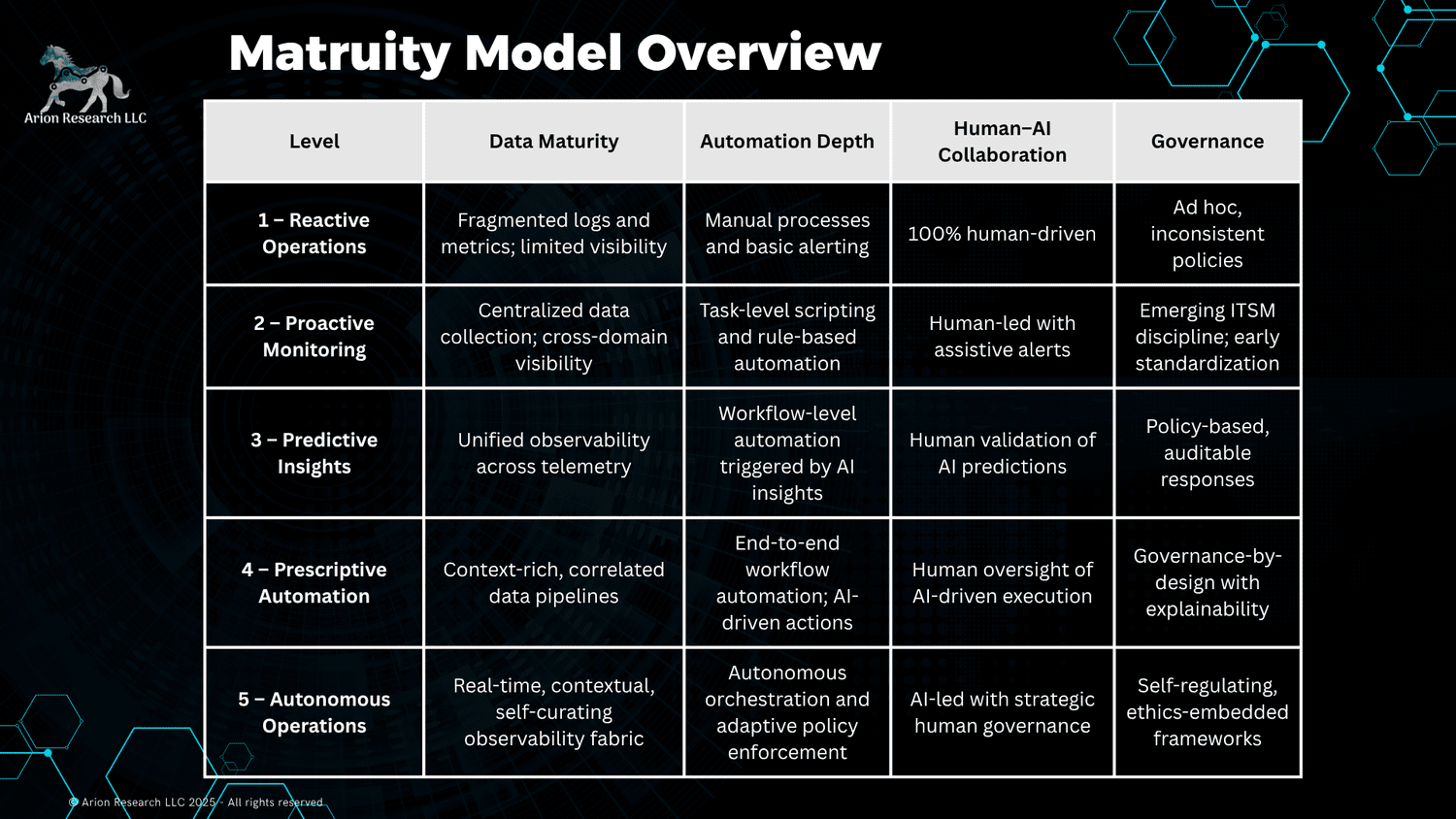
By using this model, you can ask targeted questions to assess the organization's current level:
- Data Maturity: Is our operational data fragmented and siloed (Level 1), or do we have unified observability (Level 3)?
- Automation Depth: Are we limited to manual processes (Level 1), or do we have workflow-level automation triggered by AI (Level 3)?
- Governance: Are our policies ad hoc (Level 1), or are they policy-based with automated responses (Level 3)?
An honest assessment using this model provides a clear baseline and helps define what "better" looks like, preventing the team from trying to jump from Level 1 to Level 5 overnight.
Phase 2: Identify Potential Opportunities
With a clear understanding of your bottlenecks and maturity level, you can begin to identify specific AI use cases that address your most pressing needs. We have covered several of these throughout our course:
- Code & Pipeline Generation: Automating the creation of boilerplate code, test suites, and CI/CD configurations.
- Automated Testing & Quality: Using AI to generate more comprehensive tests or predict which tests to run.
- Deployment Risk Scoring: Analyzing changes to assess the risk of a deployment before it goes to production.
- Anomaly Detection: Moving beyond static monitoring thresholds to identify meaningful deviations from normal system behavior.
- Root Cause Analysis (RCA): Automatically correlating events to diagnose the source of an incident.
- Predictive Analytics: Forecasting potential failures or performance issues before they impact users.
The following reading expands on these high-impact areas.
AI in DevOps: A Practical Guide for Teams in 2025
Returning to the same guide, we can now map specific AI capabilities to the bottlenecks we've found.
Please read the subsection on identifying opportunities. Notice how it categorizes potential AI applications into broad areas like "Code quality improvement" and "Operational efficiency."
By mapping the bottlenecks from your assessment to this menu of AI opportunities, you can create a long list of potential initiatives. For example, if "ineffective error detection leading to broken builds" is a key bottleneck, an AI opportunity would be "automated test synthesis" or "AI-driven code review."
Phase 3: Prioritize for Impact and Feasibility
A long list of ideas is useful, but resources are always finite. The final and most crucial phase is prioritization. A common and effective method for this is a 2x2 matrix that plots opportunities based on their Business Value and Feasibility.

Let's break down these axes:
- Business Value: How much impact will this have?
- Cost Opportunity: Does it reduce infrastructure costs or manual effort?
- Operations Improvement: Does it improve key DevOps metrics like deployment frequency or Mean Time To Recovery (MTTR)?
- Risk Improvement: Does it reduce the change failure rate or improve security posture?
- Feasibility: How realistic is it for us to implement this now?
- Tech Maturity: How reliable is the underlying AI technology for this task?
- Internal Org. Feasibility: Do we have the necessary skills, data quality, and cultural readiness?
- External Feasibility: Are there regulatory or other external blockers?
The ideal starting points are the "quick wins" in the top-right quadrant: High Value, High Feasibility.
The "Feasibility" axis requires a particularly sober assessment. The hype around AI is immense, but the reality on the ground is more nuanced. The following video offers a pragmatic perspective on what is currently achievable.
How AI is Changing DevOps Careers | What You Need to Know
In this excerpt from a conversation with DevOps expert Brett Fisher on the "TechWorld with Nana" channel, we get a crucial reality check on the current state of AI in DevOps.
Please watch the following segments to ground your feasibility assessment: Start with the discussion on AI accuracy. The key insight is that even 70% correctness is not enough for infrastructure code, which highlights the need for human oversight. Next, watch the segment on comparing AI in software vs. DevOps and where to start. This reinforces the idea of starting small and specific, with CI/CD as an ideal proving ground. Finally, watch the discussion on accountability and skill requirements. This is vital: because a human is ultimately accountable, they must have the skills to verify the AI's output. This directly informs the "Internal Org. Feasibility" score.
The key message is that evaluation requires deep knowledge. This has profound implications for organizational design: you cannot replace skilled engineers with AI. Rather, you augment them. Your talent development systems must continue to build foundational knowledge, as this becomes the prerequisite for safely and effectively leveraging AI.
Frameworks in Action
Let's look at how these principles are applied in comprehensive, end-to-end frameworks.
First, the "DevGen" framework provides a concrete, technical example focused on the CI/CD pipeline. It aligns perfectly with the "start small, start with CI/CD" advice.
[PDF] AI-Driven DevOps Acceleration: Orchestrating CI/CD Pipelines with ...
This paper introduces a practical framework for embedding AI into four key stages of development and deployment.
Please review the four stages of the DevGen framework in the introduction: Feature Breakdown to Pipeline Authoring. Then, examine the tables from 2.1 to 2.4. These provide the "visual-technical" detail of what an AI-driven task looks like, showing the prompts given to the AI and the artifacts it generates (YAML, Python code, etc.). This is a tangible example of a "high feasibility" opportunity.
For a more comprehensive, enterprise-scale vision, AWS has proposed the "AI-driven Development Lifecycle" (AI-DLC). This framework is particularly relevant to your work as it incorporates change management rituals directly into the process.
AWS re:Invent 2025 - Introducing AI driven development lifecycle (AI-DLC) (DVT214)
This presentation from AWS outlines a holistic methodology for building applications with AI at every step.
Please watch these key parts: The Core Principle: Understand the "AI Plan, Human Validate" cycle. This is the central tenet of responsible AI implementation. Mob Elaboration: Pay close attention to this ritual. It's a powerful change management technique that compresses requirements gathering from weeks to hours by bringing a cross-functional team together with AI. The Three Phases: Get an overview of the full, adaptive workflow, noting that it's not a rigid, one-size-fits-all process. Demo: Watch the demonstration. It provides a full walkthrough of the AI-DLC framework being used to resolve a real GitHub issue, from reverse-engineering the codebase to generating the final code.
The AI-DLC methodology exemplifies how to operationalize the Assess-Identify-Prioritize framework at scale, integrating it with agile practices and ensuring human oversight is built-in from the start.
Conclusion
This lesson, and indeed this entire course, has aimed to provide you with a strategic understanding of DevOps, SRE, and the transformative impact of AI. We have moved from foundational principles to the practical application of cutting-edge technology.
Here are the key takeaways from our final lesson:
- Adopt a Structured Framework: Don't chase AI hype. Use a systematic process to Assess your organization's maturity, Identify high-impact opportunities that solve real bottlenecks, and Prioritize them based on business value and feasibility.
- Start Small and Prove Value: The best place to start is often with a high-value, high-feasibility project, such as automating aspects of the CI/CD pipeline. Success here builds momentum and organizational buy-in.
- Human Accountability is Non-Negotiable: AI is a powerful assistant, not a replacement for expertise. The final responsibility for code and infrastructure lies with human engineers. Your organizational designs and training programs must reinforce this.
- Invest in Context: The performance of AI is directly proportional to the quality of the context it is given. Investing in good documentation, clear standards, and well-defined processes is not just good practice—it's a prerequisite for successful AI automation.
You are now equipped with the conceptual models and strategic frameworks needed to consult credibly on the organizational changes required to embrace modern software delivery and operations. Your understanding of team topologies, performance metrics, and now AI adoption strategies, provides a holistic view to guide your organization effectively through its next transformation.