Welcome back. In our last lesson, we introduced AIOps and its transformative role in modern IT operations, focusing on how it helps teams manage the complexity of live production systems. We saw that AIOps primarily addresses the "Ops" side of DevOps—making monitoring, incident detection, and response smarter and more automated.
Now, we will shift our focus "left" along the software delivery lifecycle. This lesson explores how AI is being embedded directly into the Continuous Integration and Continuous Deployment (CI/CD) pipeline itself. Our goal is to identify AI use cases across the CI/CD pipeline, including automated testing and deployment risk scoring. For your work in organizational design, understanding these use cases is vital. They represent a fundamental change in how software is built and delivered, impacting everything from team productivity and skill requirements to risk management and release strategy.
An Overview of AI in the CI/CD Pipeline
The CI/CD pipeline, as we've discussed, automates the process of turning source code into a deployed application. By integrating AI into this pipeline, organizations are moving beyond simple automation to intelligent automation, where the pipeline can make decisions, predict outcomes, and optimize itself.
The image below provides a high-level roadmap of how AI can be implemented at various stages of the CI/CD pipeline.
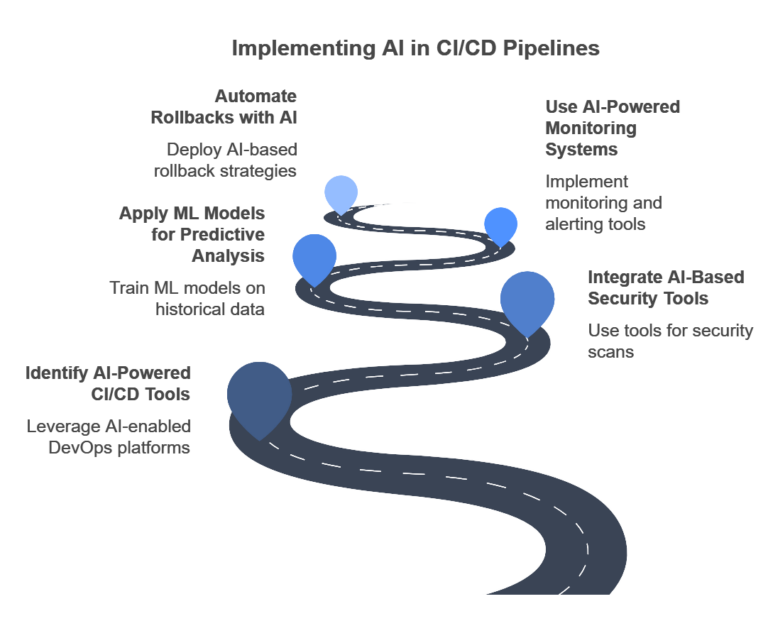
As the diagram suggests, AI's role is multifaceted. It can help teams choose the right tools, secure the code, and improve monitoring. In this lesson, we will focus on two of the most impactful applications shown here: "Apply ML Models for Predictive Analysis" (which we'll explore as deployment risk scoring) and the implied intelligence in testing that precedes deployment.
Use Case 1: AI-Powered Test Automation
One of the most significant bottlenecks in software delivery is testing. Manually writing and maintaining comprehensive test suites is time-consuming. As applications grow, test suites can become bloated, taking a long time to run and delaying feedback to developers. AI is emerging as a powerful tool to address these challenges.
To see how this works in practice, we'll look at the concept of an "Agentic AI" for testing. This is an AI system designed to act as an autonomous agent that can understand requirements, explore an application, and generate tests. The following video from Naveen AutomationLabs demonstrates a tool called ContextQA that embodies this idea.
Agentic AI for Software Testing By ContextQA - Naveen Automation Labs
This video showcases an "Agentic AI" for software testing. It provides concrete examples of how AI can automate tasks that have traditionally been highly manual.
Please watch the following three segments: First, watch the demonstration of the Requirement Intelligence agent from this segment. Notice how the AI ingests a requirements document (in this case, an Excel file, but it could be a Jira ticket) and automatically generates test cases. It even asks clarifying questions if the requirements are ambiguous—a task that would typically fall to a business analyst. Next, watch the demonstration of the Autocrawl agent, from this part. Here, the AI is given only a URL and a simple prompt ("login and verify apply leave"). It then autonomously explores the application to figure out how to perform and validate the action. This shows how AI can create tests even for legacy applications with poor documentation. Finally, see how the agent handles flaky tests from this section. It not only identifies tests that fail inconsistently but also provides a root cause analysis and suggests a fix. This directly addresses the SRE goal of reducing toil by automating debugging.
The capabilities shown in the video—generating tests from requirements, creating tests by exploring an application, and fixing unstable tests—fundamentally change the economics of software quality. They allow teams to achieve higher test coverage with less manual effort.
To see these ideas integrated into a mainstream DevOps platform, let's look at a short demo from GitLab.
GitLab Duo -- AI-Powered DevSecOps Demo
This demo of GitLab Duo shows AI features embedded directly into the developer workflow.
Watch the short clip on AI-generated tests from this section. In this scenario, a code reviewer notes that a change is missing test coverage and prompts the developer to use the platform's AI to generate the necessary tests. This illustrates how AI can be used tactically to fill gaps and speed up the code review cycle.
From an organizational perspective, these tools don't necessarily replace QA engineers. Instead, they elevate their role from manual test creators to supervisors of an AI-driven testing process, focusing on complex edge cases and validating the AI's output.
Use Case 2: Intelligent Change Risk Assessment
Perhaps the most stressful moment in the software lifecycle is hitting the "deploy" button. Will the change work as expected, or will it cause an incident? Traditionally, this decision has relied on manual code reviews, checklists, and the intuition of senior engineers. This process is subjective, inconsistent, and doesn't scale in a rapid-delivery environment.
AI offers a more data-driven approach: intelligent change risk assessment. The core idea is to train a machine learning model on historical deployment data to predict the likelihood that a new change will cause a problem.
The following article provides an excellent deep dive into this concept.
AI for Change Risk Prediction: Automating the Art of Safe Deployments
This article explains the what, why, and how of AI-driven risk prediction in a clear and accessible way.
First, please read the introductory sections, What Is Change Risk Prediction? and Why This Matters for Your Team. These sections frame the problem and the value of an AI-based solution. Next, read Real-World Application: DevOps Pipeline Integration. This is the core of the concept. Pay close attention to the signals the AI analyzes, such as change characteristics, historical context, and quality indicators. Your background in product management and business rules engines makes this analogous to building a sophisticated decision engine for deployment safety. Finally, review the hands-on exercise. You don't need to run the Python code, but read through it and the explanation. It provides a "visual-technical" look at how a simple model uses features like lines_changed and test_fail_rate to predict the probability of a rollback.
The risk score generated by such a model is not just a number; it's an actionable piece of intelligence. A CI/CD pipeline can use this score to make decisions automatically. For instance, the StackGenie article "How AI Transforms Enterprise DevOps" includes a small configuration snippet showing how this works.
How AI Transforms Enterprise DevOps: Value-Driven Use Cases
This snippet shows how a risk score can be used as a gate in a CI/CD pipeline.
Please read the section on Intelligent Change Risk Assessment. Focus on the YAML code block under "Example Implementation". This is a simplified example from a pipeline file. It shows a step named intelligent-gates that checks if the risk score is above a threshold (0.7). If it is, it automatically triggers an expanded test plan and flags the change for a mandatory senior review.
This automated gating process ensures that low-risk changes (e.g., documentation updates) can be deployed rapidly with minimal friction, while high-risk changes are given the extra scrutiny they require. This directly supports the DevOps goal of increasing velocity without sacrificing stability. As a change management consultant, you can see how this data-driven approach provides a clear, defensible policy for release management, moving away from subjective "gut feel" decisions.
Conclusion
In this lesson, we have moved beyond the operational focus of AIOps to see how AI is being integrated into the development and deployment phases of the software lifecycle.
Let's summarize the key takeaways:
- Intelligent Automation: AI is transforming CI/CD from a system of simple automation into one of intelligent automation, capable of prediction and optimization.
- AI in Testing: AI agents can automate the creation of tests from requirements, explore applications to generate test suites, and identify and help fix flaky tests. This accelerates the testing process and improves quality.
- Deployment Risk Scoring: By analyzing historical data, AI can predict the probability that a code change will cause a production failure. This allows organizations to create smart deployment gates that balance speed with safety.
- Strategic Impact: These technologies enable teams to build and release software faster and more reliably. They also shift the roles of engineers, empowering them to focus on higher-value strategic tasks rather than manual, repetitive work.
In our next lesson, we will return to the "Ops" domain and take a deeper dive into the topics we first introduced in our AIOps overview. We will explain how AI enhances monitoring and incident response through anomaly detection and root cause analysis, exploring the specific machine learning techniques that make modern AIOps platforms possible.