Welcome to your first lesson in the Business Economics course. We're starting our journey with a fundamental concept that shapes all economic analysis: the distinction between "what is" and "what ought to be." This lesson will equip you to distinguish between statements of fact and statements of opinion in an economic context, a crucial skill for objectively analysing economic arguments and policies.
Your background as a statistician and researcher has prepared you well for this. In your work, you are constantly navigating the line between presenting objective, data-driven findings and making value-based recommendations. Economics formalizes this distinction through the concepts of positive and normative statements. The key criterion we will focus on is testability, or as it's known in statistics, falsifiability. This is the cornerstone of the scientific approach that economics strives to adopt.
1. Defining Positive and Normative Economics
Let's begin by establishing clear definitions for these two branches of economic thought.
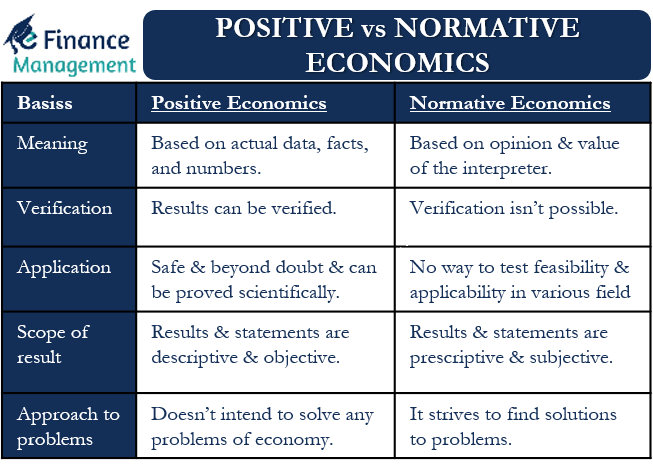
- Positive economics deals with objective explanations and the testing of theories. It seeks to describe the world as it is, based on facts and data. A positive statement is not necessarily true, but it is one that can, in principle, be tested and proven true or false.
- Normative economics provides prescriptive statements based on value judgments. It deals with how the world should be. A normative statement expresses an opinion and cannot be scientifically tested.
To get a solid grasp of this distinction, please watch the following introductory video from Khan Academy. It provides several clear examples that illustrate the core difference.
Normative and positive statements | Basic economics concepts | AP Macroeconomics | Khan Academy
This video, "Normative and positive statements," provides a concise introduction to the topic. It clearly explains that the key difference lies in whether a statement can be empirically tested.
Please watch the entire video. Pay close attention to the examples provided and how the narrator determines whether each statement is positive or normative by asking: "Can this be tested with data?"
As the video highlights, the single most important question to ask is: "Is this statement falsifiable?"
-
If the answer is yes—meaning you can imagine an experiment or a data analysis that could prove it wrong—it is a positive statement. For example, the statement "Raising interest rates will lower inflation" is positive. We can collect data on interest rates and inflation and use econometric methods to test this relationship. The result might show the statement is true, false, or that the relationship is complex, but the key is that it's testable.
-
If the answer is no—because the statement depends on ethics, values, or personal opinion—it is a normative statement. For example, "The government should prioritize lowering inflation over reducing unemployment" is normative. The word "should" is a major clue. What a government should prioritize is a matter of policy goals and values, not something that can be proven right or wrong with data alone.
The table below provides a useful summary of the differences.
2. The Nuance: Predictions and Social Welfare
While the distinction seems straightforward, it can become subtle, especially when economists make predictions or analyze policies intended to improve "social welfare." Your experience in statistics and social research will give you a unique appreciation for these complexities.
Economists generally view their predictions as positive statements. A prediction like, "If the carbon tax is increased to $50 per ton, gasoline consumption will fall by 10%," is derived from an economic model. That model is built on assumptions about how the world works, and its prediction is ultimately testable against future data. This process is analogous to building a statistical model and using it to forecast an outcome; the forecast's accuracy can be objectively evaluated.
However, statements about social welfare are trickier. To explore this, let's turn to a slightly more advanced discussion.
Positive vs Normative in Economics
The video "Positive vs Normative in Economics" by Ashley Hodgson delves into some of the finer points, particularly how economists see their role and the challenges that arise with predictions and social welfare analysis.
Please watch the portion of the video discussing predictions and social welfare. The speaker explains why predictions are considered positive but why analyzing social welfare introduces value judgments.
As the video explains, a statement like, "A universal basic income would increase social welfare," seems positive. But what is "social welfare"? Is it the simple sum of every individual's happiness (a utilitarian view)? Or is it determined by the well-being of the least fortunate person in society (a Rawlsian view)? The choice of definition is a normative one. It embeds values into an analysis that might otherwise appear purely objective. This is a critical point that the Stanford Encyclopedia of Philosophy article on the "Philosophy of Economics" explores in depth, noting that the values governing economic science and economic policy are often difficult to separate.
3. Practice: Classifying Economic Statements
Let's put your understanding to the test. For each statement below, classify it as positive or normative and briefly state your reasoning. Think like a researcher: could you design a study to test this?
- A rise in consumer incomes will lead to a rise in the demand for new cars.
- The government should increase the national minimum wage to reduce poverty.
- A decrease in the supply of oil will result in an increase in its price.
- It is unfair to tax the income of the rich at a higher rate than the income of the poor.
- Firms that pollute the environment should be forced to pay for the cleanup.
- If a firm lays off 10% of its workforce, its stock price will rise.
Answers and Explanations
- Positive. This is a testable hypothesis. You could collect data on consumer incomes and car sales to verify or falsify this cause-and-effect relationship.
- Normative. This statement contains the word "should" and involves a value judgment about policy goals (reducing poverty). Whether the minimum wage should be increased is a matter of opinion, even though one could test the positive statement "Increasing the minimum wage reduces poverty."
- Positive. This is a core prediction from economic theory (the law of supply). It can be tested by observing market data for oil.
- Normative. The word "unfair" signals a value judgment. There is no objective, scientific measure of fairness.
- Normative. This is a prescriptive policy statement using the word "should." It expresses an opinion about who ought to bear the cost of pollution.
- Positive. This is a testable claim. You could analyze historical data of companies that have announced layoffs and track the subsequent performance of their stock price to see if this statement holds true.
Conclusion
In this lesson, we have established the crucial distinction between positive and normative economics. This separation is fundamental to thinking like an economist and is the first step in building the analytical framework for this course.
Key Takeaways:
- Positive economics is descriptive and objective, dealing with testable statements about "what is."
- Normative economics is prescriptive and subjective, dealing with value-based statements about "what should be."
- The primary criterion for classification is testability or falsifiability. If a statement can be tested with data, it is positive; if it rests on opinion or values, it is normative.
- While economists strive for positive analysis, normative judgments can be subtly embedded in assumptions, particularly in analyses of "social welfare."
This distinction will serve as a guiding principle as we move forward. In our next lesson, we will dive into our first core quantitative concept: opportunity cost. We will learn how to calculate the true cost of any choice, a foundational idea for analyzing decisions made by individuals, firms, and governments.