Introduction
In our previous lessons, we explored the market structures of perfect competition and monopoly, the two opposite ends of the competitive spectrum. We established that while a perfectly competitive firm maximizes profit where , a monopolist does so where , leading to higher prices, lower output, and a deadweight loss.
This lesson moves into the more nuanced and common middle ground of monopolistic competition. This structure combines elements from both models we've studied. You'll learn how firms in these markets, from clothing designers to restaurants, use product differentiation to gain a degree of market power. Our primary goal is to apply the profit-maximization rule you learned for monopolies to this new context, enabling you to calculate the short-run equilibrium price, output, and profit for a monopolistically competitive firm.
What is Monopolistic Competition?
Monopolistic competition is a market structure characterized by three main features:
- Many buyers and sellers: Similar to perfect competition, the market is composed of numerous firms and consumers.
- Differentiated products: This is the key distinction. Each firm produces a product that is slightly different from its competitors'. This differentiation can be based on branding, quality, design, location, or service.
- Free entry and exit: There are no significant barriers preventing new firms from entering the market or existing firms from leaving.
The video below provides a clear overview of these characteristics and explains why most of the markets you interact with daily fall into this category. The concept of product differentiation, for example, is central to industries like fashion and apparel design, where brands compete by creating unique styles and brand identities.
Chapter 16: Monopolistic Competition
This video from DrAzevedoEcon introduces the core concepts of monopolistic competition.
Please watch the first two sections of the video: First, watch the segment on the characteristics of monopolistic competition. Pay attention to the examples and the discussion of how product differentiation works. Next, focus on the explanation of the firm's demand curve from this segment. The key insight is that because products are differentiated, each firm faces its own downward-sloping, but highly elastic, "residual" demand curve.
The most critical consequence of product differentiation is that the firm is no longer a price-taker. If it raises its price slightly, it won't lose all its customers because some will remain loyal to its specific version of the product. This means the firm faces a downward-sloping demand curve, just like a monopolist. However, because there are many close substitutes, this demand curve is typically much more elastic than a pure monopolist's.
Short-Run Profit Maximization: A Familiar Model
Since a monopolistically competitive firm faces a downward-sloping demand curve, its marginal revenue (MR) curve will lie below its demand curve. Does this sound familiar? It should. The short-run profit-maximization process for a firm in monopolistic competition is identical to the process for a single-price monopolist.
The firm will follow these steps to determine its equilibrium price and quantity:
- Find the quantity of output () where marginal revenue equals marginal cost ().
- Using the demand curve, find the highest price () the firm can charge for that quantity.
- If price is above average total cost () at that quantity, the firm earns a positive economic profit. If price is below ATC, it incurs a loss.
The following video segment walks through this graphical analysis. Note how the presenter explicitly states that the diagram and the solution method are the same as what we used for monopoly.
Chapter 16: Monopolistic Competition
This part of the video demonstrates how to find the short-run equilibrium for a monopolistically competitive firm.
Watch from this segment on short-run equilibrium. The crucial steps are identifying the intersection of MR and MC to find the profit-maximizing quantity, and then moving up to the demand curve to find the price. The video also shows how to identify the area representing economic profit.
Quantitative Analysis of Short-Run Equilibrium
Now, let's apply this framework to a numerical problem, which plays to your strengths in quantitative analysis. We will work through a step-by-step example of calculating the profit-maximizing price, quantity, and total profit.
This document provides a clear, formula-driven approach.
1 A Profit-Maximization Problem Step-by- ...
This document provides an excellent, rigorous example of solving for a firm's optimal output and price.
Please focus on the section labeled ANSWER Q2. Follow the three steps outlined: Finding the optimal quantity (q*) by setting MR = MC. Finding the optimal price (p*) by substituting q^* into the inverse demand function. Calculating the resulting profit by finding total revenue (P^* \times Q^*) and total cost.
This example solidifies the procedure: given demand and cost functions, you can derive the MR curve, solve for the equilibrium quantity where , find the price from the demand curve, and calculate profit.
Let's try one more example that requires an initial step of deriving the demand function from a schedule.
[PDF] 1 Economics 101 Summer 2010 Answers to Homework #5 Due ...
This resource contains another practical problem involving a monopolistically competitive firm.
Please review Problem 4, concerning Janet's ice cream business. Pay close attention to parts (a) and (b). The problem provides a demand schedule. The solution notes that from this schedule, you can derive the demand equation P = 2 - 0.2Q (or, as they write it, Q=10-5P). From this, the marginal revenue is MR = 2 - 0.4Q. Part (a): To find the optimal quantity and price, the solution sets MR = MC (2 - 0.4Q = 0.40), which solves to Q = 4. Plugging Q = 4 back into the demand equation gives P = $1.20. Part (b): To find the profit, the solution uses the formula \pi = Q \times (P - \text{ATC}). Since there are no fixed costs, ATC = AVC = MC = $0.40. Thus, profit is 4 \times ($1.20 - $0.40) = $3.20.
Applying the Graphical Model
To confirm your understanding, let's apply the rule to a graphical problem. Examine the figure below, which shows the demand (D), marginal revenue (MR), marginal cost (MC), and average total cost (ATC) curves for a firm in monopolistic competition.
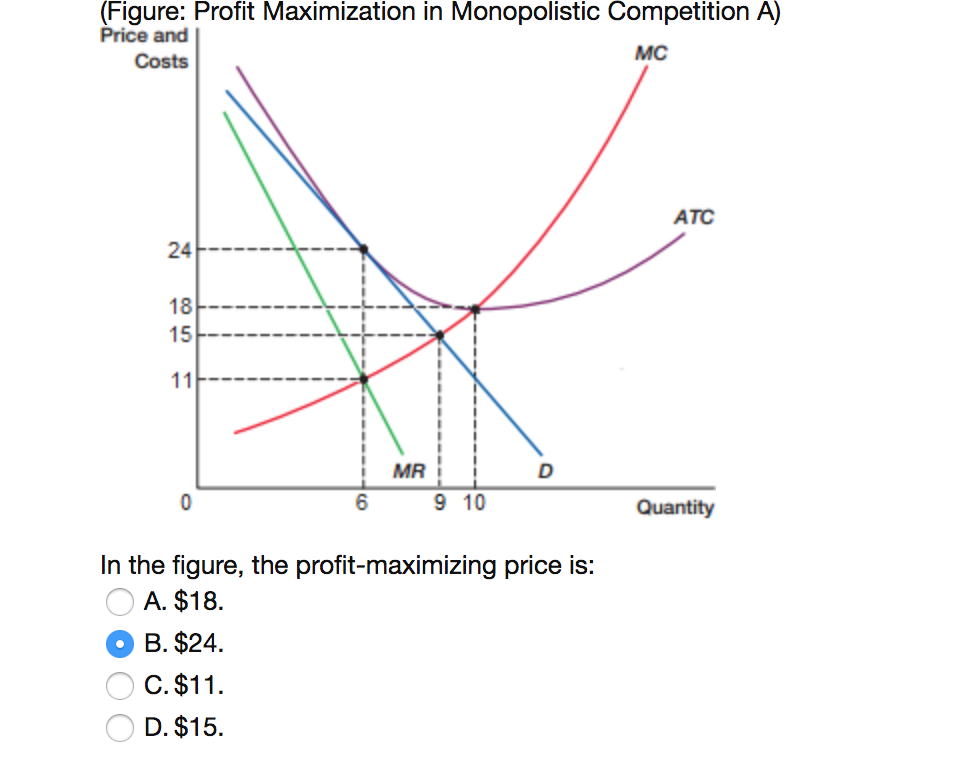
Your task is to determine the profit-maximizing price.
To do this, follow the two-step process:
- Locate the quantity where the MR curve intersects the MC curve.
- From that quantity, move vertically up to the demand curve to find the price consumers are willing to pay.
Following this procedure, we see that at a quantity of 6 units. At , the price on the demand curve (D) is $24. Therefore, the profit-maximizing price is $24.
At this equilibrium, the firm earns a positive economic profit because the price ($24) is greater than the average total cost at that quantity (which is $11). The total profit is the shaded rectangular area: .
Conclusion
In this lesson, we delved into the structure of monopolistic competition, a market defined by product differentiation and free entry. We established that due to differentiation, firms face a downward-sloping demand curve, making their short-run behavior identical to that of a monopolist.
Key Takeaways:
- A monopolistically competitive firm maximizes its short-run profit by producing the quantity where .
- The price is determined by the demand curve at the profit-maximizing quantity.
- The calculation of equilibrium price, quantity, and profit follows the same algebraic and graphical methods used for a pure monopoly.
- In the short run, a monopolistically competitive firm can earn positive economic profits if its price exceeds its average total cost.
This last point is crucial for what comes next. The existence of short-run profits, combined with the characteristic of free entry, sets up a dynamic adjustment process. In our next lesson, we will analyze how the entry of new firms erodes these short-run profits, leading to a different long-run equilibrium. We will calculate this new equilibrium and explore the concept of "excess capacity," a key feature of monopolistically competitive markets.