Introduction
In our previous lesson, we modeled the money market and saw how the central bank's control over the money supply determines the equilibrium interest rate. This raises a critical practical question: how exactly do the central bank's actions, such as buying bonds, translate into a change in the overall money supply available in the economy? The answer is not one-to-one. Due to the way the banking system operates, an initial injection of funds by the central bank leads to a much larger final increase in the money supply.
Today, we will explore this mechanism of money creation. Your learning outcome is to calculate the simple money multiplier and the total change in money supply from an initial deposit. We will derive the formula for this multiplier and apply it to numerical problems. Given your background in probability and mathematics, you'll find the underlying process, which is based on a geometric series, to be quite elegant. Understanding this multiplier effect is fundamental to grasping the power and mechanics of monetary policy.
How Banks Create Money: Fractional Reserve Banking
The modern banking system is a fractional reserve system. This means that banks are legally required to hold only a fraction of their deposits as reserves and can lend out the rest. The fraction of deposits that must be held in reserve is called the required reserve ratio (rr), which is set by the central bank.
When a bank makes a loan, it creates new money. The loan becomes a new deposit in the banking system, which then gets lent out again, creating a cascade effect. This process is often called the multiple deposit creation process.
To build an intuition for this process, let's watch how an initial injection of cash ripples through the banking system.
Money creation in a fractional reserve system | Financial sector | AP Macroeconomics | Khan Academy
The Khan Academy video "Money creation in a fractional reserve system" provides a clear, step-by-step illustration of this process.
Please watch the first three segments of the video: The Initial Deposit: Observe how an initial deposit of $1,000 becomes an asset (reserves) and a liability (checkable deposit) for the first bank. The First Loan: Follow how the bank, adhering to a 10% reserve requirement, keeps $100 in reserve and loans out $900, which is then deposited in a second bank. The Process Continues: See how the second bank repeats the process, lending out 90% of its new deposit. Focus on how each stage of lending creates a new, smaller deposit somewhere else in the system.
The Simple Money Multiplier
As you saw in the video, an initial deposit leads to a chain reaction of subsequent, smaller deposits. The total increase in the money supply is the sum of all these new deposits. We can represent this process mathematically.
If the required reserve ratio is , and there is an initial increase in bank reserves of , the process unfolds as follows:
- Stage 1: The first bank receives and lends out .
- Stage 2: This loan is deposited in a second bank, which then lends out of that amount, which is .
- Stage 3: This continues, with the third bank lending out , and so on.
The total change in deposits () is the sum of this infinite geometric series:
Factoring out :
The sum of an infinite geometric series is . In our case, . Substituting this in, the term in the brackets becomes:
This gives us the final formula for the total change in deposits:
The term is known as the simple money multiplier. It tells us the maximum amount the money supply (specifically, checkable deposits) can increase for every dollar increase in bank reserves.
The following video segments summarize this derivation and show how to apply the formula.
The Money Multiplier and Reserve Requirement
This video from Jacob Clifford offers a very concise explanation and application of the money multiplier.
Watch the following parts: The Multiplier Formula: This section introduces the simple formula 1/\text{reserve ratio}. Calculation Example: This walks through a typical scenario where the central bank injects new reserves into the system by buying bonds.
Applying the Money Multiplier: A Worked Example
Let's solve a problem similar to what you might see on your exam. This problem uses the concepts we've just discussed.
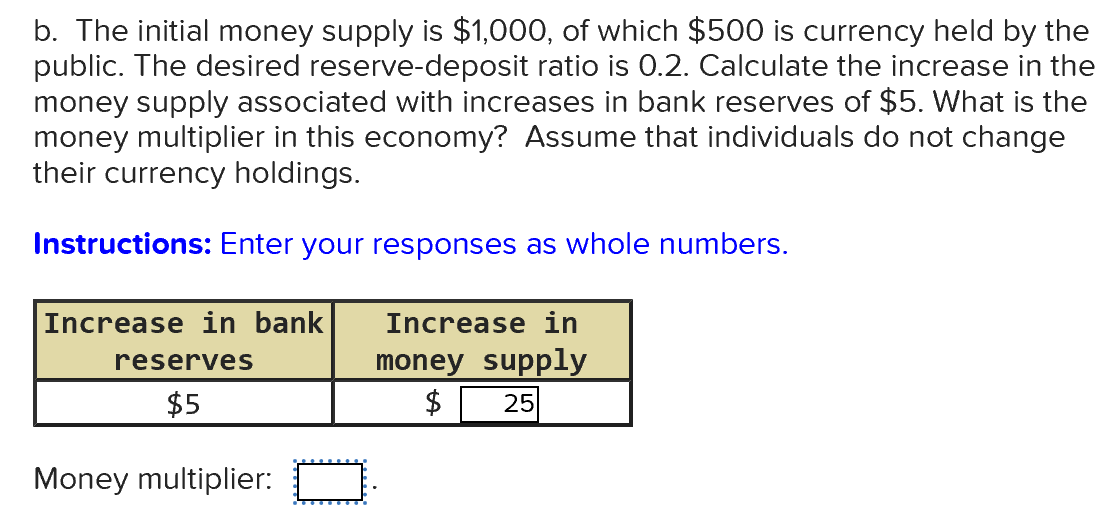
Let's break it down step-by-step:
-
Identify the given information:
- Increase in bank reserves (): $5
- Desired reserve-deposit ratio (): 0.2
- The problem also gives initial money supply ($1,000) and currency ($500), but for calculating the change, these are not needed. We only need the change in reserves and the multiplier.
-
Calculate the money multiplier:
The formula for the simple money multiplier is . -
Calculate the increase in the money supply:
The total increase in the money supply (, which in this simple model equals the change in deposits ) is the increase in reserves multiplied by the money multiplier.This confirms the answer shown in the image. The initial $5 injection of reserves ultimately leads to a $25 expansion of the money supply.
An Important Distinction: New Reserves vs. Existing Currency
It is crucial to distinguish between two scenarios:
- An injection of new reserves: When the central bank conducts an open market purchase, it buys bonds from banks and credits their reserve accounts. This is new money entering the banking system, and the full multiplier effect applies to this initial change in reserves. The example above illustrates this.
- A deposit of existing currency: When an individual deposits cash (that was previously in circulation, e.g., under a mattress) into their bank account, the immediate effect on the money supply (M1 = Currency + Checkable Deposits) is zero. The currency component of M1 decreases, while the deposit component increases by the same amount. However, this deposit does increase the bank's reserves, which then get loaned out, starting the multiplier process.
The following video explains this critical distinction.
The Money Multiplier and Reserve Requirement
The instructor explains why the change in the money supply is different when an individual deposits cash.
Watch the segment from Cash Deposit Example. Notice that if Jill deposits $100 cash with a 10% reserve ratio, total deposits will increase by $1,000, but the net new money created is only $900, because the original $100 was already part of the money supply as currency.
Beyond the Simple Multiplier: Leakages
The simple money multiplier gives us the maximum possible expansion of the money supply. In reality, the actual multiplier is smaller due to two "leakages" from the deposit creation process:
- Currency Drain: People and firms do not deposit all the money they receive; they choose to hold some of it as currency. Money held as currency cannot be used by banks to make new loans.
- Excess Reserves: Banks may sometimes choose to hold more reserves than the legally required amount. These are called excess reserves. By holding excess reserves, banks are lending out less than they could, which dampens the multiplier effect.
A more sophisticated money multiplier accounts for these leakages. While a full derivation is beyond the scope of this lesson, it's useful to see the formula to appreciate the factors at play.
The Money Supply and the Money Multiplier - 2012 Book Archive
This textbook chapter develops a more realistic money multiplier.
Skim the first part of this section. Start from the introduction of ratios for currency and excess reserves. Then, look at the formula presented for the M1 multiplier, m1. You don't need to memorize it, but observe how it incorporates the currency ratio (C/D) and the excess reserve ratio (ER/D) in the denominator. This shows that as people hold more currency or as banks hold more excess reserves, the value of the multiplier decreases.
The decision by banks to hold significant excess reserves can dramatically shrink the money multiplier. This happened following the 2008 financial crisis, when heightened uncertainty led banks to hoard liquidity rather than lend it out. As a result, despite massive injections of reserves by the Federal Reserve, the money multiplier fell below 1, meaning the money supply expanded by less than the increase in reserves.
Conclusion
In this lesson, we have dissected the process of money creation in a fractional reserve banking system. We established that an initial change in reserves triggers a larger change in the money supply, a phenomenon captured by the money multiplier.
Key Takeaways:
- Banks create money by lending out a portion of the deposits they receive.
- The simple money multiplier provides an upper bound for this process and is calculated as , where is the required reserve ratio.
- The total change in money supply is the initial change in bank reserves multiplied by the money multiplier.
- The real-world multiplier is smaller than the simple multiplier due to leakages, namely the public's holding of currency and banks' holding of excess reserves.
You are now equipped to calculate how central bank actions to change reserves will ripple through the economy to affect the overall money supply. In our next lesson, we will connect this concept to one of the oldest theories in macroeconomics: the Quantity Theory of Money. This will allow us to analyze how changes in the money supply () ultimately influence the aggregate price level () and real output () in the long run.