Hello! Welcome to the sixth lesson in our "Mathematical Foundations for Quant Finance" module.
In our last session, we explored covariance and correlation, which describe the historical relationships between assets. Today, we shift from statistics to calculus to explore a different kind of relationship: the instantaneous sensitivity of a financial instrument to changes in market factors.
This lesson addresses the learning outcome: Define a derivative as a rate of change and relate it to the concept of financial 'Greeks'. We will connect the fundamental calculus concept of a derivative to the essential risk management tools used in options trading known as "the Greeks." This concept is a cornerstone for pricing and hedging derivatives, a major area in quantitative finance.
1. The Derivative: An Instantaneous Rate of Change
From your engineering background, you're likely familiar with derivatives representing rates of change, like velocity being the derivative of position with respect to time. Let's briefly formalize this intuition.
A derivative measures how a function's output changes in response to a tiny change in its input. It is the instantaneous rate of change, or the slope of the line tangent to the function's graph at a specific point.
In finance, many instruments, especially options, have prices that depend on multiple variables simultaneously:
- The price of the underlying asset ()
- The time to expiration ()
- The volatility of the underlying asset ()
- The risk-free interest rate ()
- The strike price ()
When a function's value depends on multiple inputs, we use partial derivatives. A partial derivative measures the rate of change with respect to one input variable, while holding all other inputs constant. This is conceptually similar to testing how changing a single parameter in a function call affects its return value while keeping other parameters fixed. We denote a partial derivative with the symbol . For example, the partial derivative of an option's value with respect to the underlying stock price is written as:
This expression answers the question: "By how much does the option's value change for a very small change in the stock's price, assuming time, volatility, and interest rates do not change?"
2. Introducing the Financial 'Greeks'
The "Greeks" are simply the names given to these partial derivatives in the context of options pricing. They are a set of risk measures that tell a trader how sensitive their option's price is to changes in different market parameters.
To get a high-level introduction to the main Greeks and their purpose, let's watch a short video.
Stock Option Greeks: Delta, Theta, Vega, Rho, & Gamma - Finance for Aspiring Quants
The video 'Stock Option Greeks' by Socratica provides a great introduction to the key Greeks and, importantly, explicitly connects them to the mathematical concept of partial derivatives.
Please watch from 00:56 to 03:59. Focus on how the video introduces the Greeks as measures of change and formally defines them as the partial derivatives of the option's value with respect to different variables.
As the video highlighted, if we consider an option's value as a function of its inputs, the Greeks are the partial derivatives of . Let's explore the most important ones.
Delta (): Sensitivity to Asset Price
Delta is the first-order derivative of the option's value with respect to the underlying asset's price.
- What it measures: How much the option price is expected to change for a $1 change in the underlying stock's price.
- Example: A Delta of 0.6 means the option's price will increase by approximately $0.60 if the stock price increases by $1.
The next segment of the video explains this with a practical example.
Stock Option Greeks: Delta, Theta, Vega, Rho, & Gamma - Finance for Aspiring Quants
Let's continue with the Socratica video to see how Delta works in practice.
Watch from 03:59 to 05:19. Note how Delta gives a quick estimate of price changes without needing to re-run a full pricing model.
Theta (): Sensitivity to Time
Theta measures the sensitivity of the option's value to the passage of time. This is often called "time decay."
- What it measures: How much value an option loses as one day passes, with all other factors held constant.
- Example: A Theta of -0.05 means the option's price will decrease by approximately $0.05 each day. For option buyers, Theta is an enemy; for sellers, it's an ally.
Stock Option Greeks: Delta, Theta, Vega, Rho, & Gamma - Finance for Aspiring Quants
Now, let's look at Theta, the measure of time decay.
Watch from 05:19 to 06:37. Understand why Theta is usually negative and how it impacts option buyers and sellers differently.
Vega (): Sensitivity to Volatility
Vega measures the sensitivity of an option's value to a change in the volatility of the underlying asset. (Note: Vega is not a real Greek letter, but it is the standard name used in finance).
- What it measures: How much the option price changes for a 1 percentage point change in implied volatility.
- Example: A Vega of 0.10 means the option's price will increase by $0.10 if the asset's volatility increases by 1%.
Stock Option Greeks: Delta, Theta, Vega, Rho, & Gamma - Finance for Aspiring Quants
Next up is Vega, which relates to an unobservable but critical variable: volatility.
Watch from 06:37 to 08:10. Focus on why higher volatility generally increases an option's value.
Rho (): Sensitivity to Interest Rates
Rho measures the sensitivity of an option's value to a change in the risk-free interest rate.
- What it measures: How much the option price changes for a 1 percentage point change in the risk-free interest rate. Its impact is generally smaller than the other Greeks for short-dated options.
Stock Option Greeks: Delta, Theta, Vega, Rho, & Gamma - Finance for Aspiring Quants
Let's cover the final first-order Greek, Rho.
Watch from 08:10 to 10:21. Pay attention to why rising interest rates affect call and put options differently.
Gamma (): A Second-Order Derivative
Gamma is different from the others. It is a second-order derivative. It measures the rate of change of Delta with respect to the underlying asset's price.
- What it measures: How much an option's Delta is expected to change for a $1 change in the underlying stock's price.
- Why it's important: Delta is not constant; it changes as the stock price moves. Gamma tells you how stable your Delta is. A high Gamma means your risk exposure (Delta) can change very quickly, requiring more frequent adjustments to your hedges.
Stock Option Greeks: Delta, Theta, Vega, Rho, & Gamma - Finance for Aspiring Quants
Finally, let's examine Gamma, our first look at a second-order Greek.
Watch from 10:21 to 12:09. Grasp the idea that Gamma measures the 'rate of change of the rate of change' and why it's crucial for managing dynamic hedges.
Test your understanding!
Match the trader's concern with the Greek that measures it.
| Trader's Concern | Greek |
|---|---|
| 1. "I'm worried the stock price will move against me. How sensitive is my option?" | A. Theta () |
| 2. "My option expires in two weeks. How much value will it lose just from time passing?" | B. Vega () |
| 3. "There's a major company announcement tomorrow. Volatility might spike. How will that affect my option's price?" | C. Gamma () |
| 4. "I know my Delta, but how quickly will it change if the stock moves? Is my hedge stable?" | D. Delta () |
Show answer
- D (Delta): Measures sensitivity to the stock price.
- A (Theta): Measures sensitivity to the passage of time (time decay).
- B (Vega): Measures sensitivity to volatility.
- C (Gamma): Measures the rate of change of Delta, indicating hedge stability.
3. Summary and Visualization
The Greeks provide a complete language for describing the multi-faceted risk of an option. The following table provides a concise summary, directly linking each Greek to its mathematical definition.
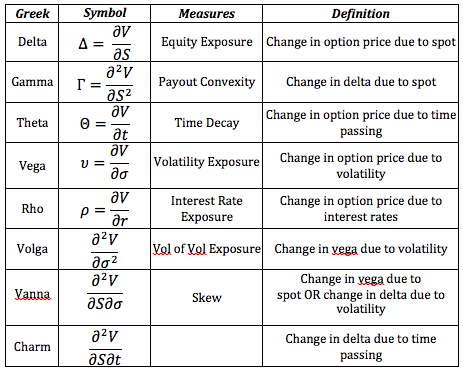
These sensitivities are not constant; they change depending on factors like how close the option is to its strike price ("moneyness") and how much time is left until expiration. The 3D plots below visualize this for Delta, Gamma, and Theta. Your software engineering background will help you appreciate these as surfaces defined by a function of two variables.

4. A Glimpse Ahead: From Definition to Calculation
Today we have focused on defining the Greeks as derivatives. As a quant developer, you will eventually need to calculate them. This is done using formulas derived from option pricing models, most famously the Black-Scholes model.
You don't need to dive deep into the math right now (we'll do that in Module 8), but it's useful to see the connection. The following article shows how the formulas for each Greek are literally the result of performing the partial derivative operations we discussed today on the Black-Scholes formula.
The article 'The Greeks with Python' by Andre Jin Nagano shows how each Greek's formula is derived. You don't need to follow all the calculus steps.
Skim through the sections for Delta, Gamma, Theta, Vega, and Rho. For each one, notice how the text defines the Greek as a partial derivative, and then a formula is presented. This reinforces the core idea of today's lesson. Also, notice the Python class at the end—this is a preview of the kind of implementation you'll be building later in this course.
Conclusion
This lesson served as a bridge between a core concept in calculus and its powerful application in finance. You've learned that derivatives are not just abstract mathematical ideas but are used every day by traders to measure and manage risk.
Key Takeaways:
- A derivative measures the instantaneous rate of change of a function. A partial derivative does this for functions with multiple inputs.
- The Greeks are the financial industry's names for the partial derivatives of an option's price with respect to key market variables.
- Delta () measures sensitivity to the underlying price.
- Gamma () is a second-order derivative that measures the rate of change of Delta.
- Theta () measures sensitivity to time (time decay).
- Vega () measures sensitivity to volatility.
- Rho () measures sensitivity to interest rates.
Preview of the Next Lesson:
We've just seen that an option's price is a function of volatility (). But what if we know the market price and want to find the volatility that the market is "implying"? We would need to solve the equation for . This is a root-finding problem. In our next lesson, "Use a numerical library (e.g., SciPy) to find the roots of a function," we will learn the numerical techniques required to solve exactly this type of problem, a critical skill for any quant.