Hello. This first module looks at grizzlies as members of the wider brown bear species, then at how landscapes and food shape their lives. We will begin with a distinction that makes the rest of the course easier to follow: “grizzly” and “brown bear” are not names for two separate species. Today you will sort out what the names mean, why bears called by different names can look different, and what appearance alone cannot tell you.
One species, several names
The scientific name Ursus arctos identifies the brown bear species, which occurs in North America, Europe, and Asia. A grizzly is a brown bear. In North America, people often call inland brown bears grizzlies and coastal ones brown bears, particularly when comparing bears with different access to marine food. That convention is useful, but it is not a boundary between species.
The National Park Service’s account of bears in Lake Clark makes this distinction concrete. It describes coastal and inland bears living in different food landscapes while noting that both belong to Ursus arctos.
Brown Bears - Lake Clark National Park & Preserve (U.S. National Park Service)
Read the National Park Service account to see how one species can acquire different everyday names and ways of feeding in neighboring habitats.
In “Brown Bear or Grizzly Bear?”, read the naming explanation. Continue into “Lake Clark's Coastal Brown Bears,” from the description beginning “Estuaries, where rivers meet the sea” through the coastal foods. Then find “Lake Clark's Inland Brown Bears” and read the inland comparison, ending with the observation that not every inland bear uses the salmon available there. Focus on which differences follow from where food is available, rather than from a change in species.
Notice a revealing detail: the park describes both its coastal and inland bears as belonging to the same named subspecies, Ursus arctos horribilis, even though it generally calls all of them brown bears. A subspecies is a proposed grouping within a species; it is not simply another word for “coastal bear” or “inland bear.” Subspecies classifications can also be disputed. For this lesson, the firm point is the species identity: the bears on either side of the coastal–inland comparison are brown bears.
This helps with names encountered elsewhere. A “Kodiak bear” is a brown bear identified with a particular island region, not a species separate from grizzlies. Brown bears in Europe and Asia also belong to Ursus arctos, though calling them “grizzlies” would not follow the usual North American naming convention. Scientific identity and everyday naming answer different questions: one identifies the species; the other often tells you something about geography or local usage.
Why bears of the same species can look different
Consider what the Lake Clark bears can obtain. Coastal estuaries bring several foods close together, including sedges, clams, berries, and seasonal salmon. Inland forests and tundra offer roots, berries, insects, small mammals, and sometimes salmon—but these foods may be farther apart or less consistently available. Both bears are omnivores. The comparison concerns the availability and importance of particular foods, not an absolute rule that coastal bears eat fish while grizzlies do not. An inland bear can eat salmon; a coastal bear can eat plants.
Rich, accessible food helps explain why coastal brown bears are often larger on average than inland grizzlies. It does not provide a reliable size test for an individual bear. Age, sex, season, local food supply, and inherited traits all matter. A smaller coastal bear and a larger inland bear remain members of the same species, regardless of whether either fits the familiar picture.
Color is no firmer a boundary. Despite the word grizzly, a grizzly need not have visibly pale-tipped fur; brown bears can have coats ranging from light to very dark. In particular, a dark coat does not make a bear an American black bear, which is a different species. The diagram below is useful for that species-level comparison—not for separating a coastal brown bear from a grizzly.
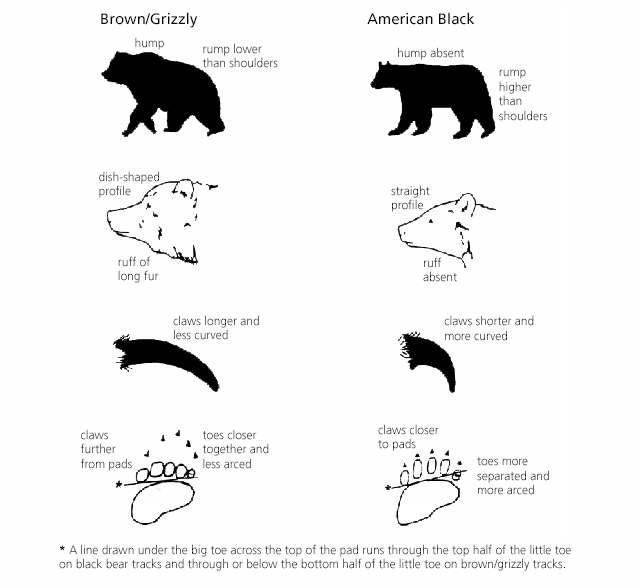
The shoulder hump, facial profile, and track features shown on the brown/grizzly side belong to the shared brown bear form. None is a special mark that a coastal brown bear loses. If you see a photograph of a large bear with a hump, its features may support identifying it as a brown bear rather than a black bear. Without information about where it lives, the photograph alone usually cannot settle which regional common name people would use.
A useful distinction, not a biological dividing line
Why not treat the typical size difference as proof that inland grizzlies and coastal brown bears are separate kinds of bear? The answer requires distinguishing a population difference from a species boundary. Populations of one species can differ in average size or food use, especially when they live under different conditions. Such differences do not, on their own, show that the populations are biologically separate.
The Alaska Department of Fish and Game account adds two pieces of evidence. It describes genetic exchange among neighboring mainland populations, including coastal and inland bears. It also explains why food alone is too simple an account of size: inherited differences and the effects of local conditions over many generations can contribute too. You do not need to resolve every subspecies debate to use that reasoning.
A Bear by Any Other Name, Alaska Department of Fish and Game
Read this Alaska Department of Fish and Game article for the evidence behind treating grizzlies and other brown bears as one species, and for a more careful explanation of size differences.
In the opening, read the taxonomy history, stopping just before “What Do Genes Have to Do With It?”. In that section, find the paragraph beginning “Populations in mainland Alaska” and read the genetic comparison; focus on the reported exchange between coastal and inland populations. Finally, in “Breeding, Feeding, and Regional Size Disparities,” read the food explanation and its limit. Continue from the paragraph beginning “As an example, consider the Brooks Range” through the local-size example. These passages are enough to follow the argument without working through every proposed subspecies designation in the article.
The resulting picture is more interesting than either “food determines everything” or “size is fixed by ancestry.” Food affects how much an individual can grow and maintain. Over generations, conditions can also favor inherited traits that work well locally. Those influences can produce noticeable regional patterns within a species. Nor should a regional average become a prediction about every bear: individual diets and bodies vary.
The same restraint applies to behavior. Food concentrated in one place may bring bears close together, while scattered food may require wider travel. That gives researchers a reason to investigate differences in how bears use space. It does not justify deciding that a particular bear is aggressive, safe, or predictable from the label “grizzly” or “coastal brown bear.” Later lessons will examine what observations of bear behavior can actually support.
Takeaway
A grizzly is a member of the brown bear species, Ursus arctos. In common North American usage, “grizzly” often points to an inland brown bear and “brown bear” to a coastal one, but the names are not a strict species distinction. Differences in food access can help explain regional differences in diet and average size, alongside inherited traits and local conditions. Coat color and body size alone cannot draw a dependable line between grizzlies and other brown bears.
Next, you will use this link between bears and their surroundings to assess whether a landscape offers suitable food, cover, denning places, and connections to other habitat.