Hello. Last lesson treated grizzly habitat as a set of seasonal opportunities: food must be available and reachable as conditions change. This lesson takes the next step. You will build a plausible diet for a bear in a particular landscape rather than memorize a universal menu. The key is to connect each food to its place, season, and accessibility—and to account for the intensified feeding that precedes winter denning.
A diet is a calendar, not a checklist
Grizzlies are omnivores: they eat plants, animals, and, at times, fungi. That description tells us what they can eat, but not what a bear in a given habitat will eat. A salmon run matters enormously to a bear with access to that river and not at all to one living far from salmon streams. Even within one landscape, a food may be abundant for a few weeks and absent for the rest of the active season.
Food quality changes too. Bears digest the sugars, starches, fats, and proteins in plants better than they digest tough plant fiber. Newly growing grasses and other tender plants can therefore be more useful than the same vegetation after it matures. Meat and fat-rich foods can be valuable, but a bear does not need to hunt large animals to feed well; scavenging and readily gathered foods may offer better opportunities.
Start with the National Park Service’s explanation of food habits in the Greater Yellowstone Ecosystem. Treat it as a worked regional example, not a diet prescribed for every grizzly.
Food Habits of Bears in the Yellowstone Ecosystem (U.S. National Park Service)
Read the National Park Service’s account to see how digestibility and the timing of available foods shape a spring diet.
In the opening passage beneath the chart, read the explanation of plant digestion and changing food availability. Then, under “Spring,” read the spring account, ending with the mention of seeds left from the previous fall. Notice the distinction between scavenged animals, vulnerable prey, and newly available plants.
After winter, a bear may encounter winter-killed animals or the remains of predators’ kills while fresh vegetation is still scarce. As green-up proceeds, tender grasses, sedges, clover, and other plants become available. These are possibilities tied to the Yellowstone setting; elsewhere, different animals or plants fill those roles. The rule for constructing a diet is to name foods supported by the specified habitat, not to copy every item from a regional list.
Plant foods have their own timetable. This shorter selection from a Montana food guide makes that progression easier to see.
Read the “Section I: Plants” overview in the Montana Fish, Wildlife & Parks guide for a closer look at how bears use plants as they become available.
On the guide’s printed p. 8, under “Section I: Plants,” begin with the plant overview; stop before the definitions. Then go to printed p. 10, “Graminoids and Forbs,” and read from the seasonal summary, stopping after the discussion of seeds gathered by squirrels. Focus on how young growth, later berries, and accessible seeds offer different feeding opportunities.
The guide describes bears following fresh plant growth across elevations. This does not mean every bear follows the same route. It means that location and timing interact: a lower meadow may green up while higher ground is still snow-covered, then a higher meadow may offer tender growth later. Roots and bulbs add another option where suitable plants and diggable ground occur.
Building an inland seasonal diet
Consider a hypothetical inland mountain landscape with elk winter range, lower meadows, higher slopes with berries, and some whitebark pine stands. Those details supply the ingredients; the calendar determines when each ingredient is plausible.
In spring, begin with what is exposed and obtainable as snow retreats. A bear could scavenge elk carcasses left by winter mortality or other predators. Fresh grasses, sedges, clover, and diggable underground plant parts become increasingly useful as growth begins. Elk calves may become available later in spring, but that does not make hunting calves every bear’s principal feeding strategy. The distinction matters: “elk” on a food list could mean a carcass, a scavenged kill, or a calf caught by a bear.
In summer, the menu broadens. Tender plants remain important where fresh growth persists; forbs and roots can supplement them. Berries enter the diet as they ripen. In some parts of Yellowstone, bears also feed on concentrated resources such as army cutworm moths or spawning trout. Those are excellent examples of why a regional account must be used carefully: neither belongs in the menu of a bear that cannot reach the relevant feeding site.
In late summer and fall, a bear can draw on ripening berries, roots, and, in a productive year, whitebark pine seeds. Bears often obtain those seeds by digging into red-squirrel caches rather than harvesting cones from treetops. An abundant seed crop cannot be assumed every year; if the crop fails, the bear must rely more on other available foods and may search elsewhere.
Read the remainder of the Yellowstone example with those qualifications in mind.
Food Habits of Bears in the Yellowstone Ecosystem (U.S. National Park Service)
Continue the National Park Service account to trace how its summer foods give way to fall foods.
Under “Summer,” read the summer account, stopping before “Fall.” Then, under “Fall,” read the fall account, stopping before “Differences in Black Bear Diets.” Pay particular attention to the qualifications about where foods occur and whether the pine seed crop is abundant.
This gives us a defensible diet for the hypothetical inland bear, but not an exact record of what it ate. We know what the landscape could offer. To claim which foods an individual actually consumed, we would need evidence about that bear and that season—a distinction the later module on interpreting bear evidence will develop.
Why feeding intensifies before denning
As winter approaches, the bear’s task is not merely to find a final meal. It needs to accumulate fat reserves that will supply energy during denning. The period of especially intense pre-denning feeding is called hyperphagia. It is an increase in food intake, not a separate kind of food: a bear may exploit berries, seeds, fish, roots, or animal foods according to what its habitat offers.
The Montana guide identifies huckleberries as an important fall food in the region it covers. Read its brief example of how a poor crop changes a bear’s options.
Return to the Montana Fish, Wildlife & Parks guide for a concrete example of a fall food whose supply varies between years.
On printed p. 68, find the “Vaccinium” entry for huckleberries and related berries. Read the fall-food passage, stopping before the photograph caption. Focus on the consequence of a poor berry year, not just the fact that bears eat berries.
In our hypothetical mountain landscape, an abundant berry crop and productive pine stands could help a bear build reserves. If both are poor in the same year, an autumn diet copied from a “normal” year would be misleading. The bear still needs energy; it may spend more effort seeking other foods or use different areas. That possibility connects diet to the secure access discussed last lesson, without implying that every food shortage produces the same movement or outcome.
A coastal river provides a contrast. The following short video shows bears using a salmon run and then introduces hyperphagia.
Grizzly Bear: The Greatest Predator South of the Arctic
Watch “Grizzly Bear: The Greatest Predator South of the Arctic” from Animalogic for a visual example of a rich food source that exists only where bears can reach spawning salmon.
Watch the salmon run for the setting and the bears’ feeding, then pre-winter feeding for the introduction to hyperphagia. Keep the location in view: the scene illustrates a coastal opportunity, not a universal grizzly diet.
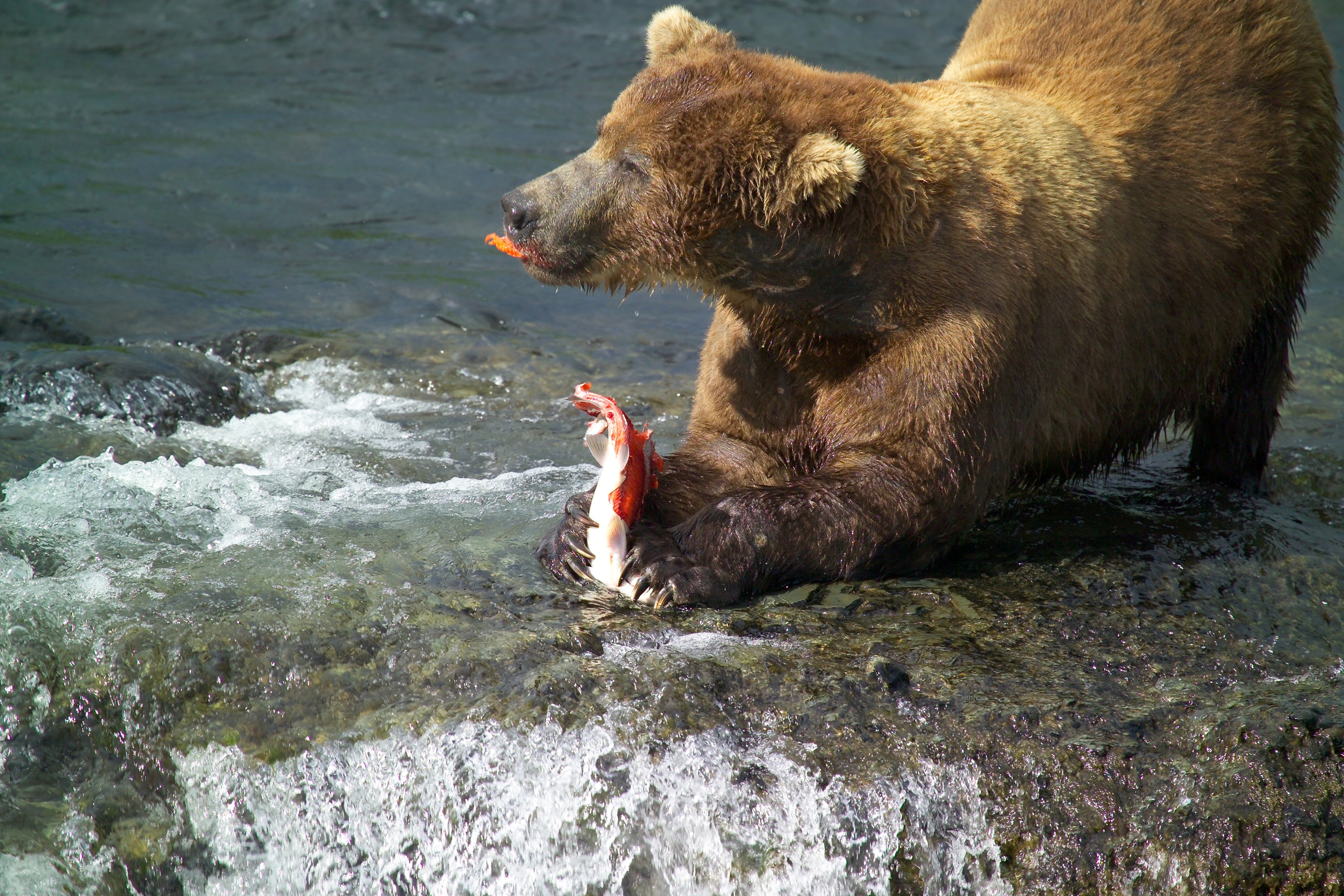
A bear with access to that run may make salmon a major part of its diet while the fish are present, particularly as it builds reserves. Outside the run, it must use other available foods. The inland bear described earlier cannot simply substitute “salmon” into its autumn menu. The same seasonal need—gaining energy before denning—can be met through different foods in different landscapes.
A practical way to construct the menu
When given a habitat description, first identify its food-bearing places: meadows, berry slopes, streams, forests with seed-producing trees, or areas where animal carcasses may occur. Next, put each food in its likely season. Finally, qualify anything that depends on a particular event: a salmon run, a productive seed year, accessible carrion, or a berry crop.
For the hypothetical inland mountain bear, the resulting account is a sequence, not a fixed shopping list. Spring offers carrion and new plant growth. Summer adds a wider range of plants and ripening berries, with local animal or insect foods if accessible. Late summer and fall emphasize obtainable energy-rich foods, including berries and pine seeds when crops permit, as feeding intensifies before denning. A bear in a coastal river habitat would need a different account that places salmon in the period when the run occurs.
That reasoning also prevents two common mistakes. One is treating a striking photograph—such as a bear catching a salmon—as a picture of the species’ everyday diet. The other is treating “omnivore” as if all possible foods were equally available throughout the year. A useful seasonal diet says not only what a bear might eat, but why that food is available then and there, and what remains uncertain.
Takeaway
A grizzly’s diet is flexible but constrained by habitat, season, and year-to-year food supply. Young plants, carrion, berries, roots, seeds, insects, and fish can all matter, but their importance depends on access and timing. Before winter denning, hyperphagia increases the urgency of obtaining enough food to build fat reserves; it does not give every bear the same autumn menu.
Next, you will examine what happens after that feeding period: how stored energy and changes in physiology support a bear through winter denning, without assuming it remains continuously asleep.