Hello! Welcome back to our module on the T-shirt bra.
In our last lesson, we defined the core purpose of a T-shirt bra: to create a perfectly smooth and invisible silhouette under fitted clothing. We identified that the key to this function lies in its molded, seamless cups and simple, smooth fabrics.
Today, we will delve into the technical details behind that seamless effect. This lesson addresses the learning outcome: Explain how molded cup construction and specific fabric choices achieve the seamless effect. We'll move from the what to the how, exploring the manufacturing processes and material science that make the T-shirt bra a masterpiece of functional design.
1. The Art of Molding: Engineering an Invisible Shape
The defining feature of a T-shirt bra is its seamless cup. Unlike traditional "cut-and-sew" bras that construct a three-dimensional cup from multiple fabric pieces stitched together, a molded bra cup starts as a single piece of material that is permanently shaped using heat and pressure.
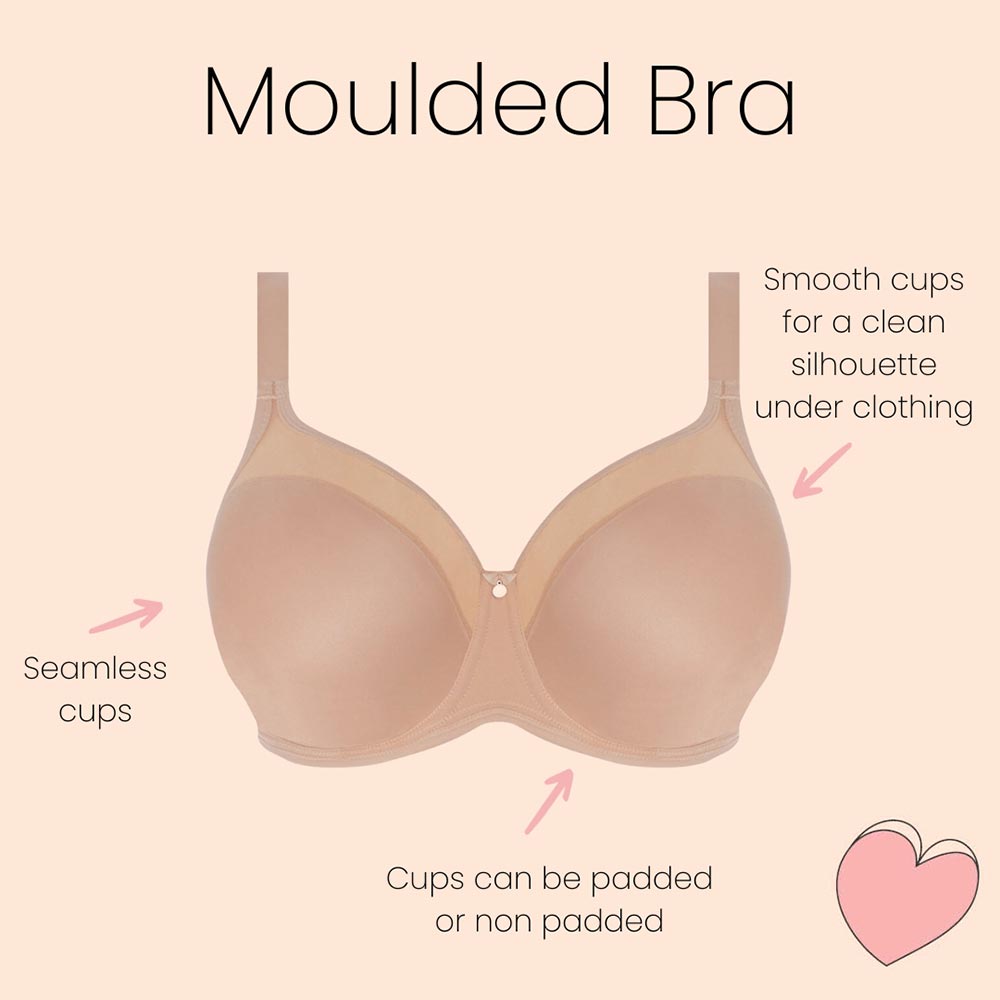
This seamless surface is precisely what prevents lines from showing through a thin knit top. But how is this shape created and made permanent?
To understand the manufacturing process, let's look at a technical explanation of heat molding.
Molding in the Intimate Apparel Industry
This material from the Hong Kong Polytechnic University explains the mechanics of the molding process, comparing it to the traditional cut-and-sew method.
Read the first section (starting with 'Traditional bras...') to grasp the basic principle of heat molding. Then, read the section under the heading 'Types of moulding process used in intimate apparel industry' to learn about the 'Contour moulding' method, which is most relevant for the padded or foam-lined cups used in T-shirt bras.
The key takeaway is that molding uses heated forms to permanently reshape fabric or foam. This process eliminates the need for structural seams on the cup's exterior, which are the primary culprits for creating texture under clothing.
A molded cup isn't just a single layer of fabric; it's often a composite structure.

2. The Right Ingredients: Material Choices for a Flawless Form
The molding process is only effective with the right materials. The choice of inner padding and outer fabric is critical for achieving the T-shirt bra's signature smooth contour, comfort, and breathability.
Let's explore the specific materials that make a T-shirt bra successful.
How Do Molded Cup Choices Shape Your Bra's Success?
This article from HAVING, a lingerie component supplier, gives an industry insider's view on how different materials and thicknesses contribute to a bra's final shape and function.
Please read the following sections: The final paragraph under 'How Does Cup Shape Define the Bust Silhouette?' to see how seamless molded cups create a smooth contour. The final paragraph under 'Does Cup Thickness Really Change the Bra's Feel and Look?' to understand why thin cups are ideal for T-shirt bras. The section 'What's Inside? How Do Materials Like Foam, Silicone, and 3D Spacer Perform?' and review the accompanying table. The FAQ entry 'What are 3D spacer cups?' at the end of the article for more detail on this innovative material.
Based on this reading, we can break down the material choices into two key categories: the inner structure and the outer fabric.
Inner Structure: The Core of the Cup
This is the material that gives the cup its permanent shape and provides modesty.
- Polyurethane (PU) Foam: This is the industry standard. It is lightweight and has excellent moldability, making it perfect for creating pre-formed cups. For T-shirt bras, a thin or medium thickness is used to create a smooth, rounded shape and provide nipple coverage without adding significant volume.
- 3D Spacer Fabric: This is a more advanced material constructed with two outer textile layers connected by "spacer yarns." This creates a cup that is exceptionally lightweight, breathable, and crush-resistant. It offers a smooth shape and support without the density or heat retention of traditional foam, making it a premium choice for comfortable T-shirt bras.
Outer Fabric: The Seamless Surface
This is the fabric that covers the molded foam or spacer material. Its properties are crucial for the final look and feel.
- Material Type: Smooth, fine-gauge knit fabrics are essential. Common choices include microfiber, jersey, or fabrics made from polyester and elastane blends. These materials have a flat, non-textured surface that glides under clothing.
- Mouldability: The fabric must be able to stretch and be heat-set into the cup's shape. As the resource from Hong Kong Polytechnic University (LINK) noted, polyester is often preferred over nylon for its superior molding properties.
- Stretch Properties: For a fabric to be molded successfully without breaking, it needs a specific degree of elasticity. From a technical standpoint, a common industry standard requires:
- Warp (lengthwise) stretch:
- Course (crosswise) stretch:
This high degree of stretch allows the fabric to conform to the mold's curve, especially at the apex (the fullest point of the cup), without tearing or distorting excessively.
In essence, the seamless effect is an engineered outcome where the molding process and material properties work in perfect harmony.
Conclusion
In this lesson, we dissected the technical elements that give the T-shirt bra its unique functionality.
Key Takeaways:
- The T-shirt bra's seamless effect is achieved through two interconnected elements: molded cup construction and specific material choices.
- Molded construction uses heat and pressure to create a pre-formed, seamless cup from a single piece of composite material, eliminating the lines and bumps of traditional seamed bras.
- Material selection is critical. A thin layer of PU foam or 3D spacer fabric provides the core shape and modesty, while a smooth outer fabric like microfiber creates the final invisible surface.
Next Up:
Now that we understand the technical construction that defines a T-shirt bra, our next lesson will explore the variety within this category. We will analyze style variations within the T-shirt bra category (e.g., full-coverage, demi-cup, wireless) and see how these core design principles are adapted.