Hello! Welcome to the third lesson in our module on Aesthetic Principles in Bra Design.
In our last lesson, we explored the surface-level elements of aesthetics: color, pattern, and texture. We saw how these choices create the immediate mood and personality of a bra. Now, we will go a layer deeper to examine an element that is simultaneously structural and decorative.
This lesson focuses on the learning outcome: Describe how seam lines and paneling can serve as both structural and decorative elements. We'll investigate how the very lines that hold a bra together are also critical for shaping the bust and creating visual appeal. This bridges the gap between the engineering of a bra and its artistry—a core concept in the technical pattern drafting you're interested in exploring.
1. From Structure to Style: The Dual Nature of a Seam
In its most basic sense, a seam is what joins two pieces of fabric. In a cut-and-sew bra, as opposed to a seamless molded one, these seams are fundamental. Their primary job is structural: to take flat pieces of fabric and create a three-dimensional cup that can shape and support breast tissue.
However, these structural lines don't exist in a vacuum. They also create powerful visual lines on the garment. The most direct way to understand this dual role is to see how a purely functional shaping element—a dart—can be transformed into a seam.
Princess Seams // How to Switch to Style Lines
This video, 'Princess Seams // How to Switch to Style Lines' by TheClosetHistorian, provides an excellent demonstration of this concept. Although it focuses on a bodice, the pattern-making principle is identical for bra cups.
Please watch the introduction (00:00 - 01:47). Pay close attention to the explanation that a 'style line' (like a princess seam) is just a dart that has been cut away and converted into a seam. This directly illustrates the dual function we're discussing.
As the video explains, a seam line can absorb the function of a dart, providing shape while also becoming a "style decision." This concept is beautifully articulated in an article from LilypaDesigns, which notes that in bra pattern adjustments, "We've just make it 'pretty' by incorporating the darts into existing seams."
This is the central idea for today's lesson: seams are the architecture of the cup, providing shape and support, while also being prominent lines that contribute to the overall aesthetic.
2. Seams in Action: Engineering the Bra Cup
The placement and orientation of seams within a bra cup are critical engineering decisions that define its function. Different seam configurations create different shapes and support profiles.
- Vertical Seams: A seam running vertically from the underwire to the top of the cup generally provides lift and forward projection. It's excellent for creating a pointed or conical shape, often seen in vintage-inspired designs.
- Horizontal Seams: A horizontal seam across the apex tends to create a rounded, natural silhouette. The lower cup panel provides lift, while the upper panel contains the tissue and completes the shape.
- Multiple Seams (3-Part or 4-Part Cups): More complex designs use multiple seams to achieve highly specific shaping. For example, a cup with a vertical seam in the lower portion and a horizontal seam above it can provide both lift and a rounded shape. A side panel, often called a powerbar or sling, is a common feature in multi-part cups designed to push breast tissue inwards, away from the underarm, for a more centered and narrow profile.

Let's look at a concrete example.
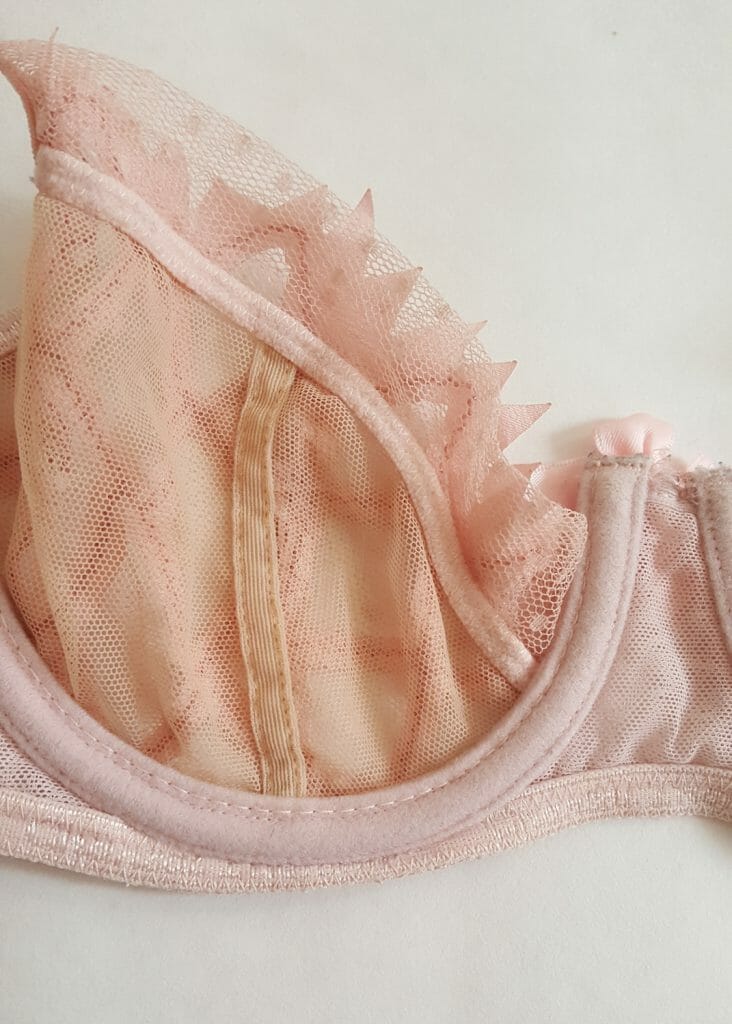
To see how these panels and seams are created from a flat pattern, let's observe a pattern drafting process.
Pattern Construction Underwire BRA (detailed) sup.1.1.5
The video 'Pattern Construction Underwire BRA (detailed)' by Katerina Ivanova offers a technical deep-dive into drafting a three-piece cup. We will watch a segment to see how the separate panels are designed to be joined by seams.
Watch the section on constructing the cup (16:31 - 28:41). You don't need to follow every measurement. Instead, focus on how three distinct pattern pieces—a lower inner cup, a lower outer cup, and an upper cup—are drafted. The lines where these pieces will be sewn together are precisely what form the structural and aesthetic seams of the final bra.
This demonstration makes it clear that seam placement is not an afterthought; it is determined at the very beginning of the design process and is integral to the bra's function.
3. Paneling for Decorative Effect
Once we accept that seams are also design lines, we can use them deliberately for aesthetic purposes. This is where the concept of paneling comes into play. By constructing a cup or band from multiple panels, you create opportunities for visual creativity.
The most common decorative uses of paneling include:
- Color-blocking: Using fabrics of different solid colors for adjacent panels. This creates bold, graphic looks and can create optical illusions to alter the perceived shape or size of the bust.
- Texture-blocking: Combining different materials, such as a smooth satin panel next to a delicate lace panel, or a sheer mesh beside an opaque microfiber. This adds depth and tactile interest.
- Creating Style Lines: As we saw with the princess seam, the seam line itself can become the main feature. A curved seam can create a sense of softness and femininity, while a sharp, angular seam can feel modern and architectural.
Let's return to the "Princess Seams" video to see this idea in practice.
Princess Seams // How to Switch to Style Lines
Now that we understand the principle, let's see how a pattern maker thinks about the aesthetic possibilities of these new seam lines.
Watch the segment from 24:51 to 27:34, where the creator drafts a style line going up to the neckline. At 27:00, listen to her comment on how this design would be 'very fun color blocked or texture blocked'. This highlights how a pattern maker immediately sees the decorative potential of structural seam lines.
This mindset is key to advanced design. You're not just creating seams to hold the bra together; you're creating a canvas of panels that can be used to tell a visual story through color, texture, and line. The seams serve their structural purpose while simultaneously becoming integral to the aesthetic composition.
Conclusion
Today, we've connected the engineering of bra construction to its aesthetic design, demonstrating that the two are inseparable.
Key Takeaways:
- Seam lines in a cut-and-sew bra are both structural and decorative. They create the three-dimensional shape of the cup while also forming visual lines that define the bra's style.
- A seam can be thought of as a "style line" that has absorbed the shaping function of a dart.
- The placement of seams is a critical design choice: vertical seams emphasize lift, horizontal seams create roundness, and angled side panels (slings/powerbars) provide centering.
- Paneling—the use of multiple seamed sections—opens up decorative possibilities like color-blocking and texture-blocking, allowing a designer to use structural lines for aesthetic expression.
Next Up:
We've now covered the foundational principles, the surface elements, and the structural lines of aesthetic design. In our final lesson for this module, we will explore the finishing touches: how hardware, trim, and decorative fabrics like lace are integrated to enhance a bra's aesthetic appeal. We'll look at how these smaller components can have a major impact on the final design.