Hello! Welcome to the first lesson in our new module, "Aesthetic Principles in Bra Design."
In the previous module, we focused on the tangible "what" of bra creation—the fabrics, findings, and materials. You learned how to formulate a "fabric recipe" to achieve specific functional goals like support or comfort. Now, we shift our focus from the physical materials to the visual language of design.
This lesson addresses the learning outcome: Apply principles of visual balance, proportion, and line to bra design. These principles are the foundational grammar of aesthetics. They govern how we arrange visual elements to create harmony, interest, and beauty. By mastering them, you'll be able to shape not just the function of a bra, but also its emotional and visual impact.
We will start by defining these core principles in the context of fashion and then apply them directly to the unique structure of a bra, analyzing how they are expressed through both decorative and structural features.
1. The Language of Visual Design
Before we can apply these principles, we need to understand what they are. In design, we distinguish between elements (the tools, like line, shape, and color) and principles (how we use those tools). This lesson focuses on three key principles: line, balance, and proportion.
To get a dynamic introduction to these concepts, let's watch a couple of short video segments.
the Elements & Principles of Design in fashion
First, let's watch a segment from Phoebe Taylor's video 'the Elements & Principles of Design in fashion'. It provides a very clear and concise explanation of what 'line' means in the context of a garment.
Please watch the section on 'Line' from 03:13 to 03:59. Notice how she identifies line in both obvious forms (like stripes) and more subtle forms (like seams and openings).
The Principles of Fashion Design
Next, this clip from 'The Principles of Fashion Design' by Catherine Sews gives an excellent overview of balance and proportion, which are often considered together.
Please watch from 01:06 to 04:15. Pay close attention to the discussion of symmetrical vs. asymmetrical balance and the concept of 'visual weight'. For proportion, note the examples of interesting (unequal) versus uninteresting (equal) ratios.
These videos give us a solid starting point:
- Line: A mark or the edge of a shape that directs the eye. In bras, this includes straps, the neckline, underband edges, and, most importantly, seam lines.
- Balance: The distribution of visual weight. It can be symmetrical (a mirror image, like most standard bras) or asymmetrical (different on each side but still visually stable).
- Proportion: The relationship between the sizes of different parts of a design. This could be the ratio of cup height to band width, or strap thickness to cup size.
2. A Deeper Look: Principles in Detail
Now let's move from the general concepts to more detailed definitions that we can apply with precision. The following resource offers a more academic breakdown of these principles.
[PDF] 3.1 Principles of Fashion Design
The document 'Principles of Fashion Design' provides a thorough exploration of our three key topics. We'll use it to understand the specific effects these principles create.
Please read the following three sections: Section (A) Proportion (pages 2-4): Start at the heading '(A) Proportion' and read to the end of that section before '(B) Balance'. Focus on the concept of pleasing versus unpleasing proportions and the introduction of the 'golden mean' as a classical guideline. Section (B) Balance (pages 4-5): Read this entire section. Note the distinction between formal (symmetrical) and informal (asymmetrical) balance. Section 3.2.2 Line and Direction (pages 30-32): Read from the heading '3.2.2 Line and Direction' up to the start of '(B) Visual Effect of Structural Lines'. This section is crucial for understanding how different types of lines—vertical, horizontal, and diagonal—create specific visual illusions.
Let's synthesize what we've learned from this reading and apply it to bras.
Line in Bra Design
As the text explains, lines have directional power:
- Vertical lines create an illusion of length and slimness. In a bra, vertical seams on a cup (common in multi-part cups) help provide lift and can make the bust appear narrower and more projected.
- Horizontal lines create an illusion of width. The strong horizontal line of a balconette bra's neckline can make shoulders appear broader and create a sense of fullness across the top of the bust.
- Diagonal lines create movement and dynamism. A plunge bra is defined by the strong diagonal lines of its neckline, which draw the eye inward and down, enhancing cleavage.
Proportion in Bra Design
The document introduces the "golden mean" (a ratio of approximately 1:1.618), a concept rooted in mathematics that is often found in aesthetically pleasing designs. While you don't need a calculator, the underlying idea is that unequal but related proportions are often more interesting than equal ones.
Consider these proportions in a bra:
- Cup to Band: A very wide, longline band creates a different proportion and overall silhouette compared to a very thin, minimal band.
- Strap Width to Cup Size: Delicate spaghetti straps on a large, full-coverage cup might look "out of proportion" and signal a lack of support, whereas a wider strap feels more balanced.
- Gore Height to Cup Width: The low, narrow gore of a plunge bra creates a very different proportional look than the tall, wide gore of a full-coverage bra.
Balance in Bra Design
Most bras are examples of formal, symmetrical balance. If you draw a line down the center gore, the left and right sides are mirror images. This creates a sense of stability and order.
Informal, asymmetrical balance is less common but can be very striking. Imagine a bra with a single decorative strap on one shoulder, or a swirl of lace that sweeps across one cup but not the other. To maintain balance, the side with more intricate detail might be smaller in area, or a bold color on one side could be balanced by a larger area of neutral color on the other.
3. Application: From Theory to Construction
These principles are not just abstract ideas; they are embedded in the very construction of a bra. The seam lines that create shape and support are the same lines that guide the eye and establish proportion.

Let's examine how these principles manifest in high-quality construction.
Inspecting Bra Craftsmanship: How to Tell If a Bra Is High Quality
The article 'Inspecting Bra Craftsmanship' explains how technical construction choices directly create the bra's aesthetic form. It bridges the gap between our abstract principles and the physical object.
Please read the sections 'What Makes a Bra “High Quality” Compared to Fast-Fashion Ones?' and 'How Do Polish Bras Showcase These High-Quality Elements?'. Focus on how 'multi-part cup construction' and 'refined wire geometry' are essentially the use of structural lines to create a specific shape, balance, and proportion.
This reading highlights a key takeaway: In bra design, structural lines are aesthetic lines. The seams in a multi-part cup are not just there to hold fabric together; they are precisely placed lines that sculpt the breast into a specific shape (e.g., rounded, lifted, projected forward). This is a perfect example of line and proportion being used to achieve a functional and aesthetic goal simultaneously.
Case Study Analysis
Let's analyze a single design using our new vocabulary.
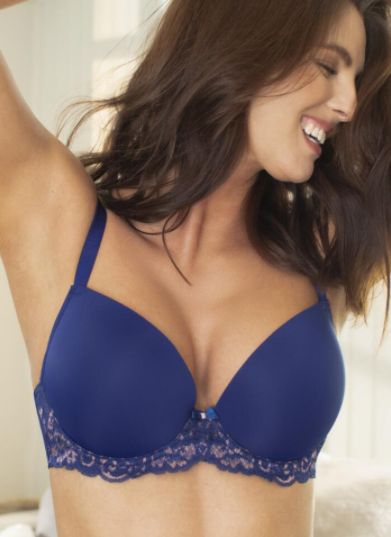
- Line: The most prominent lines are the strong diagonals forming the deep plunge neckline, designed to draw the eye and remain hidden under low-cut tops. The top edge of the cup is a gentle curved line, adding softness. The bottom edge is a decorative horizontal line created by the lace band.
- Proportion: There is a clear proportional relationship between the smooth, solid area of the cups and the delicate, detailed area of the lace band. The width of the lace band is in good proportion to the size of the cups, creating a visually pleasing foundation.
- Balance: The design is a clear example of symmetrical balance. The bow at the center gore sits directly on the axis of symmetry, emphasizing the balanced design.
Conclusion
In this lesson, you have learned to see lingerie through the eyes of a designer, moving beyond its function to analyze its visual composition.
Key Takeaways:
- Line, balance, and proportion are fundamental principles that determine a design's aesthetic success.
- In bra design, structural elements like seams and underwires are also key aesthetic lines that sculpt the body and guide the eye.
- Different bra styles are defined by their unique applications of these principles—a plunge bra uses diagonal lines, while a balconette uses horizontal lines.
- Symmetrical balance is the standard for bras, providing a sense of stability, while proportion is manipulated in the size relationships between components like the cups, band, and straps.
You are now equipped to analyze a bra's design and articulate why it looks the way it does. This skill is essential for deconstructing existing designs and for making intentional choices in your own creative work.
Next Up: We will continue exploring aesthetic principles by focusing on the surfaces of a design. The next lesson will cover how color, pattern, and texture are used to influence the look and feel of a bra, adding another layer to your design toolkit.