Welcome back! In our last lesson, we explored how the choice of a main fabric—its stretch, stability, and finish—has a direct and profound impact on a bra's support, shape, and aesthetic. We established the core principle that different parts of a bra have different jobs and therefore require fabrics with different properties.
Today, we're going deeper into the "special ingredients" that create specific functions and silhouettes. We'll be focusing on the materials that are often hidden but are essential for achieving the distinct purposes of many bra styles. This lesson directly addresses the learning outcome: Identify the functional purposes of padding, molding, and lining materials.
By the end of this session, you'll understand why a T-shirt bra is seamless, how a push-up bra creates volume, and what gives a delicate lace cup its surprising strength. This knowledge is fundamental to your goal of mastering bra design, as it empowers you to select the right internal components to achieve a specific usability goal.
1. The Role of Padding: Creating Volume and Shape
Padding refers to materials added to a bra cup to increase its size, improve its shape, or provide modesty. Its purpose is not just to add volume, but to sculpt a specific silhouette.
Let's explore the most common padding materials and their distinct functions.
Bra Material Selection: A Comprehensive Guide - Sourcing Wise
The article 'Bra Material Selection: A Comprehensive Guide' by Sourcing Wise offers a clear breakdown of the most common padding materials used in the industry and their intended purposes.
Please read the section titled 'Best materials used for Bra Padding'. As you read about foam, fiberfill, and gel, focus on the specific function each material is designed to perform—is it for structure, gentle shaping, or dramatic enhancement?
As the article explains, the choice of padding material is a key design decision:
- Foam Padding: This is the most versatile and widely used padding material.
- Function: Its primary purposes are to provide structure, create a smooth, rounded shape, and offer modesty (nipple coverage). Because it holds its own shape, it's the foundation for most T-shirt bras and molded-cup styles.
- Fiberfill: This is a soft, fluffy polyester filling, similar to what you might find in a pillow.
- Function: It provides gentle shaping and a light layer of modesty without adding significant volume or rigid structure. It's used in "lightly padded" bras where the goal is a soft, natural look.
- Gel Padding: These are silicone or oil-filled packets inserted into the cup.
- Function: Its purpose is enhancement and cleavage. Gel is heavier and mimics the weight and movement of breast tissue, creating a realistic feel and significant lift. This is a hallmark of many push-up and "enhancement" bra styles.
To see how foam padding is practically integrated into a garment, let's watch a short video. While this demonstration is for a bustier, the principles of cutting, shaping, and attaching the foam are identical for bra cups.
How To Perfectly Pad A Bustier // VERY DETAILED
The creator at Forlahstitches_ provides a very clear, step-by-step demonstration of how to work with bra foam. This will help you visualize how padding goes from a flat material to a three-dimensional shaper.
Please watch from 01:03 to 04:57. Pay attention to how the flat foam is cut to specific patterns (02:00) and how the seam allowances on the foam are trimmed after sewing (04:25) to reduce bulk. This illustrates how foam is used to build a precise shape while maintaining a smooth finish.
The video demonstrates that padding isn't just inserted; it's a structural component that is carefully patterned and integrated to build the final shape of the cup.
2. The Process of Molding: Engineering a Seamless Shape
In the last lesson, we briefly mentioned molded cups as the key to a T-shirt bra's smooth silhouette. Now, let's look at what molding actually is and the materials involved.
Molding is a manufacturing process where heat and pressure are used to permanently form a fabric or foam into a three-dimensional shape, creating a seamless cup. This is a stark contrast to the traditional "cut-and-sew" method, where multiple flat pieces of fabric are seamed together to create dimension.
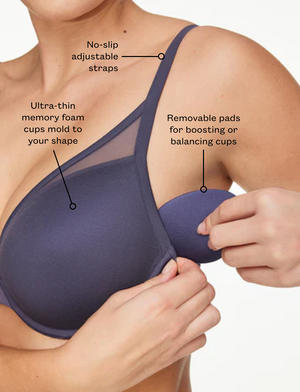
To understand the technical side of this process, we'll consult a resource from the Hong Kong Polytechnic University, a leader in textile technology.
Moulding Process in Intimate Apparel
This technical document explains the 'how' and 'why' of molding in intimate apparel. It provides a clear definition of the process and details the specific materials that are suitable for it.
Please read the following three sections: The introductory paragraph (starts 'Traditional bras are typically made...'). This explains the fundamental purpose of molding. The section titled 'Common type of mouldable pad', focusing on 'Polyurethane (PU) foams'. The section describing 'Spacer knits'.\nFocus on the advantages and functions these materials bring to a molded cup.
From this technical overview, we can identify the key functions and materials:
-
Primary Function of Molding: To create a seamless, pre-defined cup shape that is invisible under clothing and reduces bulky seams for enhanced comfort.
-
Key Moldable Materials:
- Polyurethane (PU) Foam: As we saw in the padding section, foam is a key material. In molding, its function is expanded. It is not just a filler; it is the structure. Its key properties for molding are that it is sculptable, provides support, is soft, and has excellent shape memory, meaning it will retain its molded shape after repeated wear and washing.
- Spacer Fabric: This is a high-tech alternative to solid foam. It's a 3D knit fabric with two outer layers connected by fine threads, creating a cushion of air.
- Function: Its primary purpose is to provide a highly breathable, lightweight, molded shape. Compared to foam, it offers superior air permeability, is resistant to yellowing, and is very light, making it ideal for sports bras or comfortable everyday T-shirt bras.
3. The Unsung Heroes: Lining Materials
Lining is the fabric on the inside of the bra cup or frame. While it's hidden from view, its functional role is often more important than the decorative outer fabric. A designer's choice of lining material can make the difference between a beautiful but unsupportive bra and one that is both beautiful and functional.
The primary functions of lining are:
- To add support and stability: This is the most critical function. A lining can render a delicate, stretchy lace completely stable.
- To provide comfort: A soft lining can make a scratchy outer fabric feel comfortable against the skin.
- To provide opacity: It can make a sheer fabric suitable for everyday wear.
Let's watch a video that provides an excellent comparison of two of the most common and important lining fabrics in bra-making.
Everything You Wanted to Know About Bra Tulle & Sheer Cup Lining | Emerald Erin
In 'Everything You Wanted to Know About Bra Tulle & Sheer Cup Lining', Emerald Erin Sews gives a fantastic side-by-side comparison of two essential lining fabrics, clearly explaining their different structures and, consequently, their different functions.
Please watch from 00:33 to 07:12. Pay close attention to the description of the fabric's structure (honeycomb vs. grid) and how that structure dictates its rigidity and best use in a bra (e.g., cups vs. bridge).
The video gives us a great foundation. Here’s a summary of key lining materials and their functions:
- Sheer Cup Lining (Marquisette Mesh):
- Structure: Rigid grid.
- Function: Provides maximum stability and support with virtually no stretch. It is the powerhouse of linings, perfect for the central gore (bridge) where distortion must be prevented, and for lining cups that require a very firm, non-stretch foundation.
- Bra Tulle:
- Structure: Honeycomb mesh.
- Function: Provides strong stability with a slight amount of mechanical give. It's softer than sheer cup lining, making it excellent for cups where you want firm support but a less rigid final shape. Using two layers on the bias creates firm, multi-directional support while maintaining a delicate look.
- Nylon Tricot:
- Function: A very common, stable, and smooth lining. It provides good support and a comfortable, cool feel against the skin. It’s an all-around workhorse for lining cups in cut-and-sew bras.
- Power Mesh/Power Net:
- Function: While primarily a band fabric, lighter-weight power mesh is often used to line cups where the goal is to add a degree of support while maintaining some stretch and breathability. It offers a compromise between the full stability of tricot and the stretch of the outer fabric.
Conclusion
Today we've deconstructed the internal components that are critical to a bra's function. You've learned that what's on the inside is just as important—if not more so—than what's on the outside.
Key Takeaways:
- Padding materials like foam, fiberfill, and gel are chosen to perform specific functions, from creating a smooth, structured shape to providing gentle, natural-looking volume or dramatic enhancement.
- Molding is a heat-setting process that creates seamless cups, primarily for smoothness and comfort. The key materials, PU foam and spacer fabric, are chosen for their ability to hold a shape while offering different levels of breathability and weight.
- Lining materials are the hidden workhorses of bra design. Fabrics like Sheer Cup Lining and Bra Tulle provide essential stability and support to delicate or stretchy outer fabrics, ensuring the bra can perform its structural duty.
In our next and final lesson of this module, we will synthesize everything we've learned about fabrics and materials. The learning outcome will be to select appropriate fabric and material combinations to achieve a specific design goal. We'll move from identifying materials to creating a complete "fabric recipe" for a bra, justifying each choice to achieve a desired balance of usability and aesthetics.