Hello! Welcome back.
In our last lesson, we explored the three fundamental principles of breast support: compression, encapsulation, and lift. You learned that these are the engineering strategies a bra uses to control movement and create shape.
Today, we will build directly on that foundation. Our goal is to describe the relationship between a bra's core structure and its intended function. We'll move from the abstract principles to the tangible world of design, examining how specific structural choices—the shape of a cup, the width of a band, the type of fabric—are deliberately made to fulfill a bra's purpose. This lesson will act as a bridge, connecting the principles of support to the specific bra styles you'll be designing later in the course.
The Bra as an Engineered System
Think of a bra not as a single piece of fabric, but as a system of interconnected components working together to perform a task. The effectiveness of the system depends on how well each part does its job and supports the others.
To start, let's get a quick visual overview of the main components.
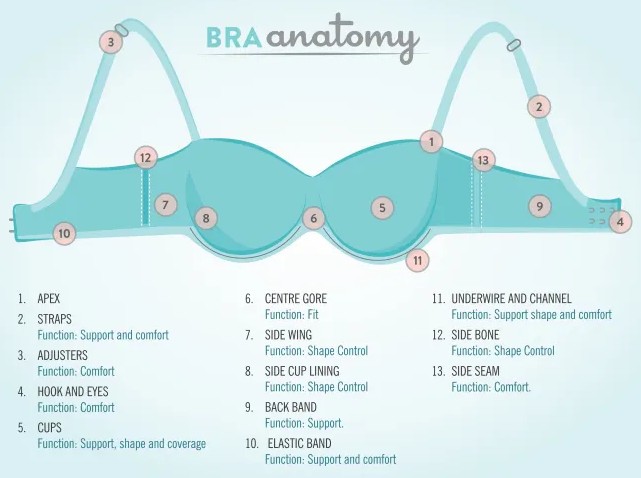
While we will dissect each of these parts in detail in our next lesson, today we'll focus on two main functional groups:
- The Foundation: The band and its related hardware.
- The Shapers: The cups and straps.
The relationship between these groups is critical. A perfectly constructed cup is useless if the band doesn't anchor it securely to the body.
The Band: The Unsung Hero
Contrary to popular belief, the straps are not the primary source of support. That job belongs to the band, which should provide around 80% of the total support. It does this through two key physical forces.
Let's read a short but insightful explanation of how this works.
Bra Physics Part 2: What Can We Learn about the Band?
The article 'Bra Physics Part 2: What Can We Learn about the Band?' breaks down the mechanics of the bra band. We will focus on the section that recaps its core function.
Please read the section titled 'Recap: How a Band Works to Support Your Breasts'. Focus on understanding how the band generates both horizontal force (tension) and vertical force (friction).
As the article explains:
- Tension in the stretched band creates a horizontal force, holding the cups firmly against your chest.
- Friction, created by the band squeezing the torso, generates a vertical, anti-gravity force that provides lift.
This is why a snug band is non-negotiable for a supportive bra. This knowledge directly informs design. For example, a wider band has more surface area, which increases the potential for friction and distributes pressure more comfortably. This is why bras designed for larger cup sizes or higher support often feature wider bands or a "leotard back" (also called a U-back), where the straps are set more centrally to keep the band wide and prevent it from bunching up.
Cups and Straps: The Shapers and Lifters
If the band is the foundation, the cups and straps are the components that execute the principles of encapsulation and lift. Their structure and materials dictate the final shape and level of control.
This next reading explains how material choice and strap design directly impact function.
Bra Physics 4 - What can we learn about the cups and straps?
The final part of the 'Bra Physics' series discusses the cups and straps. It offers clear explanations of how their design influences support and comfort.
Please read the following two sections: 'Straps - How should they be designed and why?': Note the functional differences between wide vs. narrow straps and elastic vs. fabric straps. 'Cup Materials': Pay attention to how rigid fabrics, stretchy materials, and foam each produce a different outcome in terms of shape and support.
From this, we can draw some direct structure-to-function conclusions:
- Strap Structure: Wider straps distribute weight over a larger area, increasing comfort. Rigid (fabric) straps reduce bounce but can restrict movement, while elastic straps allow movement but can contribute to oscillation.
- Cup Material: A rigid, non-stretch fabric like Duoplex will force the breast into the shape of the cup (strong encapsulation). A stretch lace will conform to the shape of the breast, offering less shaping power but more fit flexibility. Foam provides a fixed, molded shape and is great for hiding nipples, but its thickness makes it less adaptable to the breast's natural form.
Your choice of materials is not just an aesthetic one; it is a primary structural decision that defines the bra's function.
Case Studies: How Structure Defines Style
Now, let's see how different combinations of these structural elements result in the distinct bra styles you'll be designing. We'll watch a series of short clips that introduce different bra types. For each one, focus on the visual cues and how they relate to the bra's likely purpose.
We'll begin with a style whose very name describes its function: the T-shirt bra. Fashion illustrator Zoe Hong provides a concise overview in her video 'Fashion Vocabulary: Lingerie'.
Please watch the segment on the T-shirt bra from 01:46 to 01:54. Listen for the key structural characteristic.
- The T-shirt Bra (Function: Invisibility)
- Structure: Smooth, seamless, often molded cups with no external seams, lace, or embroidery.
- Relationship: The seamless structure directly achieves the function of being invisible under form-fitting clothing. This design prioritizes a smooth silhouette over decorative complexity.
Now, let's look at a style designed for a more dramatic effect.
Next, let's look at the push-up bra, a style that's all about creating a specific silhouette.
Watch the clip from 11:56 to 12:13. Note how the description links the structure to the outcome.
- The Push-Up Bra (Function: Volume and Cleavage)
- Structure: Angled cups containing graduated padding that is thickest at the bottom and outer sides.
- Relationship: This specific padding placement is the structure that performs the function of pushing the breasts upwards and inwards, achieving the principles of lift and creating cleavage.
What if the goal is to accommodate a specific type of clothing, like a low-cut dress?
The plunge bra is a brilliant piece of engineering designed for deep necklines.
Watch the segment from 12:37 to 13:09. Focus on the key structural feature mentioned: the band.
- The Plunge Bra (Function: Wear with Deep Necklines)
- Structure: A very low, narrow central gore (the piece connecting the cups). The cups are also angled away from the center.
- Relationship: The low gore is the essential structure that allows the bra to remain hidden. The angled cups provide containment, preventing spillage while still creating separation.
Finally, let's consider a style where the structure is intentionally minimal.
The triangle bra, especially common in swimwear and bralettes, takes a minimalist approach.
Watch from 13:09 to 13:36. Notice the description of its structure and level of support.
- The Triangle Bra (Function: Minimalist Aesthetic and Coverage)
- Structure: Simple triangular fabric panels for cups, with minimal to no internal construction (no underwire, light seams).
- Relationship: The simple structure provides basic coverage and a natural shape, but offers very little active support or lift. Its function is primarily aesthetic, prioritizing a "less is more" look. This is a perfect example of form being dictated by a specific, minimalist function.
Conclusion
Today we've established a crucial link in your design knowledge: a bra's function is not magic, but a direct consequence of its physical structure. Every design decision, from the width of a band to the seams in a cup, serves a purpose.
Key Takeaways:
- A bra is an engineered system where the band provides the foundational support through tension and friction.
- Cups and straps are the "shapers," using principles of encapsulation and lift to control and position breast tissue.
- Material properties (stretch, recovery, rigidity) are a core part of a bra's structure and are critical to its function.
- Distinct bra styles (plunge, push-up, T-shirt) are defined by specific structural modifications (e.g., low gore, angled padding, seamless cups) that enable their unique purpose.
You are now able to look at a bra and begin to analyze why it was made that way. In our next lesson, we will formalize this knowledge by identifying the core structural components of a bra—the band, cups, straps, gore, and closure—and detailing the specific role each one plays in the system.