Hello and welcome back to your course on bra design.
In our last lesson, we established the link between a bra's structure and its function, seeing how different styles like the plunge or push-up bra are engineered for a specific purpose. You learned to think of a bra as a system where parts work together to achieve a goal.
Today, we will zoom in on the individual parts of that system. The learning outcome for this lesson is to identify the core structural components of a bra: band, cups, straps, gore, and closure. Think of this as learning the essential vocabulary of bra anatomy. Mastering this terminology is a non-negotiable step for any designer, as it allows for precise communication and a deeper understanding of construction.
A Visual Map of Bra Anatomy
Before we break down each component, let's look at the overall structure. Just like a map, a diagram of a bra helps you see where everything is located and how the parts relate to one another.
Here are two different illustrations of a bra's anatomy. The first is a line drawing that provides a clean, schematic view, and the second is a photograph of an actual bra with its components labeled.

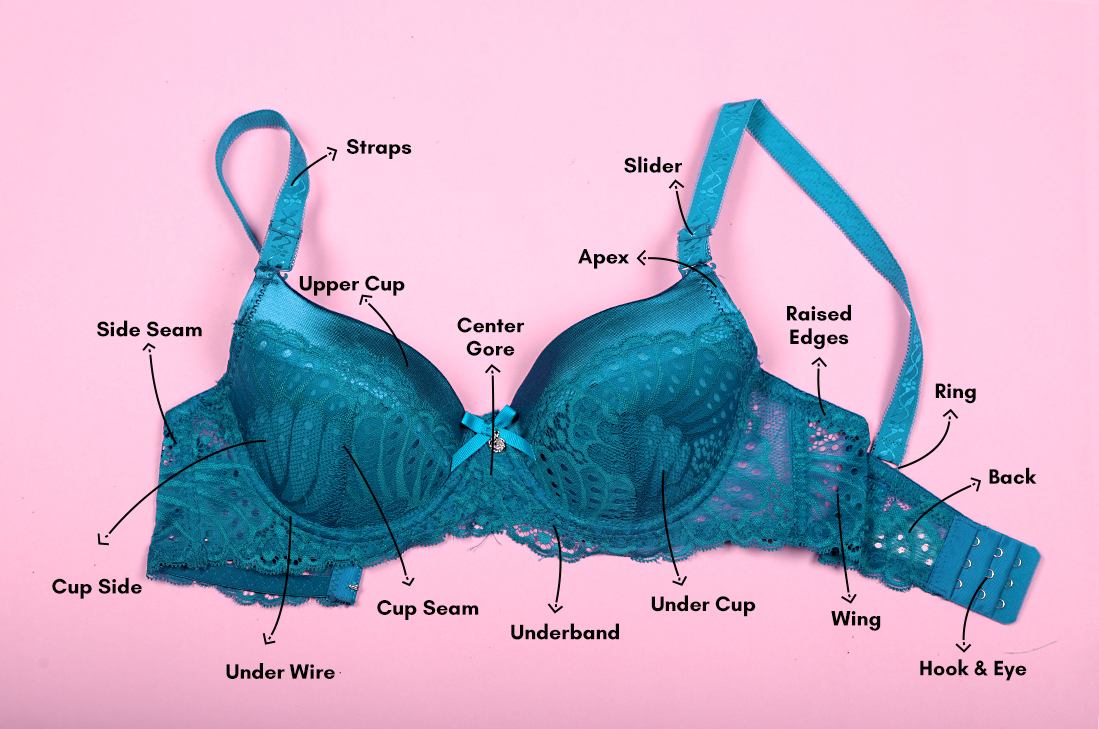
Take a moment to study these images and familiarize yourself with the names and locations of the different parts. You'll notice terms like "band," "cup," "strap," "gore," and "hook & eye," which are the five core components we will explore now.
The Core Components of a Bra
We will now go through each of the five main components. For each one, a short video clip will provide a clear visual identification, which we'll then supplement with some key details for a designer's perspective.
1. The Band (and Wings)
The band is the part that wraps around the torso. As we discussed in the last lesson, it's the primary source of support. The sections of the band that extend from the outer side of the cups to the back closure are often called the wings.
Let's watch a quick clip that identifies the band.
Anatomy of a bra | Bra terminology and fit tips
The video 'Anatomy of a bra' by Victoria Skye provides a clear introduction to each component. We'll start with the segment on the band.
Watch from 00:44 to 01:03. The presenter will point out the band and explain its relationship to bra size.
From a design standpoint, it's crucial to remember that the band is the foundation of the entire garment. An article from Interior B Studio, written for designers, reinforces this point.
Anatomy of a Bra: Terminology Every Designer Needs to Know
The article 'Anatomy of a Bra: Terminology Every Designer Needs to Know' reinforces the band's critical role. Let's read the short section on the band.
Please read the paragraph under the heading 'BAND'. Note how it explicitly states that the band, not the straps, is primarily responsible for support.
2. The Cups
The cups are the parts of the bra that enclose and shape the breast tissue. Their design, including the seams, material, and whether they contain an underwire, dictates the silhouette the bra will create.
This next clip will identify the cups and touch on how their shape varies.
Anatomy of a bra | Bra terminology and fit tips
Let's return to the 'Anatomy of a bra' video to look at the cups.
Watch from 02:55 to 03:25. Notice the different examples of cup shapes shown (demi, plunge, full coverage).
For a designer, the construction of the cup is where much of the artistry lies. The seams within a cup are not just for holding fabric together; they are powerful shaping tools.
To explore this further, let's read a section from an article on the Seamwork blog, which is aimed at those who sew lingerie.
The article 'Anatomy of a Bra' from Seamwork offers excellent technical insight into cup construction.
Read the section under the heading 'Cups'. Focus on the explanation of how seam lines and fabric stretch direction are used to shape the breast tissue. This is a key technical concept in bra drafting.
3. The Straps
The straps run from the top of the cups over the shoulders to connect to the band at the back. While they seem prominent, their main job is positioning, not heavy lifting.
Let's watch the video segment on straps.
Anatomy of a bra | Bra terminology and fit tips
Now, let's identify the straps in the 'Anatomy of a bra' video.
Watch from 05:53 to 06:17. The key takeaway here is the strap's primary job: to stay up and hold the bra in the correct vertical position.
Straps often include hardware like rings and sliders (as seen in the diagrams) to allow for adjustability. They can be made of simple elastic or be more decorative, non-stretch fabric at the front.
4. The Gore (or Bridge)
The gore is the small panel of fabric at the center front of the bra that connects the two cups. It's also frequently called the bridge or center gore. Its main role is to separate the breasts and allow the bra to sit flat against the sternum.
This clip identifies the gore and its function.
Anatomy of a bra | Bra terminology and fit tips
The 'Anatomy of a bra' video explains the gore, also known as the bridge.
Watch from 04:07 to 04:32. Notice how the presenter points out that the gore should lie flat against your chest for a proper fit.
The height and width of the gore are critical design features. A high, wide gore provides more separation and support, typical in a full-coverage bra. A very low, narrow gore is the defining feature of a plunge bra, which we'll study in a future module.
5. The Closure
The closure is the hardware that fastens the bra at the back (or occasionally the front). The most common type is a hook and eye closure, which typically features multiple columns of eyes to allow for adjustment as the band's elastic relaxes over time.
Let's look at the final video segment on closures.
Anatomy of a bra | Bra terminology and fit tips
Finally, let's identify the closure system on a bra.
Watch from 04:57 to 05:25. Pay attention to the explanation of why there are multiple columns of hooks—it's to extend the life of the bra.
The closure, along with the rings and sliders on the straps, is part of the broader category of bra hardware. These small components are essential for the bra's function, adjustability, and longevity.
Conclusion
In this lesson, you have learned to identify the five fundamental building blocks of a bra. This anatomical knowledge is the bedrock upon which all your future design decisions will be built.
Key Takeaways:
- A bra is constructed from five core components: the band, cups, straps, gore, and closure.
- The band (including the wings) is the foundation, wrapping around the torso to provide the majority of the support.
- The cups are responsible for containing and shaping the breast tissue. Their internal structure (seams, fabric choice) is key to their function.
- The straps primarily serve to position the bra vertically on the body and are not the main source of lift.
- The gore (or bridge) is the center panel that separates the cups and anchors the bra against the sternum.
- The closure (most often a hook and eye) fastens the band and provides adjustability.
You are now equipped with the correct terminology to deconstruct and discuss any bra design. In our next lesson, we will expand on this foundation by explaining the functional role of each component in providing support, shaping, and comfort in greater detail.