Hello and welcome back to your course on bra design.
In our last lesson, we established the functional roles of each bra component. We learned that the underwire acts like a suspension bridge, expertly transferring the downward force of the breast's weight outward to the stable anchor of the band.
Today, we will build directly on that concept. Our learning outcome is to describe how underwire shape and placement impact support and silhouette. We'll move from knowing that the underwire provides support to understanding how designers manipulate its geometry and position to achieve specific functional and aesthetic goals. This knowledge is fundamental to creating bras that are both effective in their purpose (usability) and visually appealing.
The Underwire as a Design Tool
Before we dive into specifics, it's crucial to grasp the core concept of what an underwire represents in design. It is not merely a piece of metal; it is the foundational curve upon which a bra's shape is built.
A great way to think about it comes from the article "Bra Underwires 101." It describes an underwire as an "artificial, idealised, regularised form of the breast root." This idea is central to our lesson today.
Bra Underwires 101: A Basic Guide
Let's start by reading a brief section from the article 'Bra Underwires 101: A Basic Guide' on The Lingerie Addict. It provides an excellent conceptual framework for the underwire's role.
Please read the first three subsections, starting from 'What are underwires?' and ending just before 'The 3 Main Types of Underwires.' Focus on the idea that the underwire's main function is to contain the breast and push it into a specific shape.
As the article explains, the underwire works with the bra's fabric to create a cantilever system that lifts and shapes the breast. The shape of the wire itself is the primary determinant of the final silhouette.
How Underwire Shape Creates Silhouette
Different bra styles are defined, in large part, by the shape of the underwire they use. There are a few key shapes that correspond to the main categories of bras.
Bra Underwires 101: A Basic Guide
Now, let's explore the primary underwire shapes and the bra styles they are used for. We will continue with the same article.
Please read the section 'The 3 Main Types of Underwires.' Pay attention to the description of each wire's shape (J-shape, banana, deep U) and the silhouette it's designed to create (everyday, cleavage, strapless support).
To visualize these differences, examine the image below, which shows the three archetypal wire shapes.
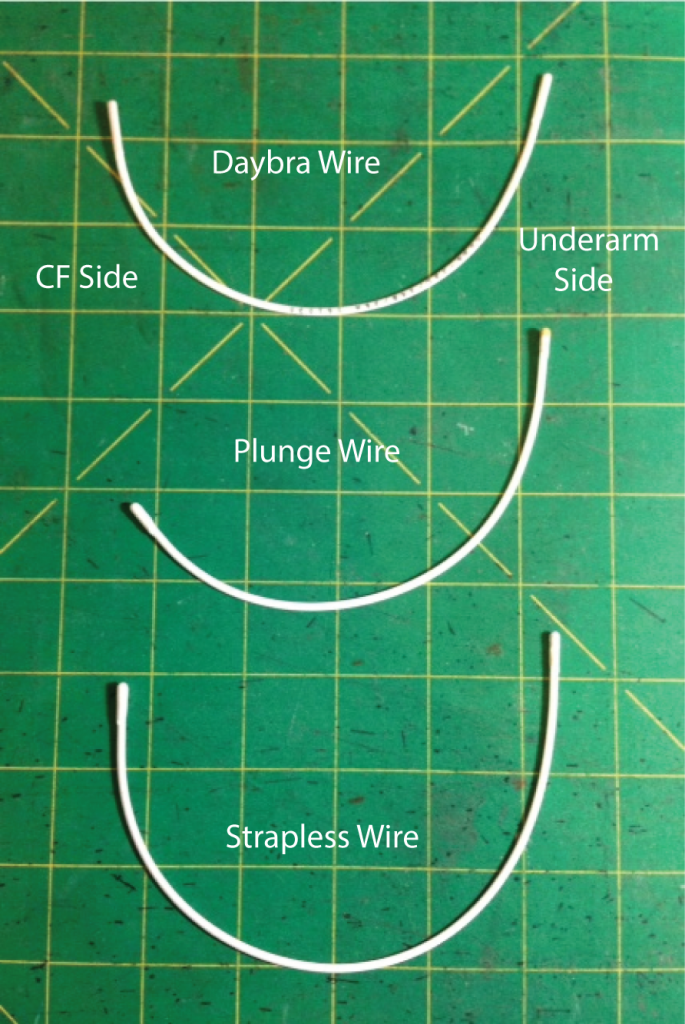
Beyond these three basic types, there exists a wide variety of more specialized wire shapes, each designed to solve a particular fitting or shaping challenge.
A Brief Explanation of the Differences Between Underwire Styles by Porcelynne
The video 'A Brief Explanation of the Differences Between Underwire Styles' by Porcelynne offers a great look at this variety. It shows how subtle changes in wire geometry can have a significant impact.
Please watch from 02:26 to 07:15. As you watch, notice how the presenter compares different wires and explains their purpose: Regular vs. Vertical: How a narrower, taller 'vertical' wire is better for larger cups. Vertical Variations: How shorter or taller vertical wires accommodate different torso heights. Demi Wire: How its curved shape is used for low-front designs and to create cleavage.
As you can see, selecting an underwire is a critical design decision. The choice dictates the bra's fundamental purpose, from the everyday support of a balconette to the dramatic cleavage of a plunge.
The Critical Importance of Placement
Choosing the right wire shape is only half the battle. Its placement on the body is equally, if not more, important for both support and comfort. The rule is simple: the underwire must perfectly trace the root of the breast, where the breast tissue joins the chest wall. It should not sit on top of breast tissue, nor should it sit too far away from it.
When placement is wrong, the bra's entire support structure is compromised.

A blog post from "Hugs for Your Jugs" explains the specific consequences of poor wire fit with excellent clarity.
Are You Overfitting Your Wires? A look at breast root anatomy
To understand the consequences of improper placement, let's read a section from 'Are You Overfitting Your Wires? A look at breast root anatomy.'
Read the section that begins with 'A wire that is too wide...' and ends with '...it feels comfortable.' It details the negative effects of wires that are too wide, tall, narrow, or short, linking placement issues directly to failures in support, comfort, and aesthetics (like wrinkled cups).
Translating Placement to the Pattern
This correct placement must be translated from the three-dimensional body to the two-dimensional pattern. A crucial detail that hobbyists often miss is that an underwire is never flat when worn; it is under tension, or in a "stressed position." This must be accounted for during pattern drafting.
Pattern Construction Underwire BRA (detailed) sup.1.1.5
This video on pattern construction for an underwire bra shows this principle in practice. It's a key step in turning a wire into a well-fitting bra.
Watch from 03:46 to 04:42. Observe how the pattern maker first traces the wire in its resting state, then stretches it to its 'stressed position' before marking the final pattern line. This slight outward stretch mimics how the wire will sit on the body when pulled taut by the band.
This small adjustment is vital. It ensures the finished bra has the correct tension to pull the wire perfectly into the breast root, providing the intended support and silhouette.
Synthesizing Shape and Placement for Optimal Support
Ultimately, shape and placement work together. A taller wire, for instance, provides a larger area to anchor the cup fabric. When placed correctly, this allows for better support, especially for larger busts, because it transfers the breast's weight more effectively to the band.
Are You Overfitting Your Wires? A look at breast root anatomy
Let's return to the 'Hugs for Your Jugs' article for a final point that synthesizes these ideas.
Please read the section titled 'Wire height is crucial for large bust support.' This section explains how the wire acts as an anchoring point and why a taller wire can provide better support by distributing forces more effectively, preventing strain on the straps.
This brings us full circle. The underwire is not passive; it is an active component that, through its specific shape and precise placement, directs forces and sculpts tissue to achieve the designer's intended goal.
Conclusion
In this lesson, we have explored the nuanced role of the underwire as a primary tool for shaping and support in bra design.
Key Takeaways:
- Underwires as Molds: An underwire is an idealized form of the breast root, used to contain and shape the breast into a specific silhouette.
- Shape Dictates Function: The main underwire shapes—balconette (J-shape), plunge (banana-shape), and strapless (U-shape)—directly correspond to the functional purpose of different bra styles.
- Placement is Paramount: For an underwire to function correctly, it must be placed perfectly along the breast root, neither on the breast tissue nor too far below it.
- Consequences of Poor Fit: Incorrect wire placement leads to discomfort, instability, loss of support, and a poor aesthetic result.
- Design for Tension: In pattern drafting, the underwire must be traced in its "stressed position" to account for the tension it will be under when worn.
In our previous lessons, we identified the bra's components and their functions. Today, we've gone deeper into the engineering of the most critical structural element. In our next lesson, we will address the system used to standardize these components for production and fitting: the numerical relationship between band size, cup size, and sister sizing.