Hello! Welcome back to our course on bra design.
In our last lesson, we examined how the underwire's shape and placement are engineered to transfer the weight of the breast to the bra's structure. We established that the underwire acts as a conduit, directing forces to a stable anchor. Today, we focus on that anchor.
Our learning outcome is to explain how the band provides the majority of a bra's support. This is perhaps the single most important—and most commonly misunderstood—principle in bra design. While many assume the straps do the heavy lifting, the reality is that a well-designed bra functions because of its band. Understanding this principle is the foundation for creating bras that are both comfortable and effective.
The Myth of the Straps
A common fitting issue, slipping straps, is often a symptom of a larger problem: a band that isn't doing its job. A well-fitting bra should adhere to a principle often cited by fit experts: the band provides 80-90% of the support, while the straps handle the remaining 10-20%, mostly to keep the top of the cup flush against the body.
Let's watch a short video that makes this point very clearly and introduces a simple test to check a band's effectiveness.
Why Are My Bra Straps Slipping? - HerRoom
This video from HerRoom explains why the band, not the straps, is the primary source of support and demonstrates the consequences of a poorly fitted band.
Please watch from 00:22 to 01:06. Pay close attention to the 'strap test' and the explanation of what happens when a band is too loose.
As the video demonstrates, if a bra cannot stay up without its straps, the band is not providing adequate support. The bra is failing at its fundamental purpose. This happens because a loose band rides up the back, causing the entire structure to tilt forward and lose its supportive tension.
The Physics of Band Support
So, how does the band accomplish this feat of engineering? The support it provides is not simply a matter of being tight; it's a function of two key physical forces: tension and friction.
An excellent blog post, "Bra Physics Part 2: What Can We Learn about the Band?", breaks this down. We'll read the first part to understand the core mechanism.
Bra Physics Part 2: What Can We Learn about the Band?
Let's read a section from 'Bra Physics Part 2' by Hugs for Your Jugs. This will introduce the two types of forces the band uses to provide support.
Please read the section titled 'Recap: How a Band Works to Support Your Breasts'. Focus on how the band generates both horizontal force (tension) and vertical force (friction).
To summarize the key points from the reading:
-
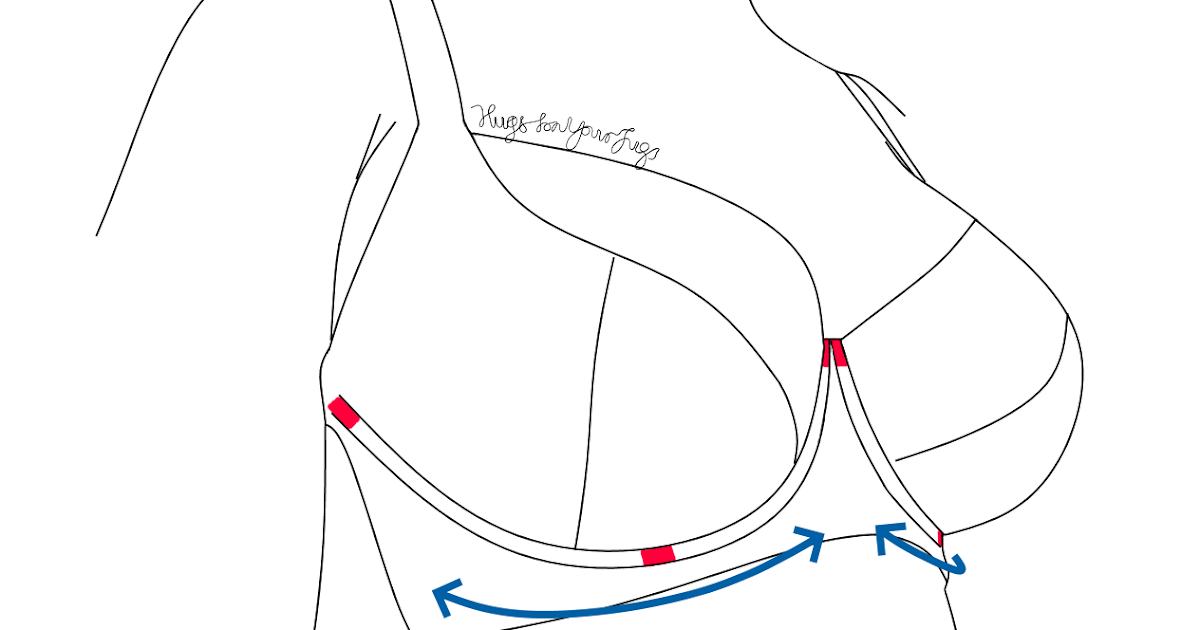
Horizontal Force (Tension): A bra band is cut shorter than the torso's circumference. When worn, it stretches. This stretch creates tension, an inward-pulling force that holds the entire bra structure—the cups and underwires—firmly against the chest. This is what provides containment and initial shaping.
-
Vertical Force (Friction): The tension-filled band squeezes the torso. According to Newton's third law, the torso pushes back with an equal and opposite force, called a normal force. The vertical support, or "lift," is generated by the friction between the band and the skin. The amount of friction is directly proportional to the normal force—in simpler terms, the snugger the band (more tension), the more friction is generated, and the better it can defy gravity.
The image below, from the article you just read, illustrates this concept. The band acts as a cantilevered system, where the tension (blue arrows) anchors the structure horizontally, allowing it to support the vertical weight of the breasts.
From Physics to Fabric: Stress and Strain
Given your background in statistics, you'll appreciate that the relationship between how much a fabric stretches and the force it exerts is not arbitrary. This brings us to the engineering concepts of stress and strain, which are critical for selecting the right materials for a band.
- Strain is the amount a material stretches relative to its original length.
- Stress is the internal force within the material that resists that stretching.
For a bra band to be supportive, it must be made from a material that generates high stress (strong resistance) at a relatively low strain (not too much stretch). This is why a simple jersey fabric, while stretchy, makes for a poor bra band—it doesn't provide enough resistance.
Let's go back to the "Bra Physics" article to explore how these concepts apply to fabric choice.
Bra Physics Part 2: What Can We Learn about the Band?
This next section from the same article explains the crucial link between the physical principles of stress and strain and the practical fabric properties of stretch, recovery, and creep. This is key to understanding why certain fabrics are used for bands.
Please read the sections 'Stress and Strain' and 'How Stress and Strain Relate to Stretch and Recovery'. Focus on understanding the difference between elastic and plastic deformation, and why 'recovery' and resistance to 'creep' are more important than just the stretch percentage.
The key takeaway for a designer is that a band fabric must have excellent elastic recovery. It needs to stretch and then powerfully return to its original shape. Fabrics that stretch out permanently (plastic deformation) or slowly lengthen under tension over time (creep) will quickly lose their supportive ability. This is why powermesh, with its high elastane content, is a go-to fabric for bra bands.
Practical Design Considerations
Understanding the physics allows us to make informed design choices. A supportive band isn't just about choosing the right fabric; it's about how you use it.
The following video demonstrates the real-world difference a well-fitted band makes, reinforcing the principles we've discussed.
How To Find The Best Fitting Bra For Your Body | This Morning
In this clip from the show 'This Morning', a lingerie expert demonstrates the dramatic improvement in support when a model switches to a bra with a correctly sized band.
Watch the two segments from 02:37 to 03:20 and from 06:54 to 08:08. Notice the visual difference in lift and silhouette. The expert explicitly states that straps only provide about 10% of the support and emphasizes the 'band down, cup up' rule to achieve a snugger, more supportive fit.
The "band down, cup up" concept is a direct application of our topic: prioritizing a firm band fit over everything else.
To bring this all together, let's look at some specific design decisions that influence a band's effectiveness, drawn from our main resource.
Bra Physics Part 2: What Can We Learn about the Band?
Finally, let's read the section on practical design choices that enhance a band's supportive function.
Read the section 'Band Design Considerations'. Pay attention to how designers can manipulate band width, use U-backs (leotard backs), and apply elastic to improve support.
Here are the key design levers you can pull:
- Band Width: A wider band has a larger cross-sectional area, which increases its ability to resist strain and distribute pressure more evenly. For more support, design a wider band.
- Band Shape: A U-shaped or "leotard" back maintains its width closer to the closure. This design helps prevent the band from bunching up and ensures the tension is distributed across a wider area, maximizing friction and support.
- Reinforcement: For very stretchy fabrics, lining the band with a more stable fabric can increase its supportive power. Side boning can also help the band maintain its vertical height and prevent it from rolling or bunching.
Conclusion
In this lesson, we deconstructed the mechanics of bra support, shifting the focus from the straps to its true foundation: the band.
Key Takeaways:
- The band provides approximately 80-90% of a bra's total support.
- It functions through two physical forces: tension (horizontal force) which holds the bra against the body, and friction (vertical force) which prevents it from sliding down.
- Effective band fabrics require high elastic recovery and resistance to creep, not just a high stretch percentage.
- Design choices like increasing band width and using a U-back shape directly enhance the band's supportive capabilities by maximizing tension and the area over which friction can act.
You now understand that the band is the primary support and how it works from both a physics and materials perspective. In our next lesson, we will explore the system used to standardize this crucial component: explaining the numerical relationship between band size, cup size, and sister sizing. This will connect the theory of band support to the practical world of garment sizing.