In our last lesson, we demystified the flow of money between freight forwarding agents, distinguishing between 'Freight Prepaid' and 'Freight Collect' shipments and decoding the debit and credit notes used for settlement. You now understand the financial conversation that was happening behind the scenes when you received an "accounting note" from an overseas agent.
This lesson addresses the critical action you took next: using a "Pricing Tariff" to verify those charges. We will dissect what a tariff is, how to use it to validate incoming costs, and how this simple act of verification is the cornerstone of calculating a shipment's profitability. This will fully illuminate the business logic behind the final step of your previous workflow.
By the end of this lesson, you will be able to apply a Pricing Tariff to validate agent charges and calculate the profitability of a shipment, connecting your data entry tasks directly to the company's bottom line.
1. The Financial Blueprint: From Revenue to Profit
Before diving into the tariff itself, it's crucial to understand why verifying charges is so important. For a freight forwarder, profitability isn't an accident; it's the result of carefully managing the gap between what you charge the customer (revenue) and what you pay your suppliers (costs).
Take a look at this illustrative Profit & Loss (P&L) structure for a typical freight forwarder.

The largest expense, labeled "Cost of Sales," is what your company pays to third parties—ocean carriers, airlines, and other agents—to move the cargo. Your role in verifying accounting notes was to be the gatekeeper for this massive cost category.
A Pricing Tariff, in the context of your work, is your company's internal master list of these costs. It's the "buy rate" sheet that outlines the agreed-upon prices your company pays its global partners for various services. When you cross-checked a debit note from an agent, you were performing a vital function: ensuring the "Cost of Sales" for that shipment was accurate and matched your company's agreements. Any error you missed would directly shrink the "Gross Profit."
2. Anatomy of a Tariff: The Building Blocks of Cost
A pricing tariff isn't a single number; it's a detailed menu of potential charges. The debit note you received from an agent would have itemized charges that you needed to compare against this menu. These charges can be numerous and complex.
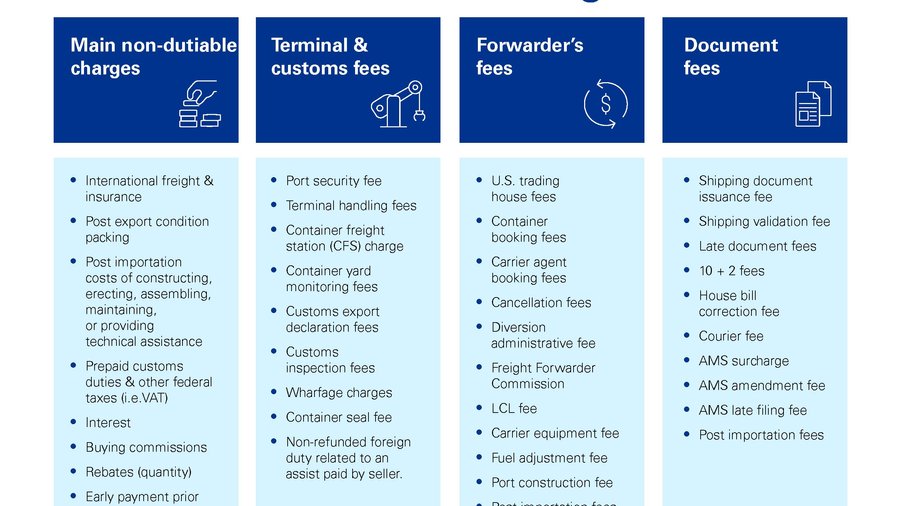
To understand how these costs are structured within a tariff and how they contribute to the total cost of a shipment, let's look at a breakdown.
NuevaFlo · How to Calculate Shipment Profitability
This article from NuevaFlo provides an excellent breakdown of the various costs involved in a shipment, which are the very components that make up a pricing tariff.
Please read the section titled The Components of Cost. Pay close attention to how costs are grouped into Origin, Freight, and Destination categories. This structure is how forwarders think about building a quote and auditing costs.
As you can see, a shipment's total cost is an accumulation of many smaller fees. To properly validate them, you need to understand not just the agreed price but also the basis of the calculation. For LCL and air freight, this often involves "chargeable weight." The video below explains this fundamental concept, which justifies why you had to enter not just weight but also dimensions into your ERP system.
How To Calculate Freight Rates - For Beginner Freight Forwarders
This video from ABTS® clearly explains the core calculations for LCL and air freight rates that every forwarder must know.
First, watch the segment on LCL rates from weight measure (WM). This explains the "whichever is greater" logic between weight and volume. Then, watch the explanation of air freight chargeable weight, which introduces the volumetric formula.
Understanding these calculations is the key to validating the core freight charges on a debit note. If an agent's calculation of chargeable weight was wrong, the entire freight cost would be inflated, and it was your job to catch that.
3. The Act of Validation: From "Cross-Checking" to Reconciliation
Your task of "cross-checking" is formally known in the industry as freight bill reconciliation. It's a systematic audit to catch billing errors before they are paid. You were not just matching numbers; you were comparing three sources of truth:
- The Agent's Debit Note: What they claim you owe.
- The Pricing Tariff: What you agreed to pay.
- The Shipment Data in Your ERP: The actual details of the shipment (weight, dimensions, container type, etc.).
When these three sources don't align, there's a discrepancy that needs to be investigated. This is where your work provided immense value.
This article from CloudSquid, though aimed at shippers, perfectly describes the reconciliation process you were performing as an NVOCC agent.
First, read the introduction, The three-source problem, which frames the challenge of comparing invoices, system records, and rate agreements. Next, focus on the section "What to catch". This lists the most common billing errors you were implicitly searching for, such as rate discrepancies and incorrect accessorial charges. Finally, read "Why teams under-recover" to understand the business impact. It highlights how failing to perform this check leads to significant financial loss, underscoring the importance of your role.
Every time you flagged a charge that didn't match the tariff, you were preventing "margin leakage." You were moving beyond robotic data entry and acting as a financial guardian for the shipment.
4. The Final Calculation: Determining Profitability
Once you have validated all the charges on the agent's debit note, you have established the true Total Direct Cost for that portion of the shipment's journey. Now, you can finally calculate profitability with confidence.
The formula is straightforward:
Shipment Profit = Total Revenue - Total Direct Costs
- Total Revenue: The total amount your company invoiced the end client.
- Total Direct Costs: The sum of all validated payments to third parties (ocean carriers, agents, truckers, etc.).
Let's walk through a practical example of how this comes together.
NuevaFlo · How to Calculate Shipment Profitability
Let's return to the NuevaFlo article, which provides a clear, worked example of this profitability calculation.
Read the section "The Formula". This shows you a table of revenue items and a table of cost items, which are then subtracted to find the Gross Profit. The "Direct Costs" table is precisely what your tariff validation work helps to confirm. Then, continue reading the next section, Hidden Costs. This illustrates how unforeseen charges like demurrage can turn a profitable shipment into a loss, further emphasizing why your initial check is so critical.
The "buy rates" in your tariff are not arbitrary. Your company's pricing or procurement department works hard to negotiate them. They leverage relationships and volume to control costs, which creates the space to turn a profit.
How Freight Forwarders Calculate Their Charges and Pricing - For Start Up's
This final video from ABTS® provides strategic context on how forwarders think about pricing and cost control.
Watch the key insight from the secret to profitability: controlling costs. Next, see how forwarders achieve this for sea and air freight by using NVOCCs and consolidators—this is how the favorable rates in your tariff are secured. Finally, watch the segment on negotiating with third parties to understand how all other costs are managed.
Your work validating charges against the tariff was the final, critical checkpoint in this entire strategy of cost control.
Conclusion
Today, we've connected your task of verifying accounting notes to the core business function of a freight forwarder: ensuring profitability. You were not just checking numbers; you were performing a freight bill audit, protecting your company's margin on every single shipment.
Key Takeaways:
- A Pricing Tariff is an NVOCC's internal list of agreed-upon "buy rates" from its partners and vendors.
- Validating agent debit notes against the tariff is a form of freight bill reconciliation, designed to catch errors and prevent financial loss.
- The fundamental formula for profitability is Shipment Profit = Total Revenue (from client) - Total Direct Costs (to vendors).
- Your validation work confirmed the "Total Direct Costs," making an accurate profit calculation possible.
- Effective cost control, through negotiation and strategic partnerships, is what allows a forwarder to offer competitive prices while maintaining a healthy profit margin.
In our next lesson, we will tackle the final piece of your workflow puzzle: transshipments. We'll examine how the physical and documentary flow differs from a simple import and decode the purpose of the Routing Orders (RO/ROI) you used to track them.