Hello! Welcome back to our course.
In our last lesson, we established the Bill of Lading's legal power, understanding it not just as a piece of paperwork, but as a document of title that grants control over cargo. We learned that this function is the very source of your authority as a documentary agent.
Today, we will decode the specific "Cargo Release" options you used to select in your ERP system. You'll move from knowing that you have authority to understanding precisely how you exercise it. By the end of this lesson, you will be able to compare the risks and physical port procedures for releasing cargo against an Original B/L, a Telex Release, and an Express Release. This will connect the buttons you clicked to the real-world flow of documents, money, and containers at the port.
The Goal: Releasing the Cargo
Regardless of the method, the ultimate objective for the consignee is to get their cargo. The image below shows a simplified, ideal sequence of events at the destination port. The specific type of Bill of Lading used dramatically changes the nature of steps like "Verification" and "Issuance of the DO."

Let's now examine the three primary methods you would have selected, mapping each to what happens on the ground.
1. The Traditional Method: Original Bill of Lading
When you selected "Original B/L" in your system, you were enforcing the most traditional and secure method of cargo release. This method relies on a physical, negotiable document.
The Physical Port Procedure:
- Issuance: The carrier or NVOCC issues a set of three identical Original B/Ls to the shipper at the port of origin.
- Transfer: The shipper sends these physical documents to the consignee via international courier (like DHL or FedEx), typically only after receiving payment for the goods.
- Surrender: Once the vessel arrives at the destination, the consignee (or their agent) must physically present one of the original, endorsed B/Ls to the carrier's destination agent.
- Release: The carrier's agent verifies the authenticity of the document, collects any outstanding charges (like freight collect or terminal fees), and then issues a Delivery Order (DO). The consignee uses this DO to clear customs and claim the container from the terminal.
The following video provides a clear walkthrough of this paper-based process and its risks.
Type of B/L (Revised Version) Explained Original B/L, Surrendered B/L and Sea Waybill
This video by "Logistics YouTuber - IINO san" clearly illustrates the document flow for an Original B/L.
Please watch the segment from this explanation of the Original B/L. Note the critical step where the document is sent by courier and the explicit mention of the "risk of loss."
Risks vs. Benefits:
- Benefit (for Shipper): Maximum Security. This is like holding the keys to a safe. The shipper doesn't hand over the B/L until they are paid, giving them total control. It is the required method for transactions involving a Letter of Credit (L/C) from a bank.
- Risk: Delay and Cost. This method's reliance on physical couriers is its weakness. If the documents are delayed or lost, the ship will arrive before the consignee has the "key" to unlock their cargo. This leads to costly demurrage and detention fees. Given Panama's role as a hub with many short-haul routes, this risk is particularly high, as the vessel can easily arrive before the courier.
The gravity of losing an Original B/L cannot be overstated. It's not like losing a password you can reset.
3 Main Types of Bill of Lading: Original vs Telex vs SWB [2025 Guide]
This article from SeaFreightGo details the severe consequences of a lost Original B/L.
Read the section titled Nightmare Scenario to understand the financial and legal complexities involved. This is the risk your system was mitigating when a different release type was chosen.
2. The Digital Workaround: Telex Release (or Surrendered B/L)
When you selected "Telex Release," you were choosing a popular method that balances speed and security. It is not a type of B/L, but a procedure to bypass the physical courier.
The Physical (and Digital) Port Procedure:
- Issuance & Surrender: Original B/Ls are printed at origin as usual. However, instead of being couriered, the shipper (after being paid) surrenders the full set of originals back to the carrier's agent at the port of origin.
- Authorization: The origin agent verifies they have the originals and sends an electronic message (once by Telex, now by email or through the ERP system) to their counterpart at the destination port. This message authorizes the release of cargo to the named consignee without the presentation of an Original B/L.
- Release: The consignee approaches the destination agent, proves their identity, pays any outstanding charges, and is issued the Delivery Order.
This process is perfect for short sea voyages where the vessel would otherwise arrive before the couriered documents.
Type of B/L (Revised Version) Explained Original B/L, Surrendered B/L and Sea Waybill
Let's return to the "IINO san" video for a great explanation of this process.
Watch the section on Surrendered B/L. The video explains why this method is used for short transits and how it still allows the exporter to control payment. Notice the stamp "Surrendered" or "Telex Release" on the B/L copy.
Risks vs. Benefits:
- Benefit: Speed and Security. It eliminates courier delays while still allowing the shipper to retain control until payment is received. They simply don't surrender the B/Ls at origin until their invoice is settled.
- Risk: Lower Security (Slight). It relies on secure internal communication between carrier offices. While generally safe, it's not as ironclad as a physically presented document. Carriers also typically charge a fee for this service.
3. The Trust-Based Method: Express Release (Sea Waybill)
When you selected "Express" or "Express Release," you were working with a fundamentally different type of document: a Sea Waybill. Unlike a Bill of Lading, a Sea Waybill is not a document of title. It is simply a receipt and a contract of carriage.
The Port Procedure:
- Issuance: The carrier issues a Sea Waybill at origin. No negotiable originals are ever printed. The cargo is consigned directly to a named party.
- Automatic Release: That's it. From the moment the Sea Waybill is issued, the cargo is destined for the consignee. There is no document to courier and no surrender procedure.
- Release: Upon the vessel's arrival, the named consignee simply identifies themselves to the carrier's agent, pays any charges, and gets the Delivery Order.
Bill of Lading vs. Telex Release: Key Differences Explained
This Forto article clearly distinguishes between the different B/L types that underpin these release mechanisms.
Please read the section titled Different Types. Pay close attention to the description of the Seaway Bill of Lading and the crucial phrases: "without any originals" and "does NOT act as a Document of Title." This is why it's also called an "Express Release."
Risks vs. Benefits:
- Benefit: Maximum Speed and Lowest Cost. This is the fastest and most efficient method. No courier fees, no telex fees, and no risk of document-related delays.
- Risk (for Shipper): Zero Security. The shipper loses all control of the cargo the moment it is loaded onto the vessel. The consignee can claim it without having paid. This method is only suitable for transactions built on absolute trust, such as between a parent and subsidiary company, or between long-term partners with an established credit line.
At a Glance: Comparing Your Options
The choice between these three methods is a critical business decision that balances the trade-off between security, speed, and cost. This table, drawing from your real-world options, summarizes the comparison.
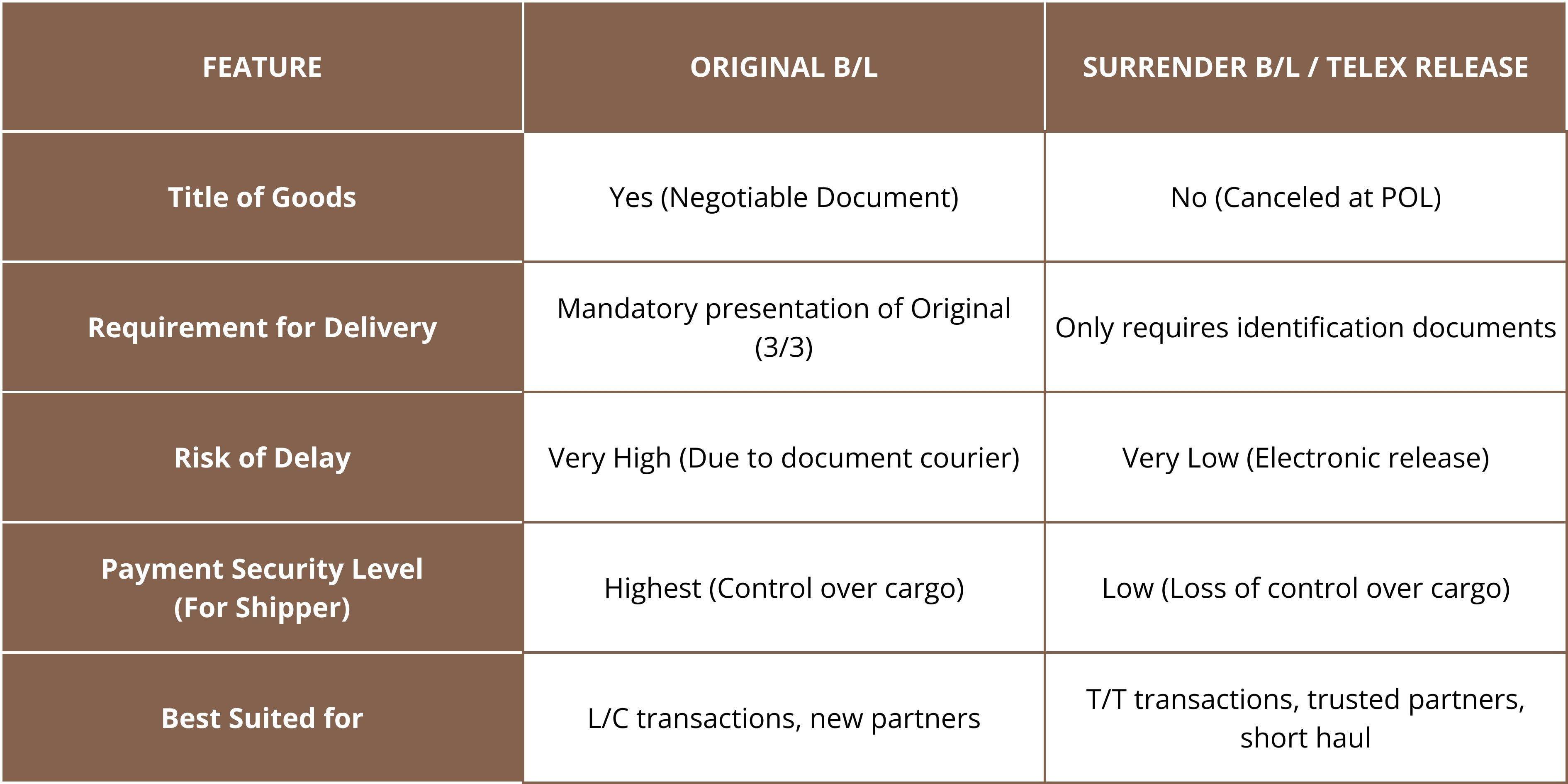
Expanding on this, we can create a complete comparison:
| Feature | Original B/L | Telex Release (Surrendered B/L) | Express Release (Sea Waybill) |
|---|---|---|---|
| Document Type | Negotiable Document of Title | Authorization based on Surrendered B/L | Non-Negotiable Transport Document |
| Physical Document? | Yes, must be couriered and presented | No, originals surrendered at origin | No, originals are never created |
| Release Speed | Slow, dependent on courier | Fast, dependent on internal message | Instantaneous upon vessel arrival |
| Shipper Payment Security | Highest. Control cargo until payment. | High. Control B/L surrender until payment. | None. No control after shipment. |
| Risk of Delay/Cost | Very High. Risk of demurrage. | Low. Mitigates courier delays. | Very Low. No document handling. |
| Best Suited For | New partners, L/C transactions, high-value | Trusted partners, T/T payments, short hauls | Intra-company transfers, very high-trust |
Conclusion
You now see the direct line connecting your data entry work to major commercial risks and port-side logistics. The "Cargo Release" flag you set was not just a system tick-box; it was a command that dictated the flow of documents across continents and determined who held power in the transaction.
Key Takeaways:
- Original B/L is the most secure method for the shipper but is slow and risky in terms of potential delays and costs for the consignee. It requires a physical document to release cargo.
- Telex Release is a procedure that offers a balance of speed and security. It allows for digital release authorization once physical B/Ls are surrendered at the origin, making it ideal for time-sensitive shipments between trusted partners.
- Express Release (Sea Waybill) is the fastest and most efficient method but offers zero payment security for the shipper, as it is not a document of title. It is only used in high-trust relationships.
- The core decision is a trade-off between Security vs. Speed.
In our next lesson, we will zoom in on the complexities of payment and third-party involvement. We will explore the role of the 'Notify Party' and the specific procedures for a bank-involved financial release, which builds directly on the security framework provided by the Original Bill of Lading.