Welcome to your fourth lesson. In our previous sessions, we’ve built a solid understanding of the Bill of Lading, distinguishing between the Master B/L (the "mother" contract with the shipping line) and the House B/L (the "child" contract with your client). You now grasp how this two-tiered system is the engine behind LCL consolidation.
This lesson zooms in on the other crucial documents that arrived in your inbox with every pre-alert: the Commercial Invoice (CI) and the Packing List (PL). You mentioned that your role was often just to check a box confirming their receipt. Today, we'll uncover the critical importance of that checkbox. We will explore why these documents are indispensable for customs clearance and operational planning, turning them from simple attachments into key players in the logistics chain. By the end, you'll understand why customs is essentially a data-matching exercise and how these documents provide the data that matters most.
The Pre-Alert: The Operational Head Start
Let's begin with the very first step of your old workflow: the email from the overseas agent. This email, containing the MBL, HBLs, CI, and PL, is known in the industry as the Pre-Alert or Pre-Advice.
Its name describes its function perfectly: it's an advance warning that a shipment is on its way. This isn't just a courtesy; it's a critical operational trigger. Receiving this package of documents allows the destination office (your former office) to:
- Begin Data Entry: This is where you came in. You would register the MBL and HBLs, creating the shipment file in the system. This act populated the system with the necessary data for all subsequent actions.
- Notify the Consignee: The destination office can inform the final receiver (the consignee) of the estimated time of arrival (ETA), allowing them to plan for payment of duties and final delivery.
- Prepare for Customs: The customs broker, whether in-house or a third party, uses the documents from the pre-alert to prepare the customs declaration before the vessel even arrives. This pre-filing is essential for a speedy release.
- Plan Financially: The office can review freight charges and prepare the invoice for the consignee.
In essence, the pre-alert and its attachments set the entire destination-side operation in motion. The simple act of you receiving that email and starting your data entry was the first domino to fall in the complex process of getting a container cleared and delivered.
The Supporting Cast: Commercial Invoice and Packing List
While the Bill of Lading is the contract of carriage, it often provides only a high-level description of the goods, especially on the MBL ("1 Container Said to Contain Consolidated Cargo"). To clear customs, officials need to know exactly what is in the container, how much it's worth, and how it's packed. This is where the Commercial Invoice and Packing List come in.
The following article from Tonlexing introduces a powerful concept: viewing customs clearance as a "data-matching workflow." This perspective is perfect for understanding the role of these documents.
International Shipping Documents Checklist (2026 Guide)
This article frames the core documents in a way that should resonate with your data-focused background.
Please read the first two sections, "Why proper documentation..." and "The core document set...". Focus on the idea that customs is a data-matching workflow and that the CI, PL, and B/L are the three key documents in this process.
The Commercial Invoice (CI): What's it Worth?
The Commercial Invoice is the single most important document for customs valuation. It is, in essence, the bill of sale from the exporter to the importer. Customs authorities use it to determine the value of the goods to calculate duties and taxes.

As you can see, a CI contains specific data points. Let's break down why each one is critical for customs:
- Exporter & Consignee: Identifies the seller and buyer in the transaction.
- Description of Goods: Must be specific. Vague terms like "parts" or "samples" are immediate red flags for customs, often leading to inspections.
- HS Code (Harmonized System Code): A globally standardized code that classifies the product. This code, combined with the value and origin, directly determines the duty rate.
- Quantity, Unit Value, Total Value: This is the core of customs valuation. The total value declared is the primary basis for calculating the duties and taxes the importer must pay.
- Country of Origin: Determines if the goods are subject to standard tariffs, preferential tariffs under a free trade agreement, or even anti-dumping duties.
- Trade Terms (e.g., Incoterms): Defines the point at which the risk and cost transfer from seller to buyer. This tells customs which costs (like freight and insurance) should be included in the dutiable value.
The video below gives a great conversational overview of the CI and PL, explaining their roles for both customs and the parties involved.
Commercial Invoice & Packing List for Import Export Business
This video by "Adrian The Logistician" clearly explains the function of both the CI and the PL.
Watch the segments explaining the Commercial Invoice, the Packing List, and why customs needs them. Note how the CI is described as the "proof of the transaction" used to determine duties and taxes.
The Packing List (PL): How is it Packed?
If the CI tells customs what the goods are and what they're worth, the Packing List tells them how they are physically organized. It is a logistical map of the shipment.
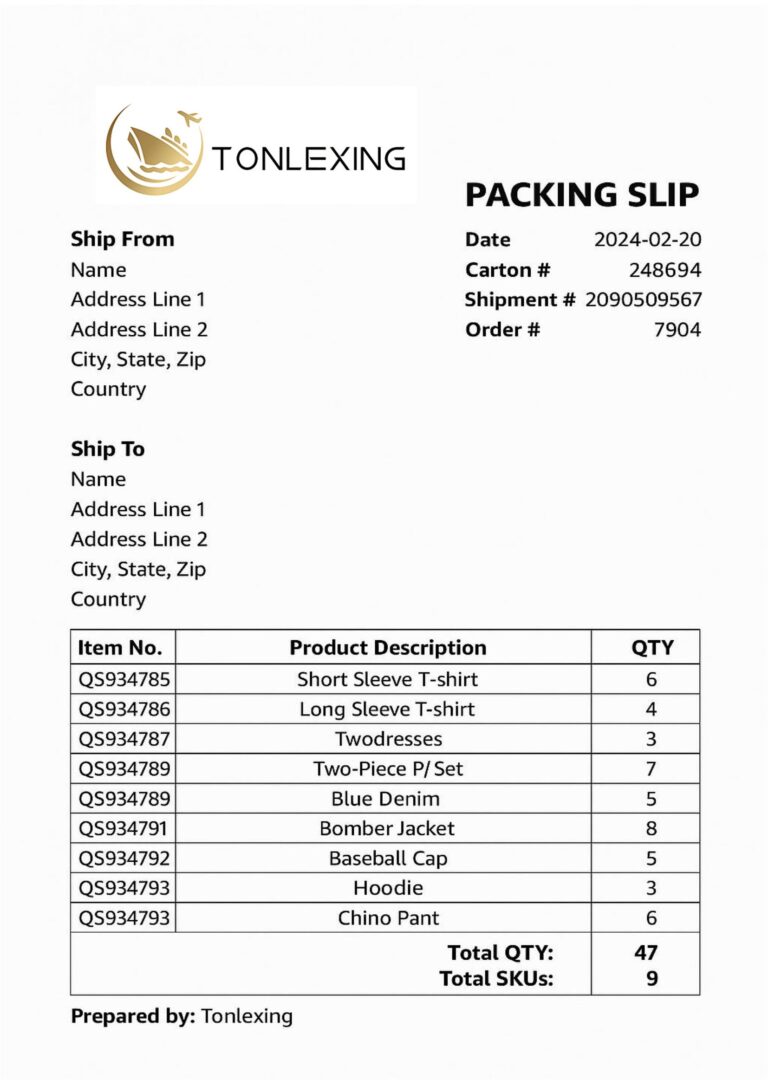
The Packing List's primary purpose is physical verification. It doesn't typically contain prices. Instead, it details:
- The number of cartons, boxes, or pallets.
- The contents of each individual package.
- The net weight (product only) and gross weight (product + packaging) of each package.
- The dimensions and total volume of the shipment.
- Any identifying marks on the packages.
This "map" is used by multiple parties:
- Customs Officials: If they decide to perform a physical inspection, the PL allows them to selectively target a specific box rather than manually unstuffing the entire container. This saves enormous amounts of time and labor.
- CFS Warehouse Staff: For LCL shipments, your colleagues at the Container Freight Station use the PL to verify that all packages have been unloaded from the container and to correctly segregate the cargo for each consignee.
- The Consignee: The final buyer uses the PL to check the received goods against their purchase order, ensuring they got what they paid for.
The Trio in Action: The Power of Consistency
Now, let's bring it all together. The Bill of Lading, Commercial Invoice, and Packing List must tell a single, consistent story. When you checked that box in your ERP system confirming receipt, you were effectively enabling the next stage of this "data-matching workflow."
Commercial Invoice and Packing List in Customs Clearance
This article from Al-Fares Cargo provides an excellent breakdown of how the documents work together and what happens when they don't.
Please read the sections on the role of the CI and PL and, most importantly, the section on "Common Mistakes". This section details the real-world consequences of data discrepancies.
As the article highlights, any inconsistency is a major red flag for customs. Consider these scenarios:
- Quantity Mismatch: The HBL and CI show 100 cartons, but the PL details 98. This discrepancy will halt the clearance process until it's explained. Is it a typo, or are two cartons missing? Or worse, are two undeclared cartons being smuggled?
- Weight Mismatch: The total gross weight on the PLs for all HBLs does not match the gross weight on the MBL. This raises both customs and safety concerns. Did something go wrong during consolidation?
- Description Mismatch: The CI describes "high-value electronics," but the HBL describes "plastic casings." This suggests an attempt to mis-declare goods to pay lower duties.
In your previous role, your reconciliation of the HBLs to the MBL was the first critical check. Downstream, the customs broker performs a similar reconciliation of the HBL, CI, and PL before submitting the declaration. Your accurate data entry was the foundation for this entire compliance structure.
The following video shows the entire logistics flow and explicitly points out where the CI, PL, and B/L are used for import customs declaration.
Logistics Flow by Sea Shipment. You will clearly understand Cargo and Documents flow of Logistics.
This video by "Logistics YouTuber - IINO san" visualizes the complete import process.
Watch the segment on the import process, which starts with the Arrival Notice and submission of the B/L. Pay close attention to the very next step, Import Customs Clearance, where the narrator explicitly states that the Invoice and Packing List are required to make the customs declaration.
Conclusion
You now see that the Commercial Invoice and Packing List are far more than just attachments to an email. They are legal and commercial documents that form the basis for customs assessment and physical cargo handling.
Key Takeaways:
- Pre-Alert: An operational tool that provides advance notice and the necessary documents (B/L, CI, PL) to begin destination-side procedures like data entry and customs pre-filing.
- Commercial Invoice (CI): The primary financial document used by customs to determine the shipment's value and calculate duties and taxes. Its accuracy is paramount for legal and financial compliance.
- Packing List (PL): A detailed logistical "map" of the shipment, used for physical verification by customs, warehouses, and the final consignee.
- Data Consistency is King: Customs clearance is a data-matching workflow. The information on the Bill of Lading, Commercial Invoice, and Packing List must be perfectly aligned to ensure a smooth, fast, and penalty-free clearance. Even a small discrepancy can lead to costly delays and inspections.
In our next lesson, we will move into a new module and connect the data you entered to the physical world. We will explore how inputting "FCL" vs. "LCL," along with container dimensions and weight, directly impacts the real-world handling of cargo at the port and in the warehouse.