Welcome back. The previous lesson followed the solar wind and distinguished its continuing flow from fast streams and coronal mass ejections. Now we will look at what that moving plasma encounters near Earth: a magnetic field that can redirect charged particles and, under some conditions, guide them toward the upper atmosphere.
By the end of this lesson, you should be able to look at a magnetic-field diagram and explain both what its lines represent and how a particle can move relative to them. Allow about 35–40 minutes, including the readings and time to inspect the diagrams.
Reading a magnetic-field diagram
Begin with the left-hand drawing below. The blue curves represent magnetic field lines near Earth. A field line is a way of drawing the field’s direction: at any point, the curve runs in the direction a compass needle would align there. The lines are not material strands, and a charged particle is not attached to one like a bead on a wire. Nor do the few lines drawn show every path through space.
Near Earth, the field has a roughly dipole-shaped pattern, somewhat like that around a bar magnet. Notice how the drawn lines curve around Earth and approach it at high latitudes. The magnetic poles are not identical to the geographic poles, so “toward a magnetic pole” does not mean “exactly along Earth’s rotation axis.”
The solar wind changes the field’s large-scale shape. It presses on the Sun-facing side and stretches the region controlled by Earth’s field into a long magnetotail on the opposite side. That region is the magnetosphere. Read the short account below before examining a diagram of its shape.
Solar-Terrestrial Interactions
Read the Space Weather Prediction Center’s explanation to distinguish the motion of an individual charged particle from the deflection of much of the incoming solar wind.
In Chapter 4, Section 1, “The Terrestrial Space Environment” (printed p. 29), read particle motion and the boundary. Then continue in the same section from the paragraph beginning “Until 1960” and read the field's shape. Focus on why “protective” does not mean that every particle is simply stopped.
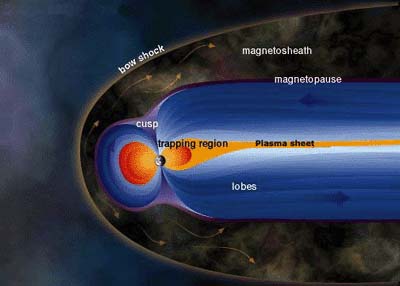
Use this second image as a map of regions, rather than as a drawing of particle orbits. Incoming solar wind approaches the left side. Much of its flow is diverted around the magnetopause, the boundary of the magnetosphere. Farther out are the bow shock and magnetosheath, where the arriving flow has been disturbed. On the right, the field’s domain extends away from the Sun as the magnetotail.
These two diagrams answer different questions. The first makes the direction of the local field easier to see; the second shows how the whole magnetic environment is reshaped by the solar wind. We need both views to understand what “guided by Earth’s magnetic field” means.
Why a moving charge spirals
A magnetic field acts on a moving charged particle. The force depends on the charge, its velocity, and the local magnetic field:
Here is the particle’s charge, its velocity, and the magnetic field. The essential feature of the cross product is geometric: the magnetic force is perpendicular to the particle’s motion. If a particle moves exactly parallel to the field, the magnetic force on it is zero. If it moves across the field, the force bends its path. Reversing the sign of the charge reverses the direction of that bend.
The OpenStax reading develops this result using circular and spiral paths. You do not need to calculate an orbit radius; concentrate on the change in direction.
Read OpenStax’s account of how a magnetic force bends a trajectory without, by itself, increasing the particle’s speed.
In Section 22.5, begin with the opening paragraph and read circular and spiral motion, stopping before Example 22.2. Pay particular attention to the discussion beside Figure 22.20 and the final paragraph distinguishing velocity across the field from velocity along it. The extracted equations may display poorly; the prose and figures carry the idea needed here.
Imagine separating a particle’s motion into two parts. Its motion across the field is continually deflected, producing a circular motion. Its motion along the field continues while it circles. Together, those motions make a spiral, or corkscrew, around the field’s direction. In a region where the field varies gradually, the centre of this spiral can follow a curved field line. The drawn line is therefore a useful guide to the particle’s overall route, not a tracing of every turn of its actual path.
The perpendicular force also explains an important limit. A magnetic force alone changes direction, not speed or kinetic energy. Other effects, including electric fields, can change a particle’s energy. So a diagram showing particles following magnetic lines tells you where they may travel; it does not, on its own, tell you what accelerated them.
Guided, trapped, or able to reach the atmosphere
Look again at the loops in the first diagram. Some charged particles spiral along such paths toward higher latitudes, where the magnetic field grows stronger. In the changing field, their motion along the field can slow and reverse: they turn around before reaching the dense atmosphere. This is called magnetic mirroring. A particle may travel back and forth between regions near the two ends of a field line, remaining trapped for a time.
Other particles have motion along the field that takes them far enough downward to enter the atmosphere instead of turning back above it. Thus “guided toward the poles” is not the same as “certain to hit the atmosphere.” Which outcome occurs depends in part on the particle’s motion relative to the field.
Return to OpenStax for the distinction between a particle that turns around and one that reaches the atmosphere.
Still in Section 22.5, find Figure 22.22 after Example 22.2. Read the magnetic mirror in its caption. Farther down, find the paragraph beginning “Some incoming charged particles become trapped” and read belts and reflection, including Figure 22.24. Focus on trapping and reflection rather than the schematic belt altitudes.
The orange loops labelled Van Allen belts in our first diagram depict trapped populations. They should not be read as a picture of the usual auroral light source. Auroras occur when energetic particles—especially electrons—enter the upper atmosphere along suitable magnetic paths and interact with its gases. We will examine the intervening energy transfer and the production of light in later lessons.
Putting the two diagrams together
Suppose you are explaining these pictures to someone who has seen only a photograph of the northern lights. Start at the magnetosphere diagram: Earth’s field confronts the incoming solar wind, so much of that flow is diverted around the magnetopause rather than simply falling onto Earth. Then use the field-line diagram to show what can happen to a charged particle within Earth’s magnetic environment. Its cross-field motion bends into a spiral, while its along-field motion can carry it toward a high-latitude region. It may mirror and remain trapped, or it may travel into the upper atmosphere.
One question remains deliberately open: how does solar-wind activity make energy and particles available on paths that lead into the atmosphere? A field-line drawing alone cannot answer it. The next lesson introduces magnetic reconnection, a way the magnetic field carried by the solar wind can couple to Earth’s magnetic environment—especially when that incoming field points southward.
Key takeaways
Magnetic field lines show the field’s direction, not physical tracks. A moving charge with motion across the field is deflected; combined with motion along the field, this gives a spiral whose overall path can follow the field’s shape. Near Earth, some particles mirror and become trapped, while others reach the atmosphere. Meanwhile, the solar wind reshapes Earth’s magnetosphere and is largely diverted at its outer boundary. These distinctions let you use a field diagram to explain guidance without mistaking it for either guaranteed particle entry or the complete explanation of an aurora.