Welcome to the first lesson. We will follow the path from the Sun toward Earth, beginning with the material that leaves the Sun. Later lessons will examine what happens when that material encounters Earth’s magnetic field and, eventually, how energy from that encounter produces auroral light.
Today’s distinction is between the solar wind, a continuing outflow, and coronal mass ejections, which are eruptions that can disturb that outflow. You will also see why some regions of the Sun supply faster wind than others. Allow about 35–40 minutes for the lesson and its short resources.
A wind made of plasma
The Sun’s outer atmosphere, the corona, is extremely hot. Much of its matter is plasma: atoms have lost electrons, leaving a mixture of charged particles. In the solar wind, those particles are chiefly electrons and protons, with smaller amounts of heavier ions.
Unlike ordinary wind, this is not air moving through an atmosphere. The corona’s hot plasma expands outward, and some of it escapes the Sun’s gravity. That continuing outward flow is the solar wind. It is thin compared with air near Earth, but it moves at hundreds of kilometres per second and extends across the solar system.
The Sun is magnetic as well as hot. Moving charged plasma helps generate and reshape its magnetic fields; the fields, in turn, affect how plasma moves. Watch the opening of this video for a visual introduction. Its language about magnetic fields “snapping” is a shorthand for a change in magnetic-field configuration, not a claim that field lines are physical cords.
Could Solar Storms Destroy Civilization? Solar Flares & Coronal Mass Ejections
Watch “Could Solar Storms Destroy Civilization? Solar Flares & Coronal Mass Ejections” from Kurzgesagt – In a Nutshell for its depiction of solar plasma, magnetic activity, and the continuing solar wind.
Watch plasma and magnetism, then the continuing wind. Focus on the distinction between the Sun’s ongoing outflow and the more abrupt events introduced later.
NASA’s Heliophysics Big Idea 3.1 provides a compact account of the same foundation. Read its “Quick Facts” for the plasma background, then its “Solar Wind” subsection for what escapes and what travels with it.
Heliophysics Big Idea 3.1 - NASA Science
Read NASA Science’s “Heliophysics Big Idea 3.1” to connect the hot corona, escaping plasma, and the Sun’s magnetic field.
Under “Quick Facts,” read the plasma overview. Farther down the page, locate “Solar Wind” after the “Electromagnetism” material and the solar-flare image. Read its Introductory, Intermediate, and Advanced paragraphs, beginning with the description of a gusty stream and ending with the coronal origin. Focus on why this is an ongoing outflow that carries solar magnetic field into space.
One refinement matters here: the wind is not simply a few exceptional particles flying free of an otherwise static corona. It is an outward flow of plasma. Heating and magnetic activity in the corona help sustain that flow, although the detailed processes that heat and accelerate the wind remain an active subject of research.
The escaping plasma also carries an interplanetary magnetic field—the Sun’s magnetic field extending into the space between planets. That carried field will matter when we reach Earth. For now, keep the picture of a sparse, continuous plasma flow with magnetic field embedded in it.
Why some solar wind is faster
“Continuous” does not mean “uniform.” A useful first distinction is between slow solar wind, commonly around 300–500 kilometres per second, and fast solar wind, commonly around 500–800 kilometres per second. These are broad ranges, not speed limits.
Fast streams are strongly associated with coronal holes. Despite the name, a coronal hole is not an opening through the Sun’s surface. It is a region of the corona that appears darker in certain ultraviolet images because it emits less of that light. Its magnetic field has pathways extending out into interplanetary space, along which solar plasma can flow outward. Slow wind is associated with other coronal structures, including streamers, often found nearer the Sun’s equatorial regions.
NASA’s Solar Wind Animations page describes both regimes side by side. Its “Conceptual Animation” captions are especially useful because they pair the speeds with the solar regions where the wind originates.
NASA SVS | Solar Wind Animations
Read NASA’s “Solar Wind Animations” introduction and its fast- and slow-wind descriptions to compare two forms of the continuing outflow.
At the top of the page, read the opening paragraph from the wind’s origin; the following paragraph about effects at Earth can wait. Then find the first “Conceptual Animation” description, the one beginning with Earth’s magnetosphere in “fast” solar wind. Read its full paragraph, including the fast-stream explanation. Continue to the next “Conceptual Animation” description, beginning with a representative “slow” solar wind, and read its full paragraph, including the slow-wind explanation. Compare both the speeds and the solar source regions.
In this ultraviolet view of the Sun, the dark patches help make coronal holes recognizable. The image does not show what your eyes would see when looking at the Sun: it uses light at a particular ultraviolet wavelength. Nor does dark mean empty.

As the Sun rotates, a coronal hole can send a fast stream toward Earth for a period of time. A fast stream may also catch up with slower wind emitted earlier, producing a more compressed and disturbed region of the flow. Neither feature requires a new eruption: the underlying wind is still being supplied continually.
What a coronal mass ejection adds
The Sun can also release a coronal mass ejection, or CME: a large eruption of coronal plasma and magnetic field. Magnetic fields in the corona can store energy as they are stressed by the motion of solar plasma. A major reconfiguration of those fields can release energy and launch a cloud of magnetized plasma outward. A CME then travels through, and may disrupt, the solar wind already filling interplanetary space.
Return to the video for its brief introduction to eruptions. It mentions both solar flares and CMEs; keep them distinct. A flare is principally a burst of electromagnetic radiation, while a CME ejects a large quantity of plasma and magnetic field. They can occur together, but one does not mean the other must occur.
Could Solar Storms Destroy Civilization? Solar Flares & Coronal Mass Ejections
Return to the Kurzgesagt video for its contrast between a flare and a coronal mass ejection.
Watch solar eruptions. Focus on what the CME carries away from the Sun, rather than treating every form of solar activity as the same event.
NASA’s “Coronal Mass Ejection” subsection supplies a more precise description of the ejected cloud and how it expands into space.
Heliophysics Big Idea 3.1 - NASA Science
Return to NASA Science’s “Heliophysics Big Idea 3.1” for its explanation of CMEs as clouds of plasma with embedded magnetic fields.
Find “Coronal Mass Ejection” under “Related Topics By Level For Communicating Heliophysics.” Read the Intermediate paragraph and the beginning of the Advanced paragraph, from the eruption explanation. Stop after the sentence about expanding CMEs colliding with planetary magnetic fields. Focus on the CME as an ejection of both matter and magnetic field.
A coronagraph makes an outward-moving CME easier to observe by blocking the Sun’s bright disk. In these two views, the bright ejection has spread farther from the blocked Sun in the later frame.
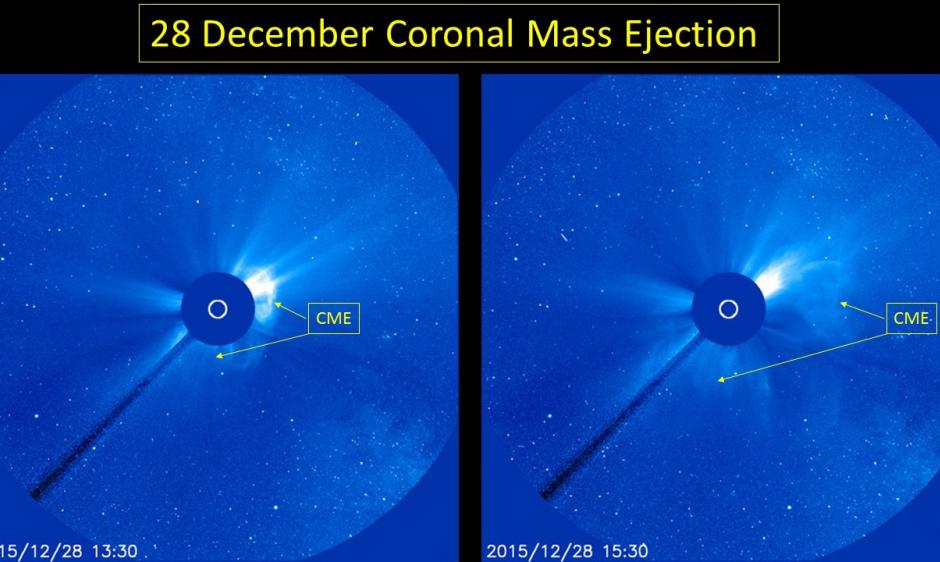
A CME may pass Earth, miss it, or reach it. Even when one is directed toward Earth, its effects depend on more than its apparent size in an image. The magnetic field it carries is especially important—a point we will develop after establishing how Earth’s own magnetic field behaves. A fast solar-wind stream and a CME are therefore different things: one is a faster portion of the continuing wind, while the other is a distinct eruption moving through interplanetary space.
The picture to carry forward
| Solar output | How to recognize it conceptually |
|---|---|
| Slow solar wind | Part of the continuing coronal outflow, generally moving more slowly and associated with structures such as coronal streamers. |
| Fast solar-wind stream | Part of the continuing outflow associated especially with coronal holes; it can disturb the slower wind ahead of it. |
| Coronal mass ejection | An eruptive, expanding cloud of plasma and magnetic field that moves through the surrounding solar wind. |
All three can bring changing plasma conditions and magnetic field toward Earth. None is itself an aurora. The light in an aurora is produced much later in the chain, in Earth’s upper atmosphere, and solar activity alone does not guarantee that an aurora will be visible from a particular place.
The key takeaway is that the Sun supplies a persistent, magnetized solar wind, but it does not supply an unchanging one. Coronal holes are important sources of fast streams, while magnetic eruptions can launch CMEs into the wind. Next, we will look at Earth’s magnetic field and use a field diagram to understand how charged particles move in its presence.