Hello. Last lesson separated three claims that are easy to blur: a forecast of geomagnetic activity, a modeled auroral oval, and the chance of seeing aurora from the ground. This lesson asks how confident the first two claims can be before the solar wind reaches Earth. You will compare forecasts made days ahead with measurements made just upstream of Earth, then read a real storm-watch graphic as an update rather than a promise. Allow about 35–40 minutes, including the readings.
Why lead time changes what forecasters know
A coronal mass ejection, or CME, can be observed leaving the Sun well before it reaches Earth. That gives forecasters time to assess whether it might arrive, but not a precise account of what it will do on arrival. Its direction and speed must be inferred from observations near the Sun. Even if a CME is Earth-directed, uncertainty in its journey translates into uncertainty about when a forecast period of heightened activity might begin.
The magnetic field carried inside the CME poses a different problem. As you learned earlier, a southward interplanetary magnetic field favors magnetic reconnection and greater energy transfer into Earth’s magnetosphere. A CME can therefore arrive without producing the strong response that its size or speed alone might suggest. Forecasters cannot reliably determine its internal magnetic-field direction from a coronagraph image taken near the Sun.
Read NOAA’s Aurora Tutorial for its direct comparison of forecast time scales.
Aurora Tutorial | NOAA / NWS Space Weather Prediction Center
NOAA’s Space Weather Prediction Center explains what observations are available at different lead times—and what remains unknown.
Under “Forecasting the Aurora,” read the “15-45 Minutes” bullet from upstream measurements through its end. Then read the “Hours to Days” bullet, beginning with the longer-range method. Continue through the sentence explaining that coronagraphs cannot measure the magnetic field within a CME. Focus on which uncertainty concerns arrival and which concerns storm strength.
“More warning” and “more certainty” are not the same thing. An event spotted near the Sun may give days of notice, but its arrival window and geomagnetic effect remain conditional. A measurement taken close to Earth offers much less warning time, yet describes the incoming solar wind and its field directly. That is why a short-lead forecast can be more informative than an earlier one.
Arrival is not the same as a strong response
NOAA’s Coronal Mass Ejections page adds useful detail to that distinction. Read the passages on CME travel, detection upstream of Earth, and magnetic-field orientation.
Coronal Mass Ejections | NOAA / NWS Space Weather Prediction Center
This NOAA Space Weather Prediction Center page shows why a forecast can become more specific as a CME approaches without becoming certain about the eventual storm.
Under “Coronal Mass Ejections,” read the opening paragraph’s speed and travel-time discussion from travel speeds. Farther down, find the paragraph beginning “Important CME parameters used in analysis”; read it for how impact likelihood is inferred. Then read from upstream arrival to the end of that paragraph. Finally, in the paragraph beginning “Important aspects of an arriving CME,” read field orientation. Notice that the field can change during the passage, not merely differ from one CME to another.
An upstream satellite near L1, about 1.5 million kilometres sunward of Earth, samples solar wind before that wind reaches the magnetosphere. Its measurements include speed and magnetic field. NOAA gives a short warning window of roughly 15–45 minutes for auroral forecasting in its tutorial; its CME discussion gives 15–60 minutes for advance notice of a CME-associated shock. These are useful ranges, not a fixed countdown for every event.
A shock detected upstream can mark the arrival of a disturbance, while the field in the material following it continues to pass the satellite and may change direction. Forecasters therefore update their expectations as new measurements arrive. Detecting an arrival raises confidence that something is incoming; observing a strong, sustained southward field raises confidence in the potential for a larger geomagnetic response. A brief southward reading does not establish that it will remain southward for hours.
Here is the central forecasting distinction:
| Lead time | What may be known | What still limits confidence |
|---|---|---|
| Days ahead | A solar feature or CME may be directed toward Earth; a period of enhanced activity is possible. | Exact arrival time, whether the disturbance will hit as expected, and especially its magnetic orientation on arrival. |
| Tens of minutes ahead | Upstream instruments measure the arriving wind and magnetic field directly. | The field may continue to change, and Earth’s geomagnetic and auroral response is not instantaneous or identical everywhere. |
A recurring coronal hole can also suggest that a fast solar-wind stream may return around a subsequent solar rotation, roughly 27 days later. That is a clue to a possible period of activity, not a 27-day prediction of a particular auroral display.
Reading a watch after the CME arrives
Consider this NOAA storm-watch graphic. Its headline says that G1–G3 geomagnetic storm levels are possible following an anticipated CME’s arrival. The plots show total interplanetary magnetic-field strength, marked Bt, and the north–south component, marked Bz, alongside solar-wind speed.
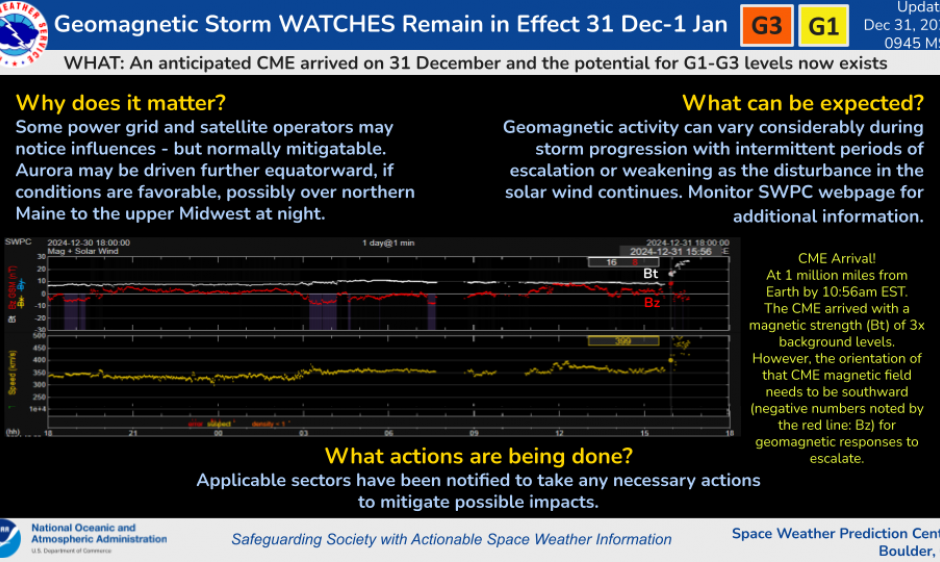
The annotations say the arriving CME’s total magnetic-field strength was elevated above background. That is significant, but Bt alone does not tell you whether the field points south. For the orientation question, inspect the red Bz trace: negative values indicate southward orientation in this graphic. The alert explicitly notes that southward field is needed for the geomagnetic response to escalate. The field can fluctuate as the disturbance passes, so neither a strong Bt reading nor one moment of negative Bz establishes the storm’s eventual peak.
Also pay attention to the headline’s word “WATCH.” It communicates potential storm conditions over the stated period, not a measurement that every level from G1 to G3 has already occurred. The CME’s upstream arrival helps resolve one uncertainty—whether and approximately when a disturbance has arrived near Earth—while the field’s developing orientation and duration still matter for how strong the response may become. This is why the graphic advises monitoring updates during storm progression.
Choosing language that matches the evidence
Forecast confidence is not one number attached to an entire event. You can be fairly confident a CME has been detected upstream while remaining less confident about its peak geomagnetic effect. Likewise, greater confidence in a geomagnetic forecast does not by itself raise confidence that you will see aurora: an oval model still has its own uncertainty, and local darkness and sky conditions remain separate questions.
A careful statement changes as evidence improves. Days ahead, it might be: “An Earth-directed CME makes elevated geomagnetic activity possible during this broad time window; its arrival time and magnetic orientation remain uncertain.” After upstream arrival, it might be: “The disturbance has been measured near Earth. Its observed field currently favors—or does not favor—stronger energy transfer, but that field may change as the rest passes.” Neither statement promises a particular Kp value at a particular hour or a local sighting.
Takeaways
Arrival-time uncertainty limits when a days-ahead forecast might apply. Magnetic-orientation uncertainty limits how strong the geomagnetic and auroral response might be even if the disturbance arrives. Upstream measurements reduce both uncertainties shortly before Earth encounters the solar wind, but a changing field and evolving magnetospheric response keep forecasts conditional.
In the final lesson, you will combine that forecast evidence with the observing conditions the forecast cannot supply—location, darkness, clouds, and light pollution—to assess a specific viewing opportunity.