In our last lesson, we established what data analytics is and why its main purpose is to enable data-driven decision-making. We saw how this process turns raw data into information, then into insights that inspire action. Now, we will build on that foundation by exploring the different kinds of questions analytics can answer.
This lesson focuses on distinguishing between the four fundamental types of data analytics: descriptive, diagnostic, predictive, and prescriptive. Understanding this framework is crucial, as it will help you categorize business problems and determine the most appropriate analytical approach to solve them. For a BI Analyst, this knowledge forms the backbone of your thinking, guiding you from simply reporting numbers to providing strategic value.
A Framework for Analysis
The four types of data analytics can be seen as a progression, moving from a focus on the past to shaping the future. Each type increases in both complexity and the value it provides to a business.
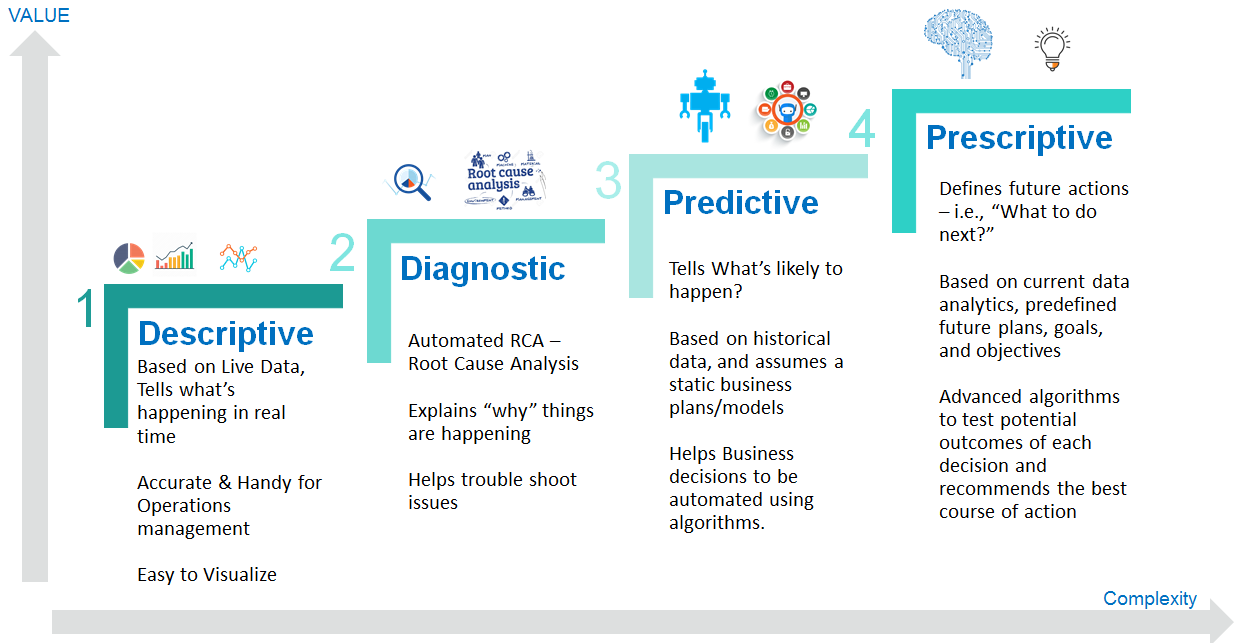
These four types answer a sequence of fundamental questions:
- Descriptive: What happened?
- Diagnostic: Why did it happen?
- Predictive: What is likely to happen?
- Prescriptive: What should we do about it?
While they are often presented as levels, it's important to think of them as complementary tools in an analyst's toolkit, rather than a strict linear path. Let's watch a brief clip that makes this important distinction.
Descriptive vs Diagnostic vs Predictive vs Prescriptive Analytics: What's the Difference?
In the video "Descriptive vs Diagnostic vs Predictive vs Prescriptive Analytics," watch the segment that explains how these categories relate to one another.
Pay close attention to the analogy about algebra and calculus from this segment. It clarifies that advanced analytics doesn't replace foundational analytics; they work together.
With that context, let's delve into each type, looking at its purpose, methods, and application—especially within the financial industry. We will use an excellent article from Domo as our guide.
The 4 Types of Data Analytics Explained + Examples
This article provides clear, concise definitions and examples for each of the four types of analytics. We will read it section by section as we cover each type.
To start, please read the introduction to get a high-level overview of the topic. Find the section titled "The 4 types of data analytics" and read from the beginning of the article down to the comparison table. Pay attention to the part that explains why this matters.
1. Descriptive Analytics: What Happened?
Descriptive analytics is the most common and fundamental type of analytics. It focuses on summarizing historical data to provide a clear picture of past events. This is the bedrock of business reporting, involving Key Performance Indicators (KPIs), sales reports, and operational dashboards. As a BI analyst, this is where much of your work will begin.
Let's return to the Domo article to understand this in more detail.
The 4 Types of Data Analytics Explained + Examples
Now, let's focus on the first type of analytics.
In the article, find the section "What is descriptive analytics?" and read it in its entirety, from that section's start to its end.
To connect this to your career goal, consider a financial context. A wealth management firm might use descriptive analytics to generate a monthly report showing a client's portfolio performance, detailing which assets gained or lost value. This report describes "what happened" but doesn't explain the underlying reasons for the performance.
2. Diagnostic Analytics: Why Did It Happen?
Once you know what happened, the natural next question is "why?" Diagnostic analytics aims to answer this by drilling down into the data to uncover root causes and contributing factors. This involves techniques like segmentation, filtering, and correlation analysis to move beyond the surface-level summary.
Let's see how the Domo article explains this next step.
The 4 Types of Data Analytics Explained + Examples
Now, let's look at the next level of analysis.
Please read the section "What is diagnostic analytics?" from start to finish. Notice the emphasis on moving from symptoms to causes.
In a financial setting, if a descriptive report shows that sales for a particular mutual fund have dropped (the "what"), a BI analyst would use diagnostic analytics to investigate. They might analyze the data by sales region, by financial advisor, or by customer demographic. Perhaps they discover the drop is concentrated among younger investors in a specific city, who are shifting to a competitor's new fintech product. This is the "why."
3. Predictive Analytics: What Will Happen?
Predictive analytics moves from looking at the past to forecasting the future. It uses statistical models and machine learning techniques to analyze historical and current data to predict future outcomes, trends, and probabilities. This helps businesses anticipate challenges and opportunities, allowing for more proactive planning.
Let's examine how this forward-looking analysis works.
The 4 Types of Data Analytics Explained + Examples
This is where analysis begins to look toward the future.
Read the section titled "What is predictive analytics?" from its beginning to end. Pay attention to the important point that predictions are about probabilities, not certainties.
A powerful example from the financial world comes from risk management. A bank can use predictive analytics to analyze a loan applicant's financial history, credit score, and other variables to calculate the probability of them defaulting on the loan. This prediction helps the bank make a more informed lending decision.
4. Prescriptive Analytics: What Should We Do?
Prescriptive analytics is the most advanced stage. It goes beyond predicting a future outcome to recommending specific actions a business should take to achieve a desired goal or to mitigate a future risk. It synthesizes predictions with business rules, constraints (like budgets or capacity), and objectives to suggest an optimal path forward.
Let's read the final section in the Domo article.
The 4 Types of Data Analytics Explained + Examples
This final type of analytics turns insight into a direct recommendation.
Find and read the section "What is prescriptive analytics?" from start to finish. Note the key difference from predictive analytics: the addition of decision logic.
For a financial example, think of a hedge fund. It might use prescriptive analytics to not only predict market movements but to also recommend an optimal trading strategy. The model would consider the fund's objectives (e.g., maximize short-term return), constraints (e.g., risk limits, regulatory rules), and the predicted outcomes of various trades to recommend a specific set of buy and sell orders.
A Practical Analogy
To help solidify your understanding, let's watch a video that uses a simple, intuitive analogy of a doctor's visit to walk through all four types of analytics.
Descriptive vs Diagnostic vs Predictive vs Prescriptive Analytics: What's the Difference?
This video, "Descriptive vs Diagnostic vs Predictive vs Prescriptive Analytics," provides an excellent analogy.
Watch the segment from the doctor's visit example to the end of that analogy. Notice how each statement from the doctor corresponds to one of the four types of analytics, adding more value at each step.
Comparing the Four Types
Now that we have explored each type, let's look at a concise summary that compares them across several dimensions. This table provides a great reference for how they differ in the questions they answer, their outputs, and their typical use cases.
The 4 Types of Data Analytics Explained + Examples
Let's revisit the Domo article for a useful summary table.
Find the subheading How the 4 types and study the table that follows. This is a great tool for quick reference.
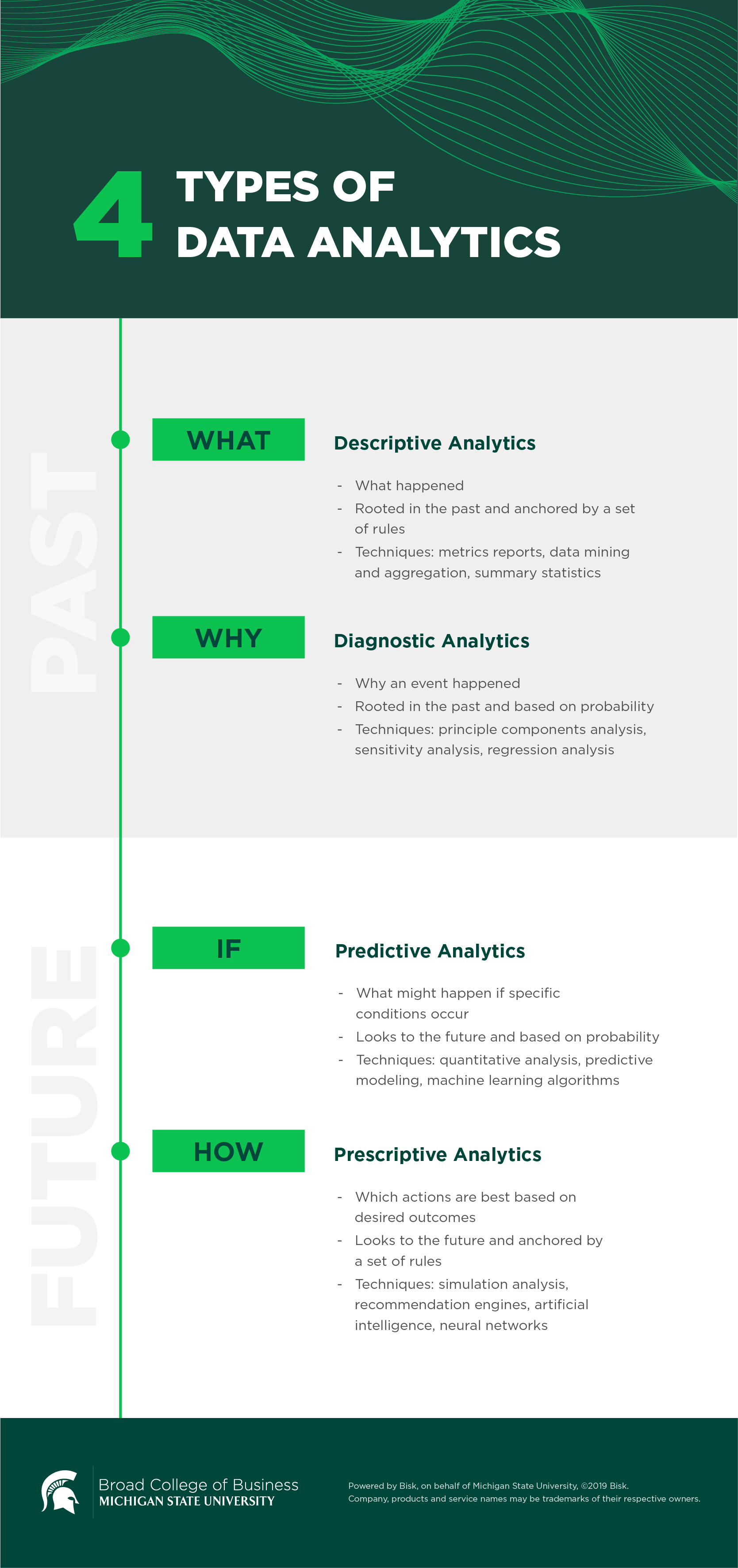
This infographic provides another clean, visual summary of the core question each type of analytics addresses.
Finally, to see how these work together in a real-world scenario relevant to your career path, let's look at one more example.
The 4 Types of Data Analytics Explained + Examples
Let's look at a practical application in the finance industry.
In the article, find the section "Use cases of data analytics across industries" and read the paragraph specifically under the Finance subheading. This example clearly shows how a finance team would use all four types to address fraud.
Conclusion
In this lesson, we have dissected the four types of data analytics, providing a clear structure for how to approach business questions with data.
Key Takeaways:
- Descriptive Analytics answers "What happened?" by summarizing past data, forming the basis of reports and dashboards.
- Diagnostic Analytics answers "Why did it happen?" by investigating the root causes behind the trends and outcomes identified in descriptive analysis.
- Predictive Analytics answers "What will happen?" by using historical data to forecast future probabilities and trends.
- Prescriptive Analytics answers "What should we do?" by recommending specific actions to optimize for a future outcome.
- These types represent a spectrum of increasing complexity and business value, and they often work together to provide a complete analytical picture.
As a future BI Analyst, your work will be heavily concentrated in descriptive and diagnostic analytics. However, understanding the full spectrum is vital for seeing the bigger picture and collaborating effectively with data scientists and other stakeholders on more advanced projects.
In our next lesson, we will shift our focus from the types of analysis to the types of data itself. We will explore the differences between structured, semi-structured, and unstructured data, which is essential for understanding what raw materials you will be working with as an analyst.