Hello! Welcome back.
In our last lesson, we analyzed the trade-offs of caching and identified several challenges that can turn a performance optimization into a system liability. One of the most critical failure modes we briefly introduced was the thundering herd problem. You saw that when a popular cached item expires, the sudden flood of requests to the database can be catastrophic.
Today, we will perform a deep dive into that specific problem. Our learning outcome is to explain the 'thundering herd' problem and strategies to mitigate it, such as using cache locks. We'll dissect why it happens and explore a toolbox of robust, production-grade solutions, including a detailed look at implementing locks with Python and Redis.
What is the Thundering Herd Problem?
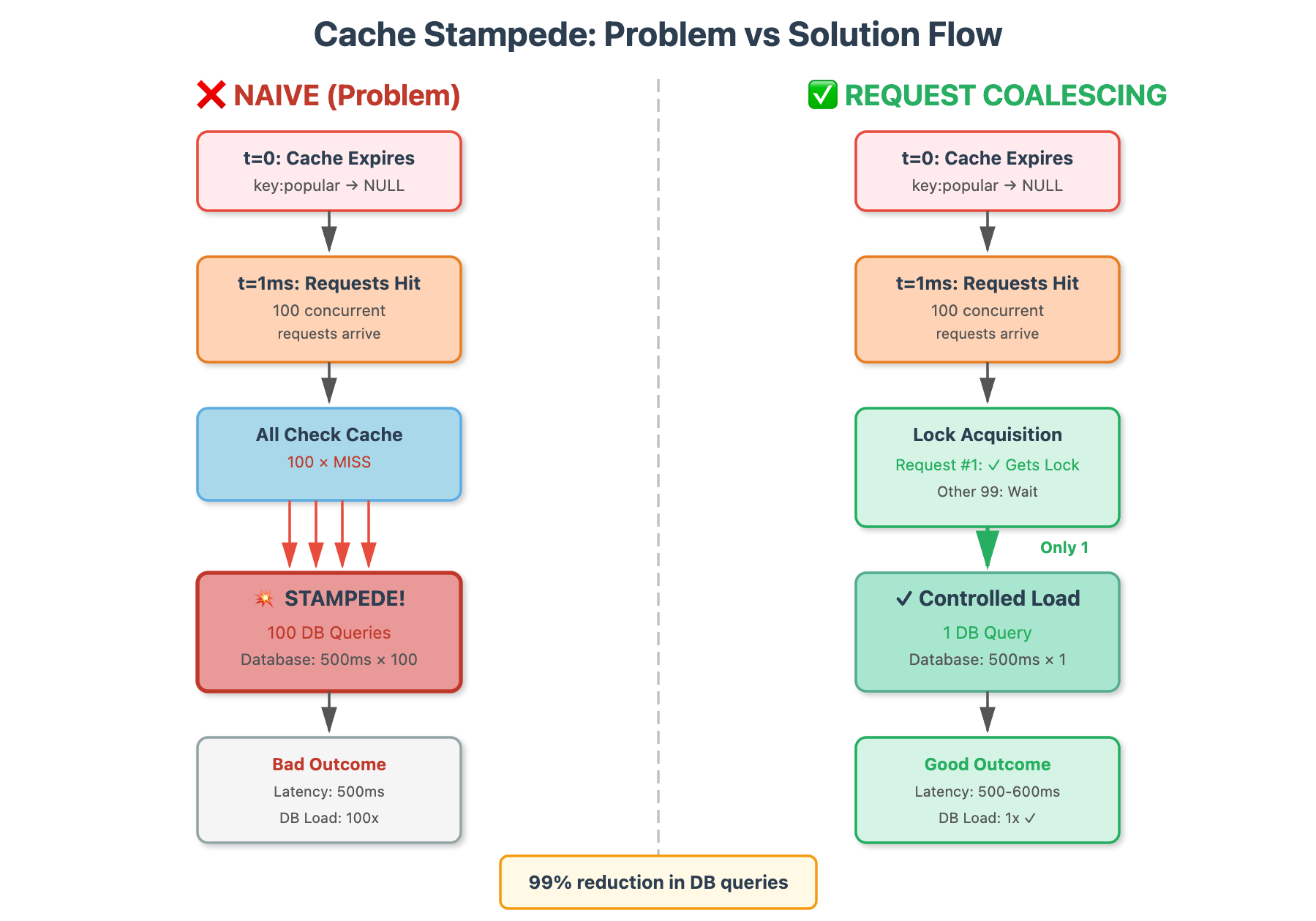
The thundering herd, also known as a cache stampede or dogpiling, occurs when a high-traffic cache entry expires or is invalidated. In the moments immediately following, multiple concurrent requests for that same item will all result in a cache miss. Since they all miss the cache, they all proceed to the "source of truth"—usually your database—to recompute the value simultaneously.
This sudden, synchronized surge of expensive operations can overwhelm your database, leading to increased latency, timeouts, and potentially a cascading failure of your entire service.
Let's watch a quick video that visualizes this exact scenario.
Caching Pitfalls Every Developer Should Know
The video 'Caching Pitfalls Every Developer Should Know' by ByteByteGo provides a clear, animated explanation of the cache stampede problem.
Watch from 00:42 to 01:31. Notice how the expiration of a single popular item leads to multiple threads overwhelming the database.
This diagram illustrates the core issue: what was once a single database query served to thousands from the cache becomes thousands of simultaneous database queries.
To understand the mechanics of this failure spiral, let's read a more detailed breakdown.
How do you mitigate the thundering herd problem?
The article 'How do you mitigate the thundering herd problem?' from Design Gurus provides an excellent step-by-step explanation of how the problem unfolds.
Read the section 'How It Works step by step'. This clearly outlines the chain reaction from a shared trigger to a potential system failure.
As the article states, mitigation is about breaking one of the links in that chain. Let's focus on the most effective one: ensuring only one worker rebuilds the expensive result.
The Primary Mitigation: Cache Locks (Request Coalescing)
The most direct way to stop a thundering herd is to prevent all but one of the concurrent processes from attempting to regenerate the cache value. This is achieved using a distributed lock (often called a mutex, for "mutual exclusion"). In the context of caching, this pattern is also known as request coalescing or single-flight.
The logic is as follows:
- A request encounters a cache miss for a key.
- It attempts to acquire a lock for that specific key.
- If it acquires the lock, it becomes the "leader." It proceeds to fetch the data from the database, writes it to the cache, and then releases the lock.
- If it fails to acquire the lock, it means another process is already regenerating the value. The request then has a few options:
- Wait: It can pause for a short period and then retry fetching from the cache, assuming the leader will have populated it by then.
- Return Stale Data: If the system supports it, it can serve a slightly old (stale) version of the data.
- Return an Error: It can immediately return an error or an "empty" state to the client.
The "Double-Check Lock" Refinement
A naive locking implementation can still be inefficient. Imagine a process acquires a lock, but by the time it does, another process has already finished computing and populating the cache. To prevent this redundant work, we use a pattern called double-check locking.
- Check cache (miss).
- Acquire lock.
- Check cache again. This is the "double-check." If the value now exists, another process populated it while we were waiting. We can simply return the value and release the lock.
- If the value is still missing, proceed to fetch from the database, populate the cache, and release the lock.
This video demonstrates the implementation of this logic. While the code is in C#, the algorithmic thinking is universal and directly applicable to your work in Python.
A Step-by-Step Guide for the Cache-Aside Pattern + Stampede Protection
The video 'A Step-by-Step Guide for the Cache-Aside Pattern + Stampede Protection' by Milan Jovanović gives a fantastic, code-level demonstration of implementing stampede protection.
Watch from 13:53 to 16:59. Focus on the logic, not the syntax: Acquiring the lock (13:53): A semaphore is used to ensure only one thread can proceed. The double-check (15:03): After acquiring the lock, the cache is checked again before hitting the database. Per-key vs. Global Lock (16:29): The speaker notes a key improvement: the lock should be specific to the cache key being requested, not a global lock for the entire application.
Practical Implementation: Python + Redis
Now, let's bring this all together into a concrete Python example. We will use Redis to implement a distributed, per-key lock. The SET command in Redis has options that make it perfect for this task:
NX: "Not eXists". This option means theSEToperation will only succeed if the key does not already exist. This is the atomic "acquire lock" operation.EX: "EXpire". This sets a timeout on the key. This is a crucial safety mechanism to prevent a lock from being held forever if the process holding it crashes.
The following resource provides a complete, runnable Python function that implements the cache-aside pattern with robust thundering herd protection.
Python + Redis: Cache-Aside with Stampede Protection
The article 'Caching Strategies That Scale' from Labvent includes a fantastic section with a full Python code example for stampede protection using Redis.
First, read the section 'Python + Redis: Cache-Aside with Stampede Protection'. Then, carefully study the Python code provided. Pay close attention to how the get_with_cache and acquire_lock functions work together to implement the double-check locking pattern we just discussed.
Let's break down the key lines from that code:
# In get_with_cache function...
# 1. First cache check (miss)
val = r.get(key)
if val is not None:
    return json.loads(val)


# 2. Acquire a lock specific to the key
lock_key = f"lock:{key}"
with acquire_lock(lock_key, ttl=lock_ttl_sec):


    # 3. Double-check after acquiring the lock
    val = r.get(key)
    if val is not None:
        return json.loads(val)


    # 4. Only if still missing, load from source
    data = loader()


    # ... set data in cache ...


# In acquire_lock context manager...
# The atomic lock acquisition using Redis
ok = r.set(lock_key, token, nx=True, ex=ttl)
This is a production-ready pattern for protecting your database from cache stampedes.
A Broader Toolbox of Mitigation Strategies
While cache locks are the most direct solution, a robust system often combines multiple strategies. Let's explore other tools at your disposal.
The Design Gurus article we looked at earlier has a brilliant table that compares various techniques.
How do you mitigate the thundering herd problem?
Let's return to the 'Design Gurus' article to get a broader view of mitigation techniques.
Read the 'Table of Comparison' and the section 'Practical mitigation patterns'. This will give you a quick, structured overview of several powerful strategies and when to use them.
Here are two key strategies from that table worth highlighting:
1. Randomized TTLs (Jitter)
A simple but effective technique is to avoid having many keys expire at the exact same moment. Instead of setting a fixed TTL of 300 seconds, you add a small random variation (a "jitter") to it, for example, setting the TTL to a random value between 270 and 330 seconds.
This is also demonstrated in the Python code from the LINK resource:
jitter_pct = 0.1
ttl = int(base_ttl_sec * (1 + random.uniform(-jitter_pct, jitter_pct)))
r.setex(key, ttl, json.dumps(data))
This desynchronizes expirations and spreads the load of cache regeneration over time.
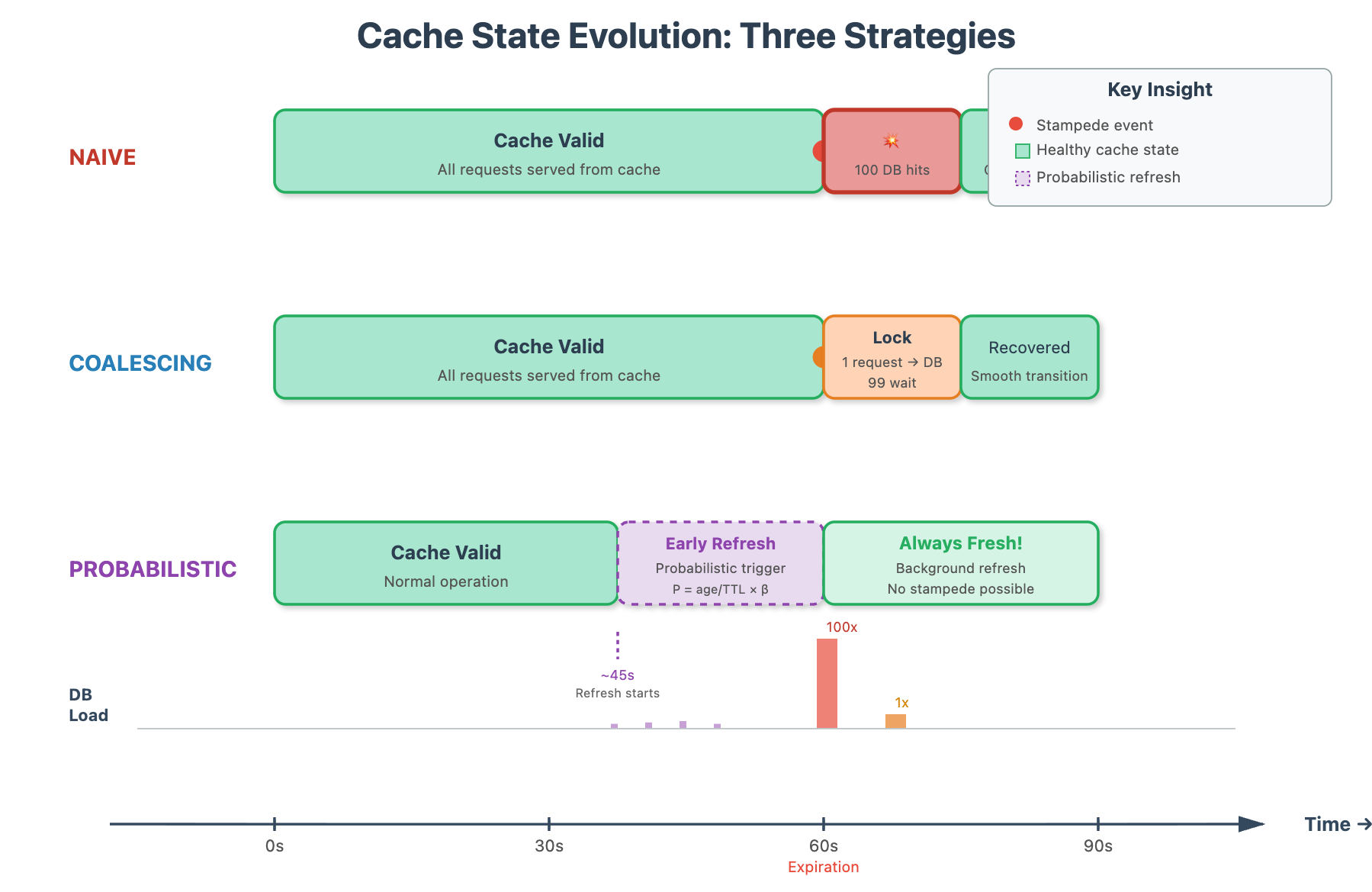
2. Stale-While-Revalidate (Background Refresh)
This strategy prioritizes user experience by almost never making a user wait for a cache regeneration. It works by using two TTLs: a "soft" TTL and a "hard" TTL.
- Before soft TTL expires: The data is considered fresh and is served directly.
- After soft TTL, but before hard TTL: The data is considered "stale." It is immediately served to the user (so they don't wait), but a background task is triggered to refresh the data from the database.
- After hard TTL: The data is truly expired and must be fetched synchronously.
This provides excellent perceived performance at the cost of sometimes serving slightly stale data.
This image beautifully visualizes how different strategies impact database load.
Conclusion
You have now moved from simply being aware of the thundering herd problem to understanding its mechanics and, most importantly, knowing how to solve it. This is a critical skill for any backend developer building scalable, resilient systems.
Key Takeaways:
- The Problem: The thundering herd (or cache stampede) is a massive, synchronized spike in load on your backend caused by multiple processes trying to regenerate the same expired cache item at once.
- The Primary Solution: Use a distributed lock (mutex) on a per-key basis to ensure only one process regenerates the value. This pattern is called request coalescing or single-flight.
- The Best Practice: Implement the lock using a "double-check" pattern to avoid redundant work after the lock is acquired.
- The Supporting Cast: Combine locking with other strategies for even greater resilience. TTL jitter helps desynchronize expirations, and stale-while-revalidate provides excellent perceived performance by refreshing in the background.
Preview of the Next Lesson
We just discussed the "stale-while-revalidate" strategy, which involves triggering a refresh in the background. But how do you reliably manage background work in a web application? You don't want to spin up a thread in your web server process, as that doesn't scale and is prone to errors.
This is the perfect segue into our next topic: asynchronous processing with task queues. We will explore the architecture of systems like Celery and Redis that are designed specifically to offload long-running or periodic work from the main request-response cycle. This is the standard mechanism for implementing background refreshes, sending emails, generating reports, and countless other essential backend tasks.