Hello! Welcome to the final lesson in our module on asynchronous processing.
In our last lesson, we successfully built the core machinery for running background jobs. We set up Celery with Redis, defined a task, and offloaded its execution from a Django view, making our web application more responsive.
However, building a working background job is only the first step. Production systems are chaotic. Workers crash, networks fail, and messages can get delivered more than once. This lesson is about moving from a working job to a reliable one. We will synthesize everything we've learned in this module to design a background job that is both idempotent and handles transient failures gracefully.
By the end of this lesson, you will be able to design a production-ready asynchronous task that can withstand the common failures encountered in distributed systems.
The Challenge: Why Simple Tasks Are Fragile
Let's consider the simple task we built previously. Imagine we modified it to perform a critical, non-reversible action, like charging a customer's credit card.
# A simple, but fragile task
@shared_task
def charge_customer(order_id, amount):


    # 1. Call external payment gateway API
    payment_gateway.charge(amount)


    # 2. Update order status in our database
    Order.objects.filter(id=order_id).update(status='paid')
This code looks straightforward, but it has critical flaws in a distributed environment:
- Duplicate Execution: What if the worker process crashes right after
payment_gateway.charge()but before updating the order status? If we configure our system for reliability, the message broker will redeliver the task to another worker to ensure it completes. The result? The customer is charged twice. - Transient Failures: What if the payment gateway API is temporarily unavailable and returns a
503 Service Unavailableerror? The task will fail, the exception will be logged, and the task will be lost. The customer's payment is never processed.
To build robust systems, we must design our tasks to handle these scenarios deliberately. This brings us to two fundamental pillars of reliable task design: idempotency and graceful failure handling.
Pillar 1: Idempotency - The "Exactly-Once" Illusion
In distributed systems, achieving true "exactly-once" message processing is notoriously difficult and often comes with significant performance trade-offs. A more practical approach is to design operations that can be executed "at-least-once" but have the same effect as if they were executed "exactly-once." This property is called idempotency.
To start, let's get a crystal-clear conceptual overview of idempotency and why it's so important when dealing with network unreliability.
Idempotency, a key term in distributed systems | Software Engineering Dictionary
This video from the 'Studying With Alex' channel provides an excellent and concise explanation of idempotency, the problem of at-most-once vs. at-least-once delivery, and the standard solution using a request ID.
Watch from the beginning to 06:33. Pay close attention to how retrying a non-idempotent operation leads to problems ('at-least-once' execution with side effects) and how introducing a unique request ID transforms it into a safe, idempotent operation.
As the video explained, the key is to make a non-idempotent operation idempotent by using a unique identifier. This allows the receiver (our Celery worker) to recognize and discard duplicate requests.

A Practical Implementation Pattern
So, how do we implement this in our backend? The most robust way is to use our database as the source of truth for tracking which operations have been completed. This involves creating a dedicated table to store idempotency keys.
The following article provides a superb, in-depth guide to building a database-backed idempotent receiver. While the code is in TypeScript, the concepts and the database schema are universal and directly applicable to our Python/Django environment.
How to Implement Idempotent Receiver
This article from OneUptime details the 'Idempotent Receiver' pattern. We will focus on the database-backed implementation, which is a highly reliable approach.
First, read the 'Database-Based Idempotency Implementation' section to understand the database schema and the core logic of the IdempotentReceiver class. Then, read the section 'Handling Edge Cases', particularly 'Concurrent Duplicate Delivery' and 'Failed Processing Recovery', to see how this design handles real-world complexities.
The core logic from the article, translated to a Django/Celery context, looks like this:
- Producer: When queueing the task, generate a unique idempotency key (e.g., a UUID) and pass it as an argument.
from uuid import uuid4 idempotency_key = str(uuid4()) process_payment.delay(order_id, amount, idempotency_key) - Consumer (Worker Task):
- Start a database transaction.
- Attempt to create a record in a
ProcessedTaskstable with theidempotency_key. - If the key already exists (due to a
UNIQUEconstraint), the task is a duplicate. Check the status of the existing record and act accordingly (e.g., return the cached result ifcompleted). - If the key is new, you've acquired a "lock." Proceed with the business logic.
- Update the
ProcessedTasksrecord with the final status (completedorfailed) and the result before committing the transaction.
The article "Advanced Celery for Django" provides excellent, Django-specific advice that simplifies this pattern using the ORM.
Advanced Celery for Django: fixing unreliable background tasks
This article from Vinta Software has a section dedicated to ensuring idempotency in Celery tasks using Django's built-in features.
Read the section 'Ensuring idempotency and safety in task execution'. Focus on the use of ORM methods like get_or_create and wrapping the task logic in transaction.atomic. This is a more idiomatic Django way to implement the idempotency pattern.
Using transaction.atomic() and get_or_create() combines the check, lock, and execution logic into a safe, atomic block, which we will use in our final design.
Pillar 2: Graceful Failure Handling
Idempotency solves the problem of duplicate executions, but what about transient failures? If our task fails because an external API is temporarily down, we don't want to give up immediately. We want to retry, but we need to do it intelligently.
Retrying with Exponential Backoff and Jitter
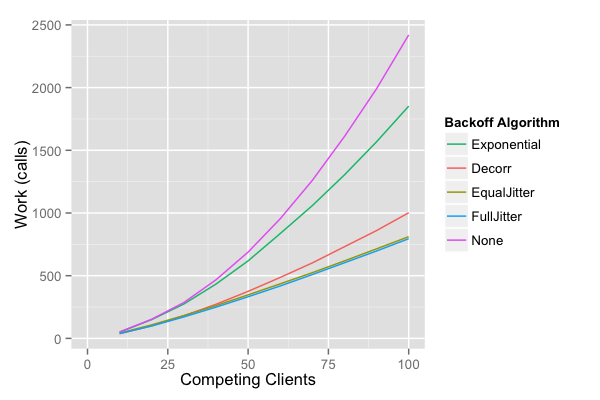
As we discussed in a previous lesson, retrying a failed operation immediately is often counterproductive. If a service is overloaded, hammering it with retries will only make things worse. The solution is exponential backoff with jitter.
- Exponential Backoff: Increase the delay between retries exponentially (e.g., 1s, 2s, 4s, 8s).
- Jitter: Add a small, random amount of time to each delay. This prevents multiple clients from retrying in lockstep, which can cause a "thundering herd" problem where waves of retries crush a recovering service.
Implementing Retries in Celery
Celery has powerful, built-in support for automatic retries. You can configure a task to retry automatically on specific exceptions, with full control over the backoff strategy.
This is another area where the "Advanced Celery for Django" article provides exactly the guidance we need.
Advanced Celery for Django: fixing unreliable background tasks
Let's revisit the 'Advanced Celery for Django' article to see how to implement automatic retries for our tasks.
First, read the section 'Best practices for exception handling and retries'. The code example shows how to use autoretry_for and retry_kwargs. Then, to understand why retries are often necessary, read 'Handling worker failures and task acknowledgments' which introduces the task_acks_late setting that enables task redelivery on worker failure.
By setting task_acks_late=True in our Celery configuration, we tell the broker not to remove a task from the queue until the worker has successfully completed it. If the worker crashes, the task remains and is redelivered. This provides at-least-once delivery, which is why idempotency is so critical.
Putting It All Together: A Reliable Task Design
Let's now combine these two pillars to create a robust process_payment task.
We'll need a model to track our idempotency keys:
# models.py
from django.db import models

class ProcessedTask(models.Model):
    class Status(models.TextChoices):
        PROCESSING = 'processing', 'Processing'
        COMPLETED = 'completed', 'Completed'
        FAILED = 'failed', 'Failed'

    idempotency_key = models.UUIDField(primary_key=True)
    task_id = models.CharField(max_length=255, unique=True) # Celery's task ID
    status = models.CharField(max_length=20, choices=Status.choices, default=Status.PROCESSING)
    created_at = models.DateTimeField(auto_now_add=True)
    updated_at = models.DateTimeField(auto_now=True)
    result = models.JSONField(null=True)
And here is the task itself, designed for reliability:
# tasks.py
import requests
from django.db import transaction
from celery import shared_task
from .models import Order, ProcessedTask

class PaymentGatewayError(Exception):
    """Custom exception for payment gateway issues."""
    pass

@shared_task(
    bind=True,
    autoretry_for=(requests.exceptions.Timeout, PaymentGatewayError),
    retry_backoff=True, # Enables exponential backoff
    retry_jitter=True,  # Adds jitter to backoff
    retry_kwargs={'max_retries': 3}
)
def process_payment(self, order_id, amount, idempotency_key):
    """
    An idempotent and reliable task to process a payment.
    """
    try:


        # transaction.atomic ensures the entire block is one DB transaction.
        with transaction.atomic():


            # get_or_create is an atomic operation.
            processed_task, created = ProcessedTask.objects.get_or_create(
                idempotency_key=idempotency_key,
                defaults={'status': ProcessedTask.Status.PROCESSING, 'task_id': self.request.id}
            )

            if not created:


                # Idempotency key already exists, this is a duplicate task.
                if processed_task.status == ProcessedTask.Status.COMPLETED:
                    print(f"Duplicate task {self.request.id}: Already completed.")
                    return processed_task.result  # Return the cached result
                elif processed_task.status == ProcessedTask.Status.PROCESSING:
                    print(f"Duplicate task {self.request.id}: Another worker is processing.")


                    # Let Celery's retry mechanism handle this, wait a bit before next attempt
                    raise self.retry(countdown=5)


                # If status was 'failed', get_or_create lets this attempt proceed.


            # If created is True, we are the first to process this key.
            print(f"Processing task {self.request.id} for order {order_id}.")
            try:


                # 1. Call external payment gateway
                response = requests.post("https://api.paymentgateway.com/charge", json={"amount": amount}, timeout=10)
                if 500 <= response.status_code < 600:


                    # Treat 5xx errors as transient and retryable
                    raise PaymentGatewayError(f"Gateway returned status {response.status_code}")
                response.raise_for_status() # Raise HTTPError for 4xx errors
                result_data = response.json()


                # 2. Update local order status
                Order.objects.filter(id=order_id).update(status='paid')


                # 3. Mark idempotency record as completed and store result
                processed_task.status = ProcessedTask.Status.COMPLETED
                processed_task.result = result_data
                processed_task.save()

                print(f"Task {self.request.id} completed successfully.")
                return result_data

            except Exception as e:


                # Business logic failed. Mark as failed before re-raising.
                processed_task.status = ProcessedTask.Status.FAILED
                processed_task.save()
                print(f"Task {self.request.id} failed during execution.")
                raise e # Re-raise to trigger Celery's autoretry mechanism

    except Exception as e:
        print(f"Task {self.request.id} failed after all retries or with an unhandled exception.")


        # After max_retries, Celery gives up and raises the exception here.
        # This is where you would log a critical error or send to a Dead-Letter Queue.
        # For example: send_alert_to_ops_team(self.request.id, e)
        raise e
Walkthrough of the Design:
- Retry Configuration: The
@shared_taskdecorator is configured to automatically retry onTimeoutexceptions or our customPaymentGatewayError, using exponential backoff with jitter, up to 3 times. - Atomic Idempotency Check: The entire logic is wrapped in
transaction.atomic. We useget_or_createon ourProcessedTaskmodel. This is the heart of our idempotency check. It atomically checks for the key and creates it if it's not there. - Handling Duplicates: If
get_or_createreturnscreated=False, we know it's a duplicate. We then inspect the record'sstatusto decide whether to return a cached result or retry after a short delay (if another worker is busy). - Executing Business Logic: If
created=True, we have the "lock" and can safely execute the payment logic. - State Management: Crucially, we update the
ProcessedTaskstatus tocompletedorfailedwithin the same transaction. If the task fails and is retried, the next attempt will see thefailedstatus and try again. - Exception Handling: We wrap the business logic in a
try...exceptblock. If an error occurs, we mark the task asfailedand then re-raise the exception. This ensures our state is saved before Celery's retry logic takes over. - Permanent Failure: The outermost
try...exceptblock catches the exception after all retries are exhausted. This is the place for "last resort" actions, like notifying an operations team.
Conclusion
Congratulations on completing this module! You've gone from understanding the "what" and "why" of asynchronous processing to designing a truly robust background job.
Key Takeaways:
- Reliable background jobs are not an accident; they are the result of deliberate design choices.
- Idempotency is the cornerstone of safety in at-least-once delivery systems. Using a database-backed idempotency key is a robust pattern to prevent duplicate side effects.
- Graceful failure handling through automatic retries with exponential backoff and jitter makes your system resilient to transient failures and kinder to downstream services.
- Combining these patterns in Celery using
transaction.atomic,get_or_create, andautoretry_forallows you to build production-grade, fault-tolerant background tasks.
Preview of the Next Module
We have now traced the full lifecycle of a request: from the network layer, through the HTTP protocol, into the OS, handled by a web server, processed by our Django application, and finally, offloaded to a reliable background task queue.
In the next module, System Design and Scaling Patterns, we will zoom out. We'll explore how to combine these individual components—web servers, load balancers, databases, caches, and task queues—into large-scale, resilient, and performant architectures. You'll learn the principles behind scaling systems horizontally and vertically and start thinking like a system architect.