Hello! Welcome to the next lesson in our journey through backend systems.
In the last lesson, we established the architectural blueprint for asynchronous task processing: the Producer, Broker, Worker, and Result Backend. We defined the broker as the central nervous system of this architecture—the message transport that decouples the application (producer) from the background task executors (workers).
Today, we will zoom in on this critical component. Our goal is to describe a message broker's core responsibilities and compare two of the most popular choices in the industry: RabbitMQ and Redis. By the end of this lesson, you'll understand the fundamental design principles of message brokers and be able to make informed decisions about which tool is right for a given job.
The Core Responsibilities of a Message Broker
Before we compare specific technologies, let's first define what a message broker does. At its heart, a broker is a piece of software that manages the flow of messages between different services. Its primary responsibilities are:
- Receiving Messages: It provides an endpoint for producers to send messages.
- Routing Messages: It directs incoming messages to the correct destination(s), known as queues. This routing can be simple (one producer, one queue, one consumer) or highly complex, involving rules, filtering, and patterns like fan-out (one message to many consumers).
- Storing Messages: It holds messages securely until a consumer is ready to process them. This ensures that tasks are not lost if workers are busy or temporarily offline. The guarantee of storage (durability) is a key feature of robust brokers.
- Delivering Messages: It delivers messages to consumers. This can happen in two main ways: a "push" model, where the broker sends messages to connected consumers, or a "pull" model, where consumers actively ask the broker for messages.
- Managing Acknowledgements: To ensure reliability, brokers manage a delivery confirmation process. A message is not considered fully processed (and can be redelivered) until a consumer sends back an acknowledgement (ACK).
The video below provides an excellent overview of the problems that message queues and the publish-subscribe pattern solve, setting the stage for why these broker responsibilities are so crucial.
Publish-Subscribe Pattern vs Message Queues vs Request Response (Detailed Discussions with Examples)
To start, let's watch this discussion from Hussein Nasser which frames the need for message queues and introduces the core concepts of decoupling and asynchronous processing that brokers enable.
Watch from 00:15 to 14:21 to understand the role of a message queue in a backend system. Then, watch from 24:09 to 26:47 to see how a broker fits into the publish-subscribe model, introducing key terms like 'topic' and 'channel'.
Now that we have a solid grasp of a broker's role, let's examine our two contenders.
Deep Dive 1: RabbitMQ - The Dedicated Postmaster
RabbitMQ is a mature, open-source message broker designed from the ground up to handle complex messaging with strong reliability guarantees. It is the quintessential example of a dedicated broker.
The AMQP Protocol and RabbitMQ's Model
RabbitMQ's native tongue is AMQP (Advanced Message Queuing Protocol). AMQP is a formal specification for a message-oriented middleware protocol. Think of it like HTTP for messaging—it defines the rules of engagement between producers, consumers, and the broker.
The core concepts in RabbitMQ's AMQP model are:
- Exchange: Receives messages from producers. It's the "post office." An exchange's job is not to store messages, but to route them based on its type and the rules provided.
- Queue: The buffer that stores messages. It's the "mailbox."
- Binding: A rule that links an exchange to a queue. It tells the exchange where to send messages.
- Routing Key: A message attribute. The exchange uses this key to decide how to route the message according to its bindings.
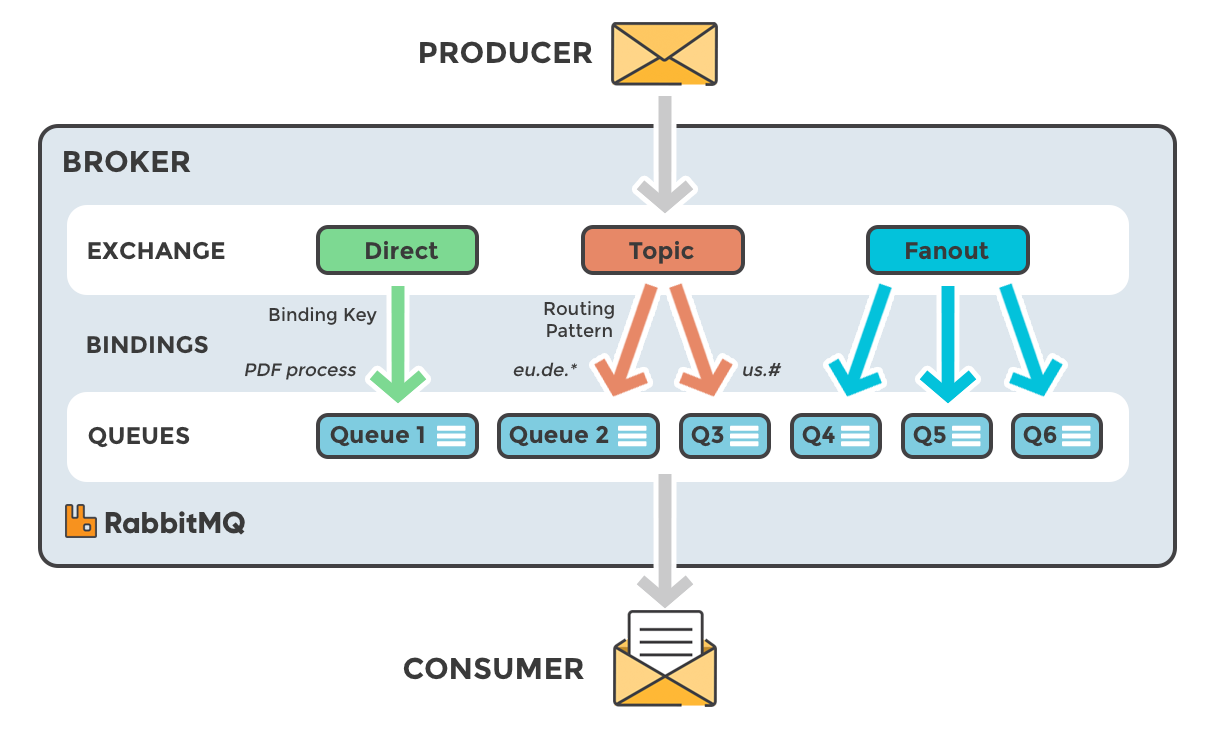
To dive deeper into these concepts, let's turn to the official RabbitMQ documentation. Given your goal to understand the root level, this is an essential read.
The official RabbitMQ documentation provides a definitive explanation of the AMQP 0-9-1 model. This will give you the precise vocabulary and mental model for how RabbitMQ works.
Please read the following sections: 'AMQP 0-9-1 Model in Brief' 'Exchanges and Exchange Types' (pay close attention to the different types: Direct, Fanout, Topic, Headers) 'Queues' 'Bindings' Focus on how these four components—Exchanges, Queues, Bindings, and Routing Keys—work together to fulfill the broker's core responsibility of routing messages.
RabbitMQ's Core Strengths
- Reliability: RabbitMQ is built for reliable delivery. It supports message acknowledgements (ACK/NACK), persistent storage for both queues and messages (so they survive a broker restart), and dead-letter queues to handle messages that fail processing.
- Complex Routing: The different exchange types (Direct, Topic, Fanout, Headers) provide immense flexibility. You can implement simple one-to-one delivery, one-to-many broadcasting (fanout), or sophisticated, pattern-based multicasting (topic). This makes it ideal for complex microservice architectures where services need to subscribe to specific categories of events.
- Interoperability: As it's based on an open standard (AMQP), it works with a wide variety of client libraries across many programming languages. It also supports other protocols like MQTT and STOMP via plugins.
Deep Dive 2: Redis - The In-Memory Speedster
Redis is fundamentally different from RabbitMQ. It's an in-memory key-value data store, not a dedicated message broker. However, its speed and data structures make it a popular and effective choice for messaging in many scenarios.
Redis's Messaging Mechanisms
Redis provides two primary ways to handle messaging:
1. Pub/Sub:
This is the simplest form of messaging in Redis.
- How it works: Publishers
PUBLISHmessages to a named channel. SubscribersSUBSCRIBEto channels they're interested in. Redis then pushes any message on a channel to all active subscribers of that channel. - Key Characteristic: This is a "fire-and-forget" model. There are no message delivery guarantees. If a subscriber is not connected when a message is published, it will never receive that message. There is no message queueing or persistence.
2. Redis Streams (Introduced in Redis 5.0):
This is a much more powerful and broker-like data structure.
- How it works: A Stream is an append-only log. Producers use
XADDto add messages to a stream. Unlike Pub/Sub, messages are stored in the stream permanently (until explicitly trimmed). - Key Features:
- Consumer Groups: This allows multiple consumers to work together to process messages from a single stream. Redis ensures each message is delivered to only one consumer within the group, effectively enabling load balancing.
- Persistence: Messages are stored in memory but can also be persisted to disk, just like any other Redis data.
- Acknowledgements: Consumers must explicitly acknowledge messages with
XACKafter processing. If a consumer fails without acknowledging, the message can be redelivered to another consumer in the group.

Redis's Core Strengths
- Performance: Because it primarily operates in memory, Redis is incredibly fast, capable of handling millions of messages per second with sub-millisecond latency.
- Simplicity: The basic Pub/Sub model is extremely simple to implement. Even Streams, while more complex, have a more straightforward API compared to the full AMQP model.
- Versatility: This is a huge practical advantage. If you are already using Redis for caching or as a result backend (as we saw in the previous lesson), using it as a broker as well means you have one less piece of infrastructure to manage.
Comparison: RabbitMQ vs. Redis
Now, let's put them head-to-head across the key responsibilities of a broker. This article provides an excellent summary of the differences.
Redis vs RabbitMQ - Key Differences
The article 'Redis vs RabbitMQ - Key Differences' from Airbyte offers a concise and structured comparison. We will use it to frame our analysis.
Read the sections from 'How Do RabbitMQ vs Redis Compare Across Key Dimensions?' up to the end of the 'FAQ'. Pay special attention to the comparison table and the discussions on Delivery Characteristics, Performance, and Use Cases.
Let's synthesize this into a clear comparison table:
| Feature | RabbitMQ | Redis |
|---|---|---|
| Primary Design | Dedicated Message Broker | In-Memory Data Store (with messaging capabilities) |
| Protocol | AMQP, MQTT, STOMP | RESP (Redis Serialization Protocol) |
| Message Routing | Highly flexible and complex via exchanges (direct, topic, fanout, headers). | Simple routing. Pub/Sub: Channel-based broadcasting. Streams: Append-only log with consumer groups. |
| Delivery Guarantees | Very High. At-least-once delivery via consumer ACKs/NACKs and persistent queues. | Configurable. Pub/Sub: None ("fire-and-forget"). Streams: At-least-once delivery via consumer groups and ACKs. |
| Persistence | High. Messages and queues can be marked as durable and are written to disk. | Optional. Can be configured to persist to disk (RDB snapshots or AOF logs), but the default is in-memory. |
| Performance | High throughput, but overhead from reliability features. Predictable performance under heavy load. | Extremely High. Very low latency due to in-memory operations. Can handle millions of ops/sec. |
| Complexity | Higher learning curve due to the AMQP model (exchanges, bindings, etc.). | Lower learning curve. Pub/Sub is trivial. Streams are more involved but still simpler than AMQP. |
| Best For | Mission-critical tasks, complex routing scenarios, decoupling many microservices, guaranteed task execution. | High-speed processing, real-time notifications, caching, leaderboards, and scenarios where extreme performance outweighs reliability needs. |
This video offers a candid critique of RabbitMQ's complexity versus other systems, which aligns with the "deepest level" perspective you're seeking.
For a critical perspective on these design choices, let's revisit Hussein Nasser's channel. In this clip, he discusses the trade-offs of RabbitMQ's complex, abstraction-heavy design.
Watch from 33:19 to 41:16. He compares RabbitMQ's 'push' model and its complexity with the 'pull' model of other systems like Kafka and the simpler approach of Redis. This highlights the real-world implications of these architectural decisions.
Conclusion
You now understand not just what a message broker does, but also the fundamental design differences between two industry giants, RabbitMQ and Redis. This knowledge is crucial for designing robust and efficient backend systems.
Key Takeaways:
- A message broker's core responsibilities are to receive, route, store, deliver, and ensure the reliable processing of messages, decoupling producers from consumers.
- RabbitMQ is a feature-rich, dedicated message broker built on the AMQP standard. It excels at reliability and complex routing, making it the go-to choice for mission-critical tasks and intricate microservice communication.
- Redis is an in-memory data store that serves as a broker through its Pub/Sub and Streams features. It excels at raw speed and simplicity, making it ideal for real-time applications or when you're already using it for caching and its messaging features are "good enough."
- The choice is a trade-off: RabbitMQ prioritizes reliability and flexibility, while Redis prioritizes performance and simplicity.
Preview of the Next Lesson
We've touched on terms like "Pub/Sub" and "event-driven architectures." In our next lesson, we will formalize this. We will explain the pub/sub pattern and how it enables event-driven architectures for service decoupling. This will build directly on the concepts of exchanges and channels we learned today, showing you how to design systems where services react to events rather than making direct requests to one another.