Hello! Let's dive into the next topic in our exploration of advanced database patterns.
In the previous lesson, we established database normalization, particularly up to Third Normal Form (3NF), as the gold standard for designing transactional databases. We saw how it eliminates data redundancy to protect against anomalies and ensure data integrity. However, we ended with a critical observation: a highly normalized schema often requires numerous JOIN operations to assemble a complete view of your data, which can be slow for complex, read-heavy queries.
This lesson addresses that exact problem. We will now explore the other side of the coin: denormalization. Our goal is to describe denormalization as a performance optimization technique, outlining its trade-offs. You'll learn that breaking the rules of normalization isn't always a mistake; sometimes, it's a calculated and powerful strategy.
What is Denormalization?
At its core, denormalization is the process of intentionally introducing redundancy into a database schema to improve read performance. Instead of striving to eliminate every piece of duplicate data, you strategically add it back in to avoid costly JOIN operations.
This might sound counter-intuitive after our last lesson, but it's a pragmatic engineering decision. Let's look at a classic example.
In what way does denormalization improve database performance?
The top-rated answer on a Stack Overflow question, 'In what way does denormalization improve database performance?', provides a simple, excellent example involving posts and comments on a blog.
Read the first answer by user 'Pascal MARTIN'. Focus on the 'Posts' and 'Comments' table example. Note how adding a 'number of comments' field changes the query pattern and what the associated costs are.
As the example illustrates:
- Normalized approach: To show a list of posts with their comment counts, you would need to either query the
Commentstable for each post or perform a complexGROUP BYquery joiningPostsandComments. - Denormalized approach: By adding a
comment_countcolumn to thePoststable, you can fetch the post list and comment counts in a single, simple query.
Here is a visual representation of how denormalization might look in a schema. Data from a related table is duplicated into the main table to make it more readily accessible.

The Fundamental Trade-Off: Read Speed vs. Write Complexity
Denormalization is a classic time-space trade-off, but more accurately, it's a read-time vs. write-time trade-off.
In what way does denormalization improve database performance?
Let's revisit the Stack Overflow page to read another answer that frames this concept perfectly.
Read the second answer by user 'ewernli'. It concisely explains the time-space trade-off and highlights the core tension between read and update performance.
Let's break down the pros and cons:
Pros (The "Speed Boost"):
- Faster Read Performance: This is the primary goal. By reducing or eliminating
JOINs, queries become simpler and faster. The database has to do less work, fetching data that is already pre-joined or pre-calculated. - Simpler Queries: Application code becomes simpler as complex join logic is no longer needed for common read patterns.
Cons (The "Integrity Guardian's" Concerns):
- Slower Write Performance: Every time you write, you now have to update data in multiple places. In the blog example, adding a comment now requires two operations: inserting the comment and incrementing the
comment_countin thePoststable. This adds overhead and complexity. - Increased Storage: You are storing redundant data, which naturally takes up more disk space.
- Data Inconsistency Risk: This is the most significant danger. If you fail to update the redundant data everywhere, your database will contain conflicting information. For example, if the
comment_countupdate fails, thePoststable will show an incorrect count. This is a direct violation of data integrity.
This image provides an excellent summary of the balancing act between normalization and denormalization.
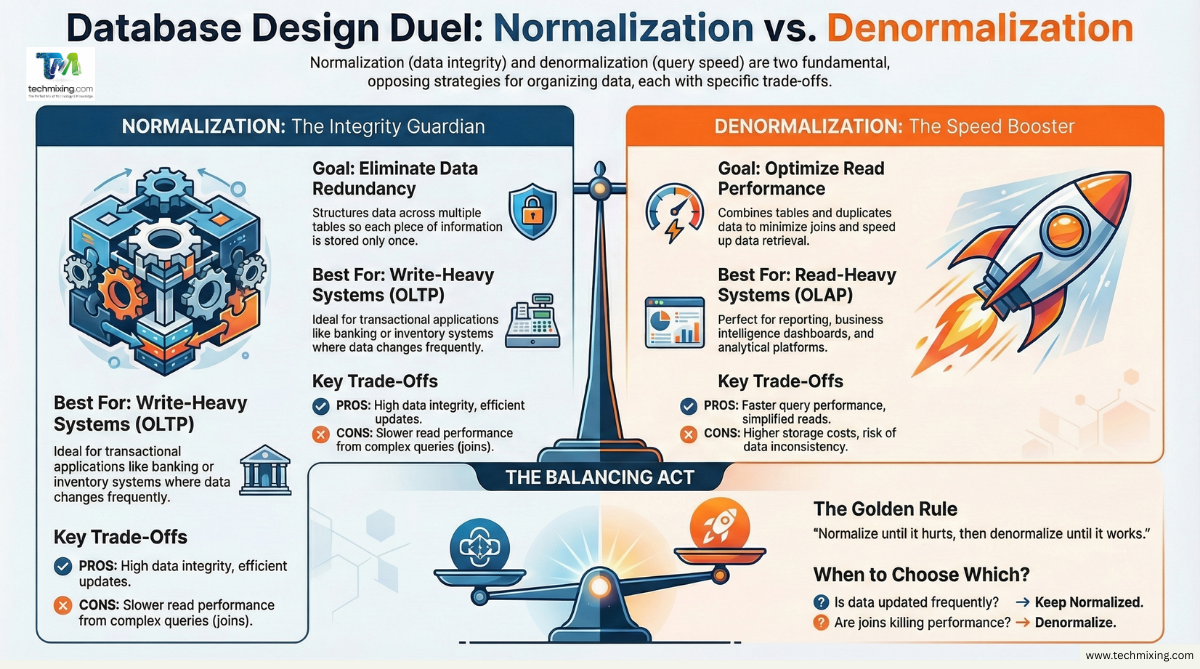
Why Denormalize? The Performance Impact of Joins
Since your goal is to understand the deep technical "why," let's go further than just saying "joins are slow." Why are they slow, and by how much?
Complex queries that join multiple large tables are one of the most CPU and I/O-intensive operations a database performs. Research has shown that a disproportionate amount of database resources are spent on them.
[PDF] Optimizing system performance in large-scale backend architectures
This excerpt from a research paper provides some concrete numbers on the performance impact of joins and the benefits of denormalization.
Read the first two paragraphs of section 4.3, 'Data Denormalization and Materialized Views'. Focus on the statistics cited, such as the percentage of CPU resources consumed by joins and the performance improvement seen in the case study.
As the paper highlights, joins can consume 45-60% of database CPU resources despite being a minority of queries. Denormalizing a schema in one case study reduced query time from 1,240ms to 95ms—a performance increase of over 10x. This is the kind of impact that motivates engineers to accept the trade-offs.
To truly understand this dilemma, it helps to think about the database in two layers.
Learn Database Denormalization
The video 'Learn Database Denormalization' introduces a very useful mental model: the 'logic layer' vs. the 'processing layer' of a database.
Watch from 07:51 to 15:38. This section explains that while performance issues should ideally be solved in the 'processing layer' (with indexes, etc.), sometimes the only way to get the required speed is to change the 'logic layer' (the schema) through denormalization.
The key takeaway from the video is that denormalization is often a last resort. You should first try to optimize performance using processing-layer tools like indexes, query optimization, and caching. However, for extremely read-heavy workloads or when those methods aren't enough, modifying the logical schema via denormalization becomes a valid and necessary strategy.
When to Denormalize? Common Use Cases
Given the trade-offs, denormalization is not something you apply everywhere. It is best suited for specific scenarios:
- Read-Heavy Systems: If your application reads data far more often than it writes it (e.g., a product catalog, a blog, a social media feed), the performance benefit for reads can outweigh the cost of slower writes.
- Reporting and Analytics (OLAP): Data warehouses and business intelligence systems are prime candidates for denormalization. These systems are designed for a few users running very complex queries over huge datasets. Data is typically loaded in large batches (e.g., overnight), so the write-performance penalty is less of a concern, and the risk of update anomalies can be managed within the batch-loading process.
Learn Database Denormalization
The same video provides a great overview of denormalization in the context of a read-only Data Mart.
Watch from 16:14 to 18:29. This part discusses how structures like 'fact' and 'dimension' tables in data marts are deliberately denormalized to make reporting queries simple and efficient.
A Practical Technique: Materialized Views
Manually keeping redundant data in sync is difficult and error-prone. Fortunately, modern databases provide features to help manage this. One of the most powerful is the materialized view.
A regular view is a stored query that is executed every time you access it. A materialized view, on the other hand, is a stored query whose results are physically stored on disk. It's essentially a table that the database automatically populates based on a query. This is a form of denormalization, as it pre-calculates and stores the result of joins and aggregations.
Count Millions of Rows Fast with Materialized Views: Databases for Developers: Performance #6
This video from 'The Magic of SQL' offers an excellent and clear explanation of materialized views, how they work, and their trade-offs.
Please watch the following segments: 00:00 - 02:40: What are materialized views and how do they differ from regular views? 03:27 - 04:28: The problem of 'staleness' and the need to refresh the view. 09:03 - 10:52: The concept of 'stale tolerated' data and the trade-off between data freshness and performance. This will give you a solid understanding of this powerful technique.
The concept of staleness is the crucial trade-off with materialized views. The data in the view is only as fresh as its last refresh. This forces a conscious decision:
- Do you need data to be 100% real-time and consistent? If so, you probably can't use a materialized view and must stick to a normalized schema.
- Is it acceptable for data to be a few minutes or even an hour old for a given use case (like a dashboard)? If yes, a materialized view that refreshes periodically is a fantastic way to get massive performance gains.
Conclusion
Today we've dismantled the idea that normalization is the only "correct" way to design a database. You've learned that denormalization is a deliberate and powerful optimization strategy driven by the need for high-performance reads.
Key Takeaways:
- Denormalization is the intentional introduction of data redundancy to reduce joins and improve read performance.
- It represents a fundamental trade-off: faster reads vs. slower, more complex writes and an increased risk of data inconsistency.
- The primary motivation is to avoid expensive
JOINoperations, which can be a major performance bottleneck in read-heavy applications. - It's most appropriate for read-heavy systems, such as reporting dashboards, analytics platforms (OLAP), and content delivery applications.
- Techniques like materialized views allow the database to manage pre-computed and denormalized data, helping to automate the process, though you still have to manage the trade-off of data staleness.
Preview of the Next Lesson
We've just spent two lessons discussing how to design schemas to either enforce integrity (normalization) or optimize for reads (denormalization by avoiding joins). But what happens when you do need to perform a join? How does the database actually execute it under the hood?
In the next lesson, we will dive into the database engine itself and explore how it executes joins. We'll cover common join algorithms like the Nested Loop Join, Hash Join, and Merge Join, and learn how the query planner chooses between them. This will give you an even deeper appreciation for why avoiding joins can be so beneficial.