Hello! Welcome to the third lesson in our module on Web Servers and Application Runtimes.
In the previous lesson, we established the "what" and "why" behind the common two-tier architecture: a web server like Nginx facing the internet and an application server like Gunicorn running your Python code. We saw that Nginx excels at handling massive numbers of concurrent connections using an "event-driven" model, while Gunicorn manages application instances using a "pre-fork" model.
Today, we're going to dive into the "how." This lesson is dedicated to understanding those very models. The goal is to describe web server worker models (pre-fork, threaded, and event-driven) and their trade-offs. Understanding these concurrency strategies is fundamental to designing, deploying, and debugging scalable backend systems. It explains why some servers are better for certain tasks than others and is a crucial piece of the "root level" knowledge you're seeking.
The Fundamental Problem: Handling Concurrency
Remember the simple TCP server we built in the first lesson of this module? It could only handle one client at a time. If it was busy with one client, any other client that tried to connect would have to wait. This is known as a blocking, single-process, single-thread server. For any real-world application, this is not a viable option.
Web servers need to handle thousands of requests concurrently. How a server chooses to manage these concurrent requests is defined by its worker model. The three main approaches we'll explore are all different solutions to this concurrency problem.
Model 1: The Process-Based (Pre-fork) Model
This is the model used by Gunicorn and older versions of the Apache web server (using the mpm_prefork module). The strategy is straightforward and robust.
- A single master process starts up. Its job is to manage everything.
- The master process then creates, or "forks," a number of worker processes before accepting any requests. This is why it's called a pre-fork model.
- These worker processes are essentially clones of the master. They each listen for incoming connections on the same socket.
- When a new request arrives, the operating system hands it off to one of the available, idle worker processes.
- That single worker process handles the entire request from start to finish. While it's busy, it cannot handle any other requests.
Trade-offs of the Pre-fork Model:
- Pro: Simplicity and Isolation. This is its greatest strength. Each request is handled in its own isolated process. If a worker process crashes due to a bug in your application code, it doesn't affect the master or any other worker. The master process will even gracefully restart the crashed worker. This makes the system very resilient. The code you write for the application can be simple, synchronous, and blocking, without worrying about complex synchronization issues.
- Con: High Memory Consumption. Processes are heavyweight. Each process has its own separate memory address space, which means resources (like your application's code and data) are duplicated in memory for every single worker. If you need to handle 100 concurrent requests, you need 100 workers, and your memory usage will be
100 * (memory per worker). This model scales poorly in terms of memory, especially for applications that handle many long-lived connections.
Model 2: The Thread-Based Model
This model is a common alternative, used by servers like Apache (mpm_worker module) and many Java application servers. Instead of using heavy processes, it uses lighter-weight threads.
- The server starts one or more processes.
- Each process manages a pool of threads.
- When a request arrives, it's assigned to an available thread within one of the processes.
- That thread handles the entire request.
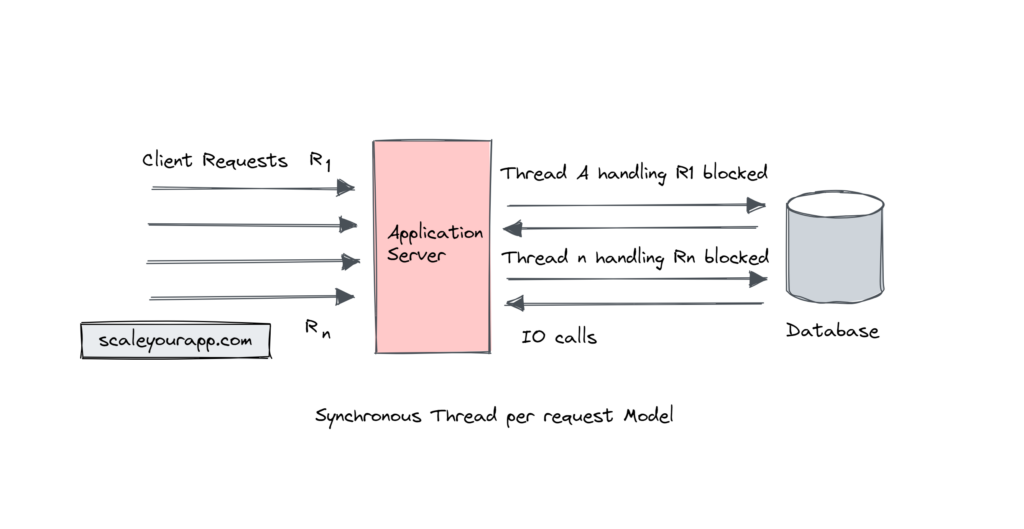
Trade-offs of the Thread-Based Model:
- Pro: Lower Memory Usage (than pre-fork). Threads within the same process share the same memory address space. This means they are much "lighter" than processes, as application code and data aren't duplicated. You can run many more threads than processes on the same hardware.
- Pro: Efficient Data Sharing. Because threads share memory, it's easy to share data between them, such as in-memory caches.
- Con: Synchronization Complexity. Shared memory is also a major source of complexity and bugs. If multiple threads try to modify the same data at the same time, you can get race conditions. To prevent this, you must use synchronization primitives like locks (mutexes). This is notoriously difficult to get right and can lead to performance bottlenecks or deadlocks (where threads are all waiting on each other and nothing progresses).
- Con (for Python): The Global Interpreter Lock (GIL). In CPython (the standard Python interpreter), the GIL ensures that only one thread can execute Python bytecode at any given time. This means that for CPU-bound tasks, multithreading provides no performance benefit on multi-core CPUs. It's still useful for I/O-bound tasks, as a thread can release the GIL while waiting for network or disk operations, allowing another thread to run.
To get a formal understanding of both process-based and thread-based models, the following text provides an excellent, detailed breakdown.
Let's formalize these concepts. The following text from the paper 'Server Architectures' provides a detailed breakdown of models based on processes and threads, which are collectively known as thread-based architectures.
Please read the subsections 'Thread-based Server Architectures', 'Multi-Process Architectures', and 'Multi-Threaded Architectures'. Focus on: The core idea of associating one connection with one activity (process or thread). The concept of 'preforking' in the multi-process model. The differences in memory usage and resource sharing between processes and threads. The trade-offs mentioned under 'Scalability Considerations for Multi-Threaded Architectures'.
Model 3: The Event-Driven (Asynchronous) Model
This is the model that powers modern, high-performance servers like Nginx. It takes a fundamentally different approach to concurrency.
Instead of dedicating a process or thread to each connection, an event-driven server uses a small, fixed number of worker processes (often just one per CPU core). Each worker is single-threaded and runs an event loop.
- The worker tells the OS kernel, "Here are all the connections I'm managing. Let me know when something happens on any of them." It does this using a highly efficient event notification interface like
epoll(on Linux) orkqueue(on macOS/BSD). - The worker then waits. It doesn't consume CPU while waiting.
- When an event occurs (e.g., a new connection arrives, or an existing client sends data), the kernel wakes up the worker and tells it exactly which connection(s) are ready for work.
- The worker processes the event(s) by executing a small amount of code (e.g., reading the incoming data from the socket). Crucially, this operation must be non-blocking. It must execute quickly and return control to the event loop.
- The loop repeats. The worker goes back to waiting for the next batch of events.
Because a worker never blocks waiting for a single connection, it can efficiently juggle thousands—or even tens of thousands—of connections simultaneously within a single thread.
Let's continue with the 'Server Architectures' resource to get a theoretical grounding in this model.
Now, let's look at the model used by Nginx. This next section from the same text explains the event-driven approach.
Read the sections 'Event-driven Server Architectures' and 'Scalability Considerations for Event-driven Architectures'. Pay attention to: How a single thread can handle many connections using an 'event loop'. The role of non-blocking I/O and event notification interfaces like epoll. The key scalability benefit: avoiding the overhead of one thread/process per connection.
A Deeper Look: Nginx and epoll
You now understand the theory. To see how this works at the "root level" in a server like Nginx, let's watch the part of the video from our last lesson that explains the underlying mechanism making it all possible.
How NGINX Handles MILLIONS of Requests With Just 1 Process 🔥
The theory of the event loop is clear, but the magic lies in how the operating system efficiently notifies the server about events. This video gives a fantastic, detailed explanation of this low-level mechanism.
Watch the segment from 04:32 to 09:18. The video explains: How efficient system calls like epoll are the key to monitoring thousands of connections at once. The flow of an event: the OS notifies the event loop, which handles the ready connection and then immediately asks epoll for the next event. Why this model is 'non-blocking' and 'ultra responsive', especially for I/O-bound tasks.
Trade-offs of the Event-Driven Model:
- Pro: Incredible Scalability for I/O. This model is unmatched for handling a massive number of concurrent connections with minimal memory and CPU overhead. This is why it's perfect for web servers, proxies, and load balancers that primarily shuffle bytes around.
- Con: Not for CPU-Bound Work. This is its Achilles' heel. If you run a long, CPU-intensive task (like complex calculations or image processing) inside the event loop, the entire worker process will be blocked. Since it's single-threaded, it won't be able to handle any of its other thousands of connections until that task is finished.
- Con: Programming Complexity. Writing code in a non-blocking, asynchronous style can be less intuitive than writing simple, sequential code. It often involves callbacks, futures, or
async/awaitsyntax, which can make control flow harder to reason about.
Summary and Comparison
Each model has a distinct profile of strengths and weaknesses. The best choice always depends on the workload.
| Feature | Pre-fork (Process-based) | Thread-based | Event-driven (Asynchronous) |
|---|---|---|---|
| Concurrency Unit | Process | Thread | Event handler (in one thread) |
| Memory Usage | High (isolated memory per worker) | Medium (shared memory, but stack per thread) | Very Low (one process handles many connections) |
| Best for... | CPU-bound tasks, running untrusted code | Mixed or I/O-bound tasks (with GIL caveats) | Highly I/O-bound tasks (many connections) |
| Key Pro | Stability, Isolation, Simplicity | Lighter than processes, shared state | Extreme scalability, low resource use |
| Key Con | High memory usage, slow context switch | Synchronization complexity, deadlocks | Blocks on CPU-bound work, complex code |
| Examples | Gunicorn, Apache (prefork) | Apache (worker), Tomcat | Nginx, Node.js, asyncio |
To reinforce these trade-offs, the following resource provides excellent diagrams and focuses on the performance implications.
Process and Thread Architecture Patterns
To consolidate these concepts, the following blog post offers another perspective with helpful diagrams and a focus on performance. It's a great way to review the key trade-offs.
Please review these sections: 'Architecture Comparison': Look at the sequence diagrams for 'Multi Process/Single Thread' (pre-fork) and 'Single Process/Multi Thread' (threaded). Contrast them with the 'Single Process/Single Thread' diagram, which represents the core of an event-driven worker. 'I/O-Intensive Workload Considerations': This section provides a fantastic comparison of resource consumption (memory, context switching) between multi-threaded and event-driven models. This is a crucial takeaway. 'Summary': This gives a concise overview of the real-world applications for each model.
The Hybrid Approach: Best of Both Worlds
You've probably realized that our Nginx + Gunicorn setup is a hybrid model.
- Nginx (Event-driven): Sits at the edge, using its highly scalable event loop to handle tens of thousands of incoming connections, serve static files, and manage slow clients. It's perfect for this I/O-intensive job.
- Gunicorn (Pre-fork): Sits behind Nginx, running a handful of pre-forked worker processes. Nginx only forwards clean, ready-to-process requests to Gunicorn. Your Django application code runs inside these workers. This is ideal because your application logic might be CPU-bound at times, and the process isolation of Gunicorn's workers provides stability. A bug in your Django view won't take down the entire server.
This architecture masterfully combines the strengths of the event-driven model (for I/O scalability) and the pre-fork model (for application stability and simplicity).
Conclusion
You now have a deep understanding of the core concurrency strategies that power modern web servers. This isn't just abstract theory; it directly explains why we build our systems the way we do.
Key Takeaways:
- Pre-fork (Process-based): Offers maximum stability and simplicity at the cost of high memory usage. Ideal for running application code (like Gunicorn).
- Thread-based: A middle ground that's more memory-efficient than processes but introduces significant complexity and risk with synchronization.
- Event-driven (Asynchronous): Exceptionally scalable for I/O-bound tasks with very low resource usage, but unsuitable for CPU-bound work. The foundation of high-performance proxies and web servers (like Nginx).
- Hybrid Architecture: Combining models (like Nginx + Gunicorn) allows us to use the right tool for the right job, achieving both scalability at the edge and stability for our application logic.
Preview of the Next Lesson:
We've repeatedly mentioned that Nginx acts as a "reverse proxy" for Gunicorn. In the next lesson, we will formally define the purpose of a reverse proxy and its common use cases, such as load balancing and SSL termination. You'll see how this pattern is not just for connecting a web server to an application server but is a cornerstone of scalable system design.