Hello! In our last two lessons, you successfully built feature extractors for both images and text, turning raw data into meaningful numerical vectors. We now have the core components from the two primary data modalities.
Today's lesson focuses on preparing the final pieces of the puzzle: the metadata. Your learning outcome is to encode categorical (e.g., school type) and temporal (e.g., season) metadata into numerical features. This is a crucial step in feature engineering, ensuring that all information, regardless of its original format, can be understood by our machine learning model. By the end of this lesson, you will be able to convert non-numeric and time-based data into a format ready for fusion with your image and text vectors.
A Roadmap for Encoding Metadata
Before we can feed metadata into a neural network, we must convert it into numbers. However, the way we convert it matters immensely. Different types of data require different encoding strategies to preserve their meaning.
The diagram below provides an excellent overview of various categorical data types and their recommended encoding methods. We will be focusing on Nominal and Cyclic data today.
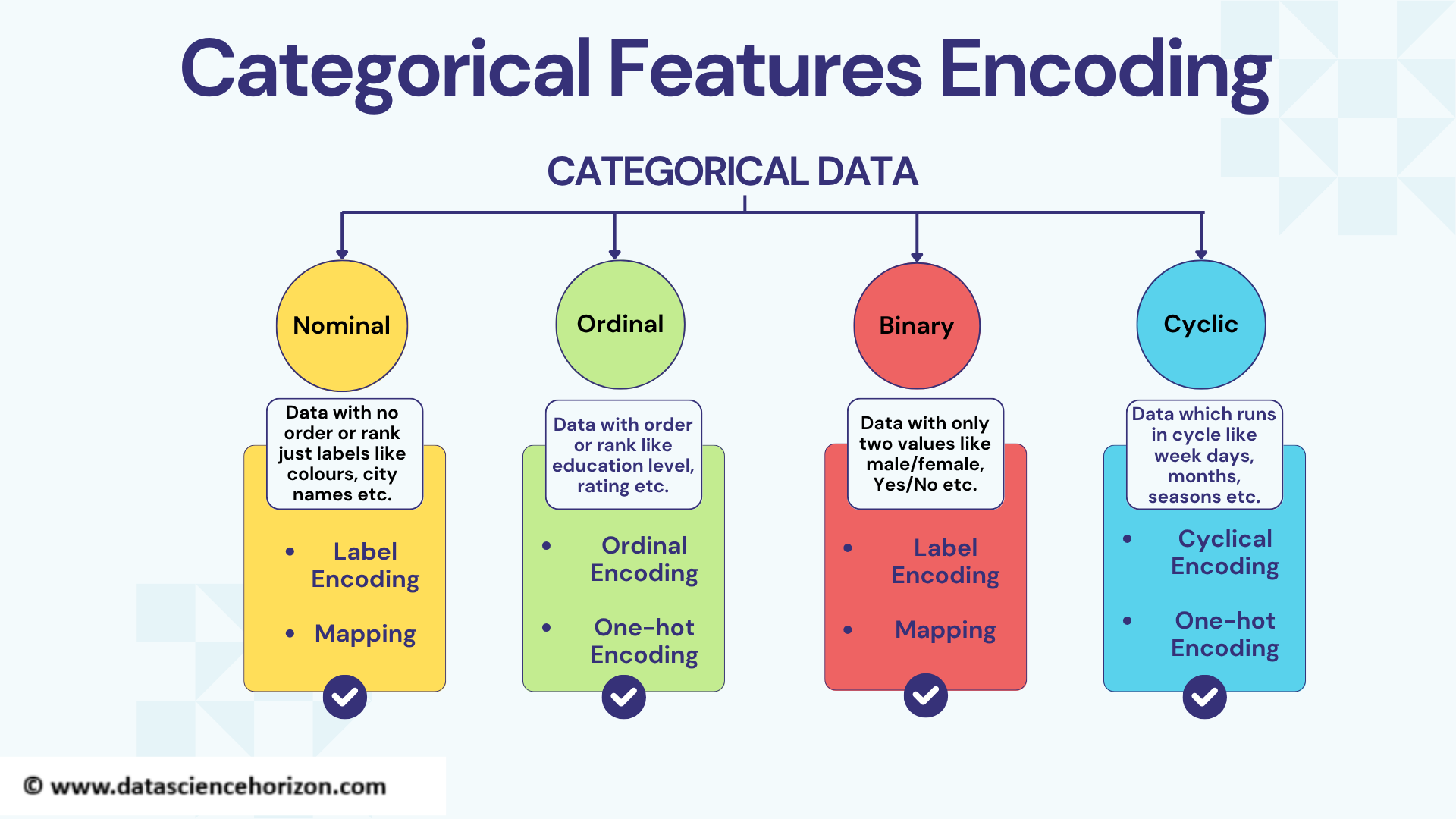
Part 1: Encoding Nominal Categorical Data
Your project metadata includes features like school type (e.g., 'government', 'aided') or location (e.g., 'urban', 'rural'). These are examples of nominal categorical data: they are distinct labels with no inherent order. 'Government' is not "greater" or "less than" 'aided'; they are simply different categories.
A naive approach would be to assign integers: government=0, aided=1. However, this introduces an artificial order that can mislead a model into thinking there is a mathematical relationship between the categories. The standard and most effective solution is One-Hot Encoding. This technique converts a single column of categories into multiple new binary (0 or 1) columns, one for each unique category.
For example, a school_type column would become:
| school_type | school_type_government | school_type_aided |
|---|---|---|
| government | 1 | 0 |
| aided | 0 | 1 |
| government | 1 | 0 |
This representation is unambiguous and does not imply any ordinal relationship. The following video provides a clear explanation of different data types and demonstrates how to perform one-hot encoding.
Encoding Categorical Data | Machine Learning Fundamentals
This video by Kody Simpson clearly defines nominal and ordinal data and then demonstrates how to use pandas.get_dummies for one-hot encoding, which is a highly practical and efficient method.
First, watch the segment that explains nominal data, where categories have no inherent order. This directly applies to features like school type. Then, watch the demonstration of one-hot encoding with Pandas. Pay close attention to how the pd.get_dummies function transforms the 'color' column into multiple binary columns. This is the exact technique you can use for your project.
For your project, using pandas.get_dummies is the most straightforward way to handle nominal features. Given a DataFrame df with a column 'school_type', the implementation is as simple as:
import pandas as pd


# Sample data mimicking your project's metadata
data = {'school_type': ['government', 'aided', 'government', 'private'],
        'region': ['rural', 'urban', 'urban', 'rural']}
df = pd.DataFrame(data)


# Apply one-hot encoding to specified columns
df_encoded = pd.get_dummies(df, columns=['school_type', 'region'], prefix=['school', 'reg'])

print(df_encoded.head())


# Output:
#    school_government  school_private  school_aided  reg_rural  reg_urban
# 0                  1               0             0          1          0
# 1                  0               0             1          0          1
# 2                  1               0             0          0          1
# 3                  0               1             0          1          0
Part 2: Encoding Temporal (Cyclic) Data
Your project also involves temporal features, like the season or month a complaint was filed. These features are cyclic. For example, December is followed by January, and Sunday is followed by Monday. If we encode months linearly (Jan=1, Feb=2, ..., Dec=12), our model will think that December (12) and January (1) are very far apart, when in reality they are adjacent.
To solve this, we use Cyclical Encoding. The core idea is to map the cyclical feature onto a circle using sine and cosine transformations. This way, the end of the cycle connects smoothly back to the beginning.
The article "Cyclic Encoding in Machine Learning" explains this concept brilliantly.
Cyclic Encoding in Machine Learning : A Practical Guide ...
This article provides an excellent intuition and practical guide for why and how to encode cyclical features using sine and cosine transformations.
Please read the following sections: Start from the beginning and read the introduction, which clearly explains the problem of representing cyclical data linearly. Continue to the section "How Cyclic Encoding Works" and focus on the mathematical formulation. This will show you the exact sine and cosine formulas. Finally, read the Best Practices section to understand key implementation details, such as always using the sine and cosine features together.
As the article explains, for a variable v with a maximum value max_v (e.g., 12 for months), we create two new features:
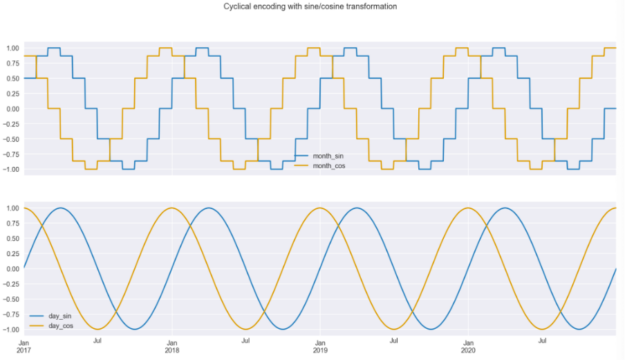
This transformation maps each point in the cycle to a unique (x, y) coordinate on a unit circle, perfectly preserving the cyclical nature of the data. The image below shows what this looks like for 'month' and 'day' features. Notice how the values form smooth, continuous waves.
Here's how you can implement this for a 'month' feature in Python. First, you'll need to extract the month from a date string. Python's built-in datetime library is perfect for this.
Python Tutorial: Datetime Module - How to work with Dates, Times, Timedeltas, and Timezones
If you need a refresher on handling dates and times in Python, this comprehensive tutorial by Corey Schafer is an excellent resource.
You can quickly review how to parse a date string using strptime and how to access components like the month or day from a datetime object.
Once you have the numerical month, you can apply the cyclical encoding:
import numpy as np
import pandas as pd
from datetime import datetime


# Sample data with timestamps
data = {'timestamp': ['2023-01-15', '2023-07-20', '2023-12-25']}
df = pd.DataFrame(data)


# 1. Convert string to datetime objects
df['datetime'] = pd.to_datetime(df['timestamp'])


# 2. Extract the month (1-12)
df['month'] = df['datetime'].dt.month


# 3. Apply cyclical encoding
max_val = 12  # Maximum value for month is 12
df['month_sin'] = np.sin(2 * np.pi * df['month'] / max_val)
df['month_cos'] = np.cos(2 * np.pi * df['month'] / max_val)


# Note: We drop the original 'month' column as it's now redundant
print(df[['timestamp', 'month_sin', 'month_cos']].head())


# Output:
#     timestamp  month_sin  month_cos
# 0  2023-01-15   0.500000   0.866025  (January)
# 1  2023-07-20  -0.500000  -0.866025  (July)
# 2  2023-12-25   0.000000   1.000000  (December, note sin is ~0, cos is 1)
A Practical Function for Your Pipeline
To make this easy to integrate into your project, you can create a single function that processes all your metadata at once. This function can take a Pandas DataFrame, identify which columns are categorical and which are temporal, and apply the correct encoding.
import pandas as pd
import numpy as np

def encode_metadata(df: pd.DataFrame, categorical_cols: list, temporal_cols: dict) -> pd.DataFrame:
    """
    Encodes categorical and temporal metadata columns in a DataFrame.

    Args:
        df (pd.DataFrame): The input DataFrame.
        categorical_cols (list): A list of column names to be one-hot encoded.
        temporal_cols (dict): A dictionary where keys are temporal columns (e.g., 'month')
                              and values are their max period (e.g., 12).

    Returns:
        pd.DataFrame: A new DataFrame with encoded features.
    """


    # Create a copy to avoid modifying the original DataFrame
    df_encoded = df.copy()


    # --- Temporal Encoding ---
    # First, ensure temporal columns are derived if needed (e.g., from a 'timestamp' column)
    if 'timestamp' in df_encoded.columns:
        dt_series = pd.to_datetime(df_encoded['timestamp'])
        if 'month' in temporal_cols:
            df_encoded['month'] = dt_series.dt.month
        if 'day_of_week' in temporal_cols:
            df_encoded['day_of_week'] = dt_series.dt.dayofweek # Monday=0, Sunday=6

    for col, max_val in temporal_cols.items():
        df_encoded[f'{col}_sin'] = np.sin(2 * np.pi * df_encoded[col] / max_val)
        df_encoded[f'{col}_cos'] = np.cos(2 * np.pi * df_encoded[col] / max_val)


    # --- Categorical Encoding ---
    df_encoded = pd.get_dummies(df_encoded, columns=categorical_cols, prefix_sep='_')


    # --- Clean up ---
    # Drop original columns that have been encoded
    cols_to_drop = list(temporal_cols.keys())
    if 'timestamp' in df_encoded.columns:
        cols_to_drop.append('timestamp')

    df_encoded = df_encoded.drop(columns=cols_to_drop, errors='ignore')

    return df_encoded


# --- Example Usage ---
if __name__ == "__main__":


    # Your real data would come from your scraped datasets
    sample_data = {
        'timestamp': ['2023-01-15', '2023-05-10', '2023-12-30'],
        'school_type': ['government', 'aided', 'government'],
        'region': ['rural', 'urban', 'rural']
    }
    metadata_df = pd.DataFrame(sample_data)

    final_features = encode_metadata(
        df=metadata_df,
        categorical_cols=['school_type', 'region'],
        temporal_cols={'month': 12}
    )

    print("--- Final Encoded Metadata Features ---")
    print(final_features.head())
Conclusion
You have now learned how to transform categorical and temporal metadata into numerical features suitable for a machine learning model. This is a vital skill in any data science project, as real-world data is rarely in a ready-to-use format.
Here are the key takeaways from this lesson:
- Nominal categorical data (like
school type) should be encoded using one-hot encoding to avoid creating a false sense of order.pandas.get_dummiesis an excellent tool for this. - Cyclic temporal data (like
monthorday of week) requires cyclical encoding with sine and cosine transformations to preserve the "wrap-around" nature of time. - These encoded features are now ready to be concatenated with the image and text vectors you prepared earlier.
In our next lesson, we will finally bring all these different feature vectors together. You will learn about multimodal fusion architectures, specifically a "late fusion" approach, and build a model that combines image, text, and metadata insights to make a single, powerful prediction.