Introduction
Hello! Over the last few lessons, we've explored the dynamic features of connected speech that make English flow naturally: linking, elision (dropping sounds), and assimilation (changing sounds). These happen spontaneously in conversation.
Today, we'll focus on contractions, which are a standardized and written form of these same principles. Contractions like I'm, he's, and don't are not just informal slang; they are a fundamental part of standard spoken English, including in professional settings. Mastering them is a crucial step toward your goal of speaking clear, fluent English for your career.
By the end of this lesson, you will be able to produce common contractions accurately in sentences, which will significantly improve your rhythm and naturalness in preparation for job interviews.
1. Why Contractions Are Key to Sounding Natural
Many English learners avoid contractions because they worry about sounding unclear or too informal. However, the opposite is often true. Using contractions helps create the natural rhythm of English by putting stress on the important "content" words (like nouns and verbs) rather than the "function" words (like am, is, not).
Let's start with a video that explains why contractions are so important for sounding both natural and clear.
Contractions in English - How to Sound More Natural and effortless
In this video, Hadar from Accent's Way English explains the role of contractions in spoken English and addresses the common hesitations non-native speakers have.
Watch from the beginning to 06:22. Pay close attention to her explanation of how reducing less important words actually helps you sound more clear by helping you focus on what really matters in the sentence.
As Hadar explains, saying "She's really happy" has a different rhythm and emphasis than "She is really happy." The first version flows better and places the focus on "happy," which is the core message. Using contractions is not about mumbling, but about mastering the music of English.
2. Common Positive Contractions
Positive contractions are formed by combining a pronoun (or noun) with an auxiliary verb like am, is, are, will, have, or would.
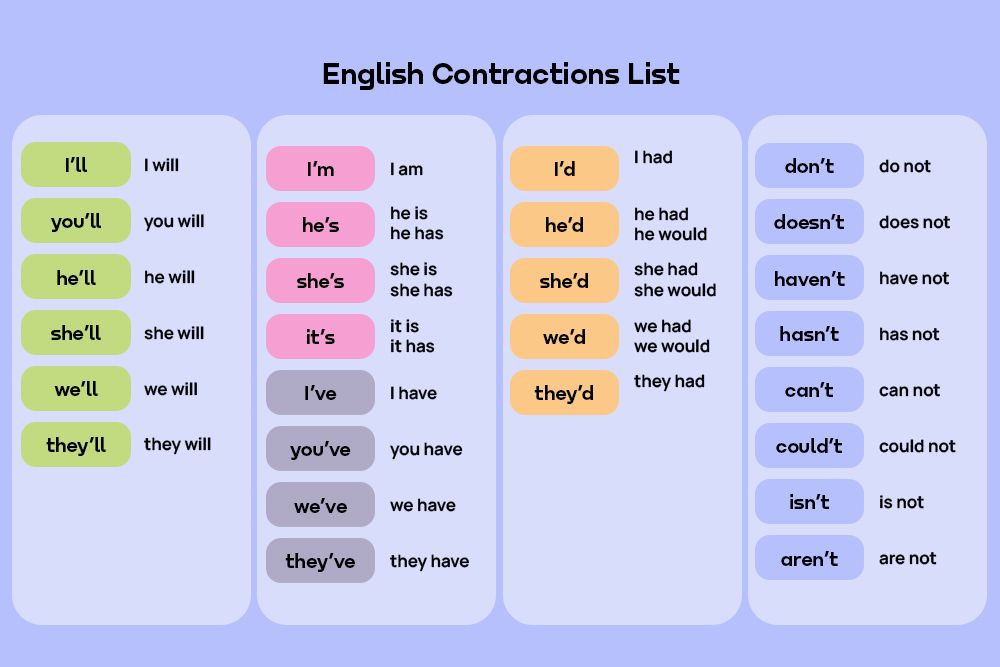
Let's break down the pronunciation of the most frequent types.
Contractions with 'am', 'is', and 'are'
These are among the most common contractions you'll use.
I am→ I'm /aɪm/he is/he has→ he's /hiːz/she is/she has→ she's /ʃiːz/it is→ it's /ɪts/we are→ we're /wɪər/they are→ they're /ðeər/
Notice the sound change with he's and she's. The 's' is pronounced as a voiced /z/ sound. However, in it's, it's a voiceless /s/ sound. This is an example of the assimilation you learned about in the last lesson: the voiceless /t/ sound in it causes the following sound to also be voiceless.
Let's watch a demonstration of how to pronounce these.
Contractions in English - How to Sound More Natural and effortless
Hadar will now walk you through the pronunciation of contractions with 'am', 'is', and 'are'.
Watch from 07:27 to 12:42. Try to repeat the sounds and phrases after her. Pay special attention to the difference between the /z/ sound in he's and the /s/ sound in it's.
Contractions with 'will', 'would', and 'have'
These involve combining with verbs that signal future or past tenses.
I will→ I'll /aɪl/he will→ he'll /hiːl/she would/she had→ she'd /ʃiːd/I would/I had→ I'd /aɪd/we have→ we've /wiːv/they have→ they've /ðeɪv/
The pronunciation of I'll and he'll uses a "dark L" sound, which you make with the back of your tongue raised. For I'd and she'd, the pronunciation is a simple, quick /d/ sound after the vowel.
3. Negative Contractions: The -n't Ending
Negative contractions, which combine a verb with not, are extremely common. The key is mastering the -n't sound. In fast speech, the /t/ is often a "stop T," meaning you don't release a puff of air. Your tongue moves to the position for the /t/ (behind your top teeth) and simply stops the airflow.
do not→ don'tis not→ isn'thave not→ haven'tdid not→ didn't
Since you are interested in the physical mechanics of speech, the following resource provides an excellent technical explanation of how this sound is produced.
How to Pronounce N’T Contractions
This article from Rachel's English, titled 'How to Pronounce N’T Contractions,' explains the 'stop T' in detail, with diagrams showing tongue and soft palate positions.
Please read the section that begins 'Here we have the N and the T sounds next to each other.' Focus on how the soft palate moves to create the N sound (nasal) and then raises to stop the sound for the T. This is the mechanism that creates that abrupt 'n' sound in words like 'shouldn't'.
Special Cases: can't and won't
Two negative contractions deserve special attention because they are often confused with other words.
-
can't vs. can:
- can't /kænt/ has the open
avowel, as in 'cat'. The vowel is long and stressed. - can /kən/ (when unstressed in a sentence) is reduced to a schwa sound. It's very short and unstressed.
- Example: "I can /kən/ do it." vs. "I can't /kænt/ do it." The main clue is the vowel quality, not the final /t/.
- can't /kænt/ has the open
-
won't vs. want:
- won't /woʊnt/ (will not) has the diphthong /oʊ/, as in 'go'. Notice the slight /w/ sound at the end of the vowel:
wo-w-nt. - want /wɑːnt/ has the /ɑː/ vowel, as in 'father'.
- The key is to make a clear /oʊ/ sound for
won't.
- won't /woʊnt/ (will not) has the diphthong /oʊ/, as in 'go'. Notice the slight /w/ sound at the end of the vowel:
This video provides excellent practice for these tricky pairs.
Contractions in English - How to Sound More Natural and effortless
Let's return to Hadar's video to practice the full range of negative contractions, including the crucial differences for 'can't' and 'won't'.
Watch from 20:26 to 26:18. Repeat the words and sentences aloud, focusing on making a clear stop T for the '-n't' ending and distinguishing the vowel sounds in 'can't' and 'won't'.
For extra review, you can refer to the full text version of Hadar's lesson here: English Contractions: The Ultimate Pronunciation Guide.
4. Your Turn to Practice
Now, let's put it all together. Read these sentences aloud at a natural, conversational pace. If you can, record yourself and listen back to check your pronunciation.
- I'm interested in the project manager role.
- He's a very experienced developer.
- It's a great opportunity for career growth.
- We're confident that we'll meet the deadline.
- I don't have direct experience with that, but I'd be excited to learn.
- She hasn't finished the report yet.
- They weren't aware of the changes.
- I can't attend the meeting tomorrow, but I can join on Friday.
- You've made a lot of progress.
- We won't know the final results until next week.
Conclusion
Excellent work! Today you've learned not just what contractions are, but why they're essential for fluent English and how to pronounce them by applying principles of connected speech.
Key Takeaways:
- Contractions are standard in both spoken and written English and are crucial for natural rhythm.
- Positive contractions combine pronouns with auxiliary verbs (e.g.,
I am→I'm,we have→we've). - Negative contractions combine a verb with
not(e.g.,do not→don't). The-n'tending often uses a "stop T." - Pay special attention to the vowel sounds to distinguish between
can/can'tandwant/won't.
Preview of Next Lesson:
We have now completed our module on the features of connected speech! In our next module, we will begin to apply everything you've learned—from individual sounds to stress, rhythm, and contractions—in a practical context. We will start by building and polishing a professional self-introduction, a cornerstone of any job interview.