In our previous lesson, we explored the theoretical architecture of Islamic finance, examining the key Riba-free instruments—Mudarabah, Musharakah, and Murabaha—that form the foundation of an ethical economic system. Having grasped these ideal models, we now turn to the critical and more complex task of evaluating their real-world application. This transition from theory to practice is essential for your CSS/PMS exam preparation, where a simple description will not suffice; a nuanced, evidence-based evaluation is required.
Today's learning outcome is to evaluate the Shariah compliance and socio-economic effectiveness of contemporary Islamic banking systems. We will dissect two fundamental questions that are at the heart of modern debates on Islamic finance:
- Are today's Islamic banks truly compliant with the substance and spirit of Shariah, or merely with its legal form?
- How effective are they in achieving the broader socio-economic objectives (Maqasid al-Shariah) of justice, equity, and inclusive development, particularly within the context of Pakistan?
This lesson will equip you with the analytical frameworks and evidence needed to construct a robust argument on this pivotal topic.
The Ideal: Principles of Islamic Banking
To begin our evaluation, let's briefly revisit the foundational principles that are meant to distinguish Islamic banking from its conventional counterpart.
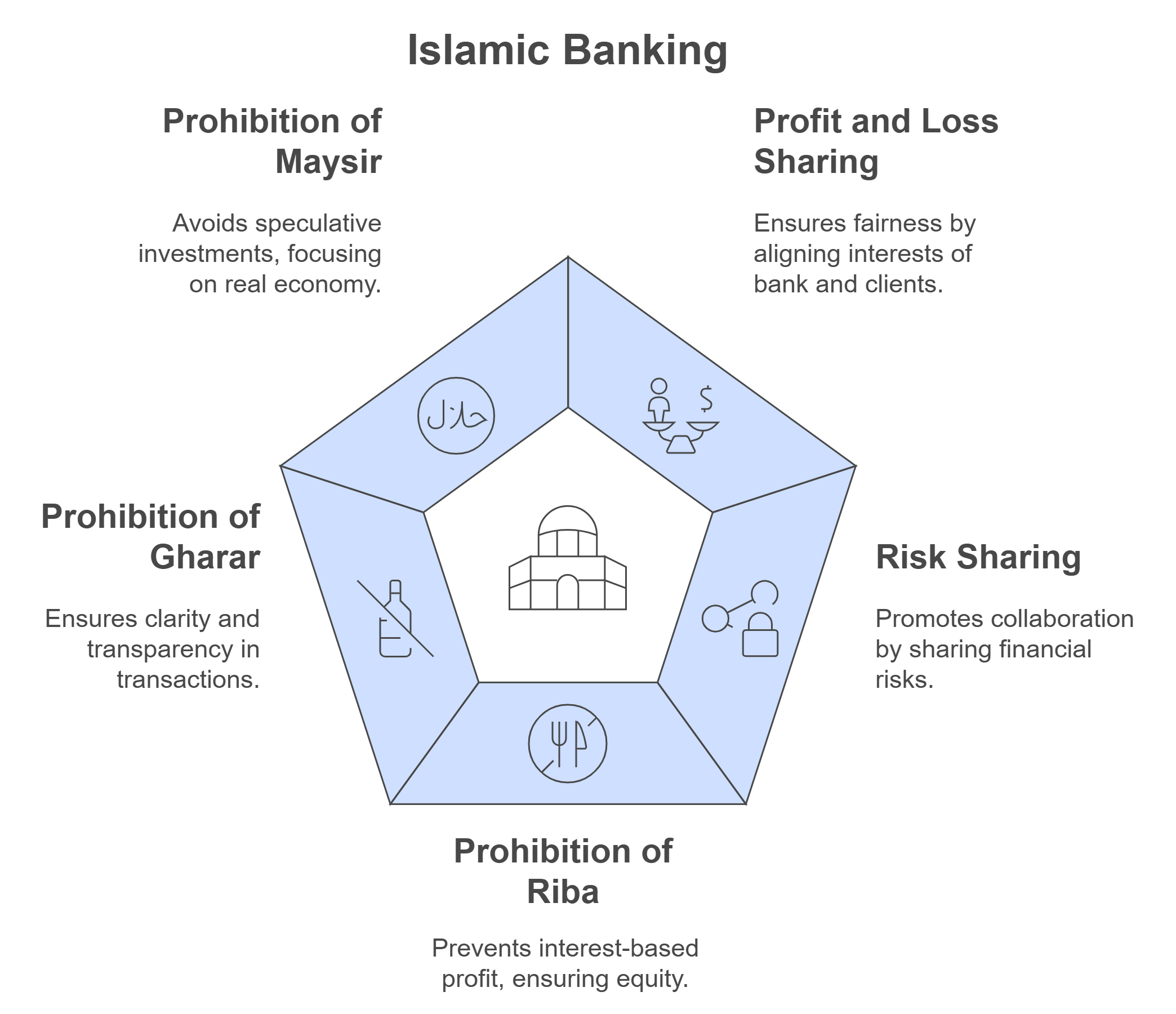
The central promise of these principles is a shift from a risk-transfer system (where lenders are guaranteed a return) to a risk-sharing one, where capital acts as a partner in an enterprise, sharing in both its successes and failures. This is the ideal. Now, let's examine the reality.
The Core Critique: Form Over Substance?
Despite its rapid growth, contemporary Islamic banking faces a persistent and powerful critique: that it has become "formally Shariah-compliant, but functionally conventional." This argument, advanced by prominent scholars and analysts, suggests that many Islamic financial products are structured to mimic the economic outcomes of interest-based loans, even though they use permissible contract forms.
This is not merely an academic debate; it strikes at the very identity and legitimacy of the Islamic finance industry. Let's explore the key pillars of this critique.
[PDF] Islamic banking: Formally Shariah-compliant, functionally conventional
This research paper by Mansoor Khan provides a sharp, evidence-based analysis of the "form over substance" issue. It synthesizes the major criticisms levelled against the industry.
Begin by reading the first paragraph in Section 2, "Literature Review," which summarizes how Murabahah and Ijarah financing often resemble conventional loans. Then, jump to Section 5, "Structural Convergence and Shariah Violations at Islamic Banks." Read the subsections 5.1, 5.2, and 5.3. These sections detail the three primary ways in which Islamic banking practices are seen to converge with conventional ones.
The reading highlights three critical issues that you must be able to articulate in an exam:
-
Profit Benchmarking: Islamic banks frequently price their financing products using conventional interest-rate benchmarks like KIBOR (Karachi Interbank Offered Rate) or LIBOR. When a Murabaha or Diminishing Musharakah financing is priced at "KIBOR + 3%", the final cost to the customer becomes economically indistinguishable from a conventional loan. This practice guarantees a predetermined, low-risk return for the bank, which runs contrary to the risk-sharing philosophy.
-
Lack of Genuine Ownership and Risk-Taking: As we learned, the legitimacy of Murabaha and Ijarah hinges on the bank taking genuine ownership and possession of the underlying asset, thereby assuming the associated risks. Critics argue this crucial condition is often diluted in practice.
- In many Murabaha transactions, the bank may never physically see or possess the asset, instead appointing the customer as its agent to purchase it. This can reduce the transaction to a mere paper trail designed to channel cash with a markup.
- In Ijarah (leasing) for home financing, ownership-related costs like major repairs, property taxes, and insurance are often contractually passed on to the customer (the lessee), even though Shariah dictates the owner (the lessor/bank) should bear them.
-
Dominance of Debt-Based Instruments: The ideal risk-sharing modes, Mudarabah and Musharakah, remain sparsely used on the financing side of Islamic banks. The vast majority of financing is done through debt-like, fixed-return instruments such as Murabaha. The renowned scholar Mufti Muhammad Taqi Usmani, a pioneer of the industry, has famously cautioned against this trend.
Islamic Finance | Shaykh al-Islam Mufti Muhammad Taqi Usmani
Listen to this segment from a lecture by Mufti Taqi Usmani. He explains the deeper economic wisdom behind prohibiting Riba and linking finance to real assets. His perspective adds significant weight to the critique of current practices.
Watch the clip from this timestamp. He explains that the fundamental difference between a prohibited Riba transaction (money for more money) and a permitted sale (money for a commodity) is that the latter creates real economic activity and links finance to tangible assets. This is the "why" behind the rules.
In his book, An Introduction to Islamic Finance, Mufti Usmani explicitly states that Murabaha is "not a mode of financing" in its ideal sense, but rather a "device to escape from 'interest'" that should be used only as a "transitory step" where true partnership modes are not practicable. The fact that it has become the dominant instrument, not a temporary one, is a central point of concern for many scholars.
Socio-Economic Effectiveness: A Case Study of Pakistan
Beyond doctrinal compliance, a crucial test for Islamic banking is its socio-economic impact. Does it create a more just and equitable society? Does it serve the underserved? As someone with a deep understanding of Pakistan's socio-economic landscape, this evaluation will be particularly relevant. We will use a detailed study on Islamic banking in Pakistan to assess its performance.
Economic Evaluation of Islamic Banking in Pakistan
This paper provides a data-driven evaluation of Islamic banking in Pakistan on three key metrics: inclusion, competitiveness, and distributional impact. It is an invaluable resource for crafting a Pakistan-specific analysis for your exam.
Please read Section 4, "Assessment of Islamic Banking: Access, Competitiveness & Redistributive Impact." Focus on the following points and the data presented in the tables: Financial Inclusion (4.1): Note the findings on the geographical distribution of branches (Table 2) and the financing mix (Table 3), which shows very low allocation to agriculture and SMEs. Competitiveness (4.2): Pay close attention to the comparison of profit rates paid to depositors (Table 4). The paper argues Islamic banks often pay less to their depositors while not necessarily being cheaper for borrowers. Distributional Impact (4.3): Understand the critique of how risk-sharing is often neutralized even in products like Running Musharakah, and how the entire system is benchmarked to KIBOR.
The study you've just read provides compelling evidence for a critical evaluation of Islamic banking in Pakistan:
-
Financial Inclusion: Despite the goal of serving those excluded for religious reasons, Islamic banks have largely replicated the model of conventional banks. Their branches are concentrated in affluent urban centers like Karachi and Lahore, with minimal outreach to rural areas. More strikingly, their financing for priority sectors like agriculture and SMEs is even lower as a percentage than that of conventional banks. This raises serious questions about their contribution to broad-based economic development.
-
Competitiveness and Fairness: The data suggests that depositors in Islamic banks in Pakistan often receive significantly lower returns on their savings compared to depositors in conventional banks. This happens while Islamic financing products are often priced at par with, or even higher than, conventional loans. This combination leads to a higher "spread" (the difference between what the bank earns on financing and pays on deposits), indicating a less efficient and more costly intermediation process for society.
-
Distributional Impact: The promise of Islamic finance is a more equitable distribution of wealth through risk-sharing. However, the study shows that even when partnership-based contracts like Musharakah are used, their structures are often modified to produce fixed, debt-like returns benchmarked to KIBOR. This means that from a cash-flow and risk perspective, their distributional impact is largely identical to conventional interest-based lending, failing to achieve a distinctive, more equitable outcome.
A Nuanced View: Why Does This Gap Exist?
A high-level analysis, such as that required for the CSS exam, must go beyond mere criticism and explore the reasons for this gap between theory and practice. Islamic banks do not operate in a vacuum.
- Systemic and Regulatory Pressures: Islamic banks function within a dual-banking system dominated by conventional finance. Central banks often implicitly or explicitly encourage rate parity to ensure market stability and prevent massive fund migration.
- Risk Aversion: Both banks and their depositors can be risk-averse. The certainty of a fixed, pre-determined return is often more appealing than the uncertain outcomes of a true profit-and-loss sharing venture.
- Information Asymmetry and Monitoring Costs: Genuine partnership financing requires extensive monitoring of the entrepreneur's business to ensure fairness and prevent moral hazard. This is complex and expensive, making standardized, debt-like products easier to scale.
- Lack of Supporting Infrastructure: The absence of a deep and liquid Islamic money market and Shariah-compliant lender-of-last-resort facilities can make liquidity management more challenging for Islamic banks, pushing them towards more predictable, shorter-term financing instruments.
Acknowledging these constraints allows for a more balanced and sophisticated evaluation, demonstrating that the issue is not simply one of bad faith, but a complex interplay of systemic, commercial, and regulatory factors.
Conclusion
Our evaluation today has revealed a significant and complex divergence between the ideals of Islamic finance and the realities of contemporary Islamic banking.
Key Takeaways:
- Form vs. Substance: The most potent critique is that many Islamic banking products are functionally equivalent to conventional loans, prioritizing legal form over economic substance.
- Key Issues: This is evidenced by the dominance of debt-like instruments (Murabaha), the use of conventional interest rates as benchmarks (KIBOR), and practices that minimize the bank's assumption of genuine asset risk.
- Socio-Economic Underperformance: In Pakistan, the data suggests that Islamic banks have so far fallen short of their potential for promoting broad financial inclusion (especially for agriculture/SMEs) and have not proven to be more competitive or equitable in their distributional impact.
- Complex Causes: This gap is not due to a single cause but stems from a combination of regulatory pressures, market competition, risk aversion, and operational complexities inherent in a conventional-dominated financial ecosystem.
You now possess the analytical tools to move beyond a simple description of Islamic banking and offer a critical evaluation grounded in scholarly critique and empirical evidence. This is precisely the level of depth expected in your competitive examinations.
In our final lesson of this module, we will broaden our lens. Building on our understanding of the challenges within Islamic banking, we will assess the key challenges to implementing a comprehensive Islamic economic system in a globalized world, moving from the micro-level of bank products to the macro-level of national and international economic policy.