Welcome to the next lesson in our module on the Islamic economic system. In our previous discussion, we conducted a thorough analysis of the prohibition of Riba, dissecting its Quranic basis and devastating socio-economic consequences. We established that Islam does not merely forbid an exploitative practice but proposes a just and equitable alternative. This lesson is dedicated to exploring those alternatives.
Your learning outcome for today is to explain the mechanisms and applications of key Islamic financial alternatives to Riba (Mudarabah, Musharakah, and Murabaha). This knowledge is crucial for your CSS/PMS exams, where you will be expected to move beyond simple definitions and demonstrate a nuanced understanding of how these instruments function in practice, contrasting them with the interest-based model you now understand so well.
The Foundational Shift: From Risk-Transfer to Risk-Sharing
Before we delve into specific contracts, it's vital to grasp the fundamental philosophical shift that underpins Islamic finance. A Riba-based system is built on risk-transfer: the lender transfers all risk to the borrower and is guaranteed a return. Islamic finance, in contrast, is built on the principle of risk-sharing and on linking finance to real economic activity. The financier must partake in the risk of the venture to be entitled to a share of the profit. This ensures that capital is a partner in the enterprise, not a detached predator.
This image provides an excellent visual summary of the core differences between the two systems.
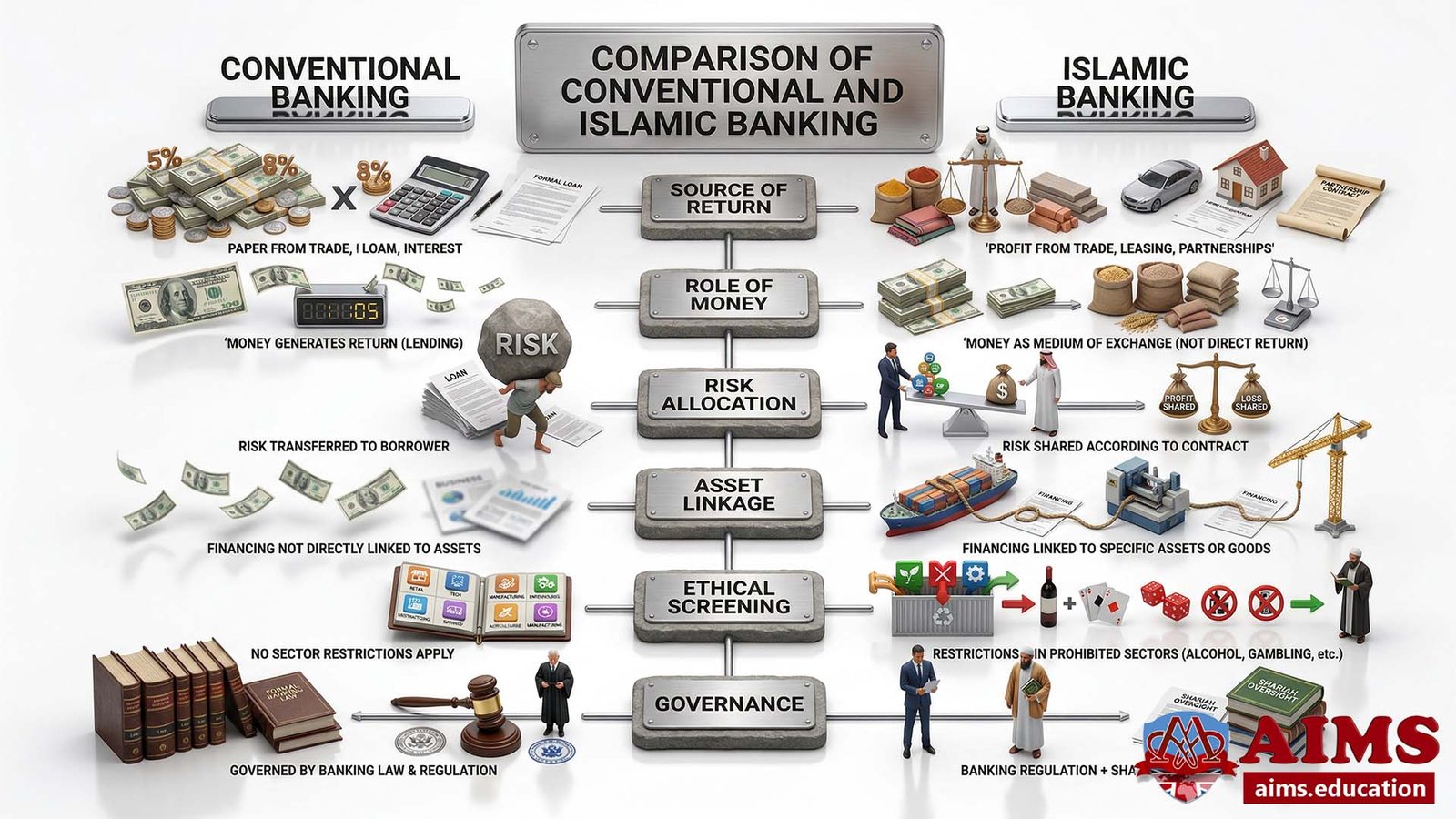
As you can see, conventional banking's return comes from interest on loans, with risk transferred entirely to the borrower. Islamic banking's return comes from profit generated by trade and partnership, with risk shared between the financier and the entrepreneur.
Let's now explore the primary mechanisms through which this philosophy is put into practice. Islamic financial instruments can be broadly divided into two categories:
- Partnership-based (Profit and Loss Sharing - PLS): Mudarabah and Musharakah
- Trade-based (Non-PLS): Murabaha, Ijarah, Salam, and Istisna
We will focus on the three most prominent ones mentioned in your learning outcome.
1. The Partnership Models: Mudarabah and Musharakah
These two contracts represent the ideal form of Islamic finance because they most purely embody the principle of risk-sharing.
#2 Types of Islamic Finance - ACCA / CPA / SFM -By Saheb Academy
This video from Saheb Academy offers a very clear and simple explanation of both Mudarabah and Musharakah using diagrams. It is an excellent starting point for understanding their core mechanics.
First, watch the section explaining Mudarabah. Focus on the roles of the Rabb-al-Maal (capital provider) and the Mudarib (manager/entrepreneur), and the crucial rule for distributing profit versus loss. Next, watch the segment on Musharakah. Note carefully how it differs from Mudarabah, particularly regarding capital contribution, management participation, and loss sharing.
Let's break down what you've just watched with some formal definitions and further analysis.
Mudarabah (Trustee Partnership)
Mudarabah is a partnership where one party provides 100% of the capital and the other party provides their entrepreneurial skill and management expertise.
- The Capital Provider (Rabb-al-Maal): This is the financier, often an Islamic bank. They provide the funds but are a "sleeping partner," meaning they do not participate in the day-to-day management of the business.
- The Manager/Entrepreneur (Mudarib): This is the working partner who uses their knowledge and effort to run the venture.
The rules for distributing the outcome are what make this contract uniquely just:
- Profit: If the venture is successful, the profit is shared between the Rabb-al-Maal and the Mudarib according to a pre-agreed ratio (e.g., 50/50, 60/40). This ratio must be a percentage of the profit, not a fixed amount.
- Loss: If the venture incurs a financial loss (and there is no negligence or breach of contract by the Mudarib), the entire loss is borne by the capital provider, the Rabb-al-Maal. The Mudarib's loss is the unrewarded effort and time they invested.
This principle ensures fairness. The one who provides the capital risks their money, and the one who provides the effort risks their labor.
Musharakah (Joint Venture Partnership)
Musharakah is a more conventional partnership where two or more parties pool their capital to finance a venture.
- All partners can contribute capital, although not necessarily in equal proportions.
- All partners have the right to participate in the management of the venture.
- Profit: Similar to Mudarabah, profits are shared according to a pre-agreed ratio, which can differ from the ratio of capital contribution. For instance, a partner who contributes 40% of the capital but takes on 60% of the management work might be allocated a 50% share of the profit.
- Loss: This is the key distinction from Mudarabah. In case of a loss, it is shared by all partners strictly in proportion to their respective capital contributions.
A highly significant modern application of this is Diminishing Musharakah, which is widely used for home financing. Here, the bank and the client jointly purchase a property. The client lives in the property and pays rent to the bank for the portion they own, while also gradually buying out the bank's share over time, until the client becomes the sole owner.
For a more detailed textual reference on these two modes, you can consult the following paper.
[PDF] A Primer on Islamic Finance - ISFIN.net
This paper provides concise, scholarly definitions that will be useful for formal exam answers.
Read the sections titled 5.1 Mudarabah and 5.2 Musharakah. Focus on the definitions and the descriptions of how funds flow and how profits/losses are distributed.
2. The Trade-Based Model: Murabaha
While partnership models are the ideal, they are not always suitable for every financing need, such as when a client simply wants to acquire a specific asset like a car or machinery. For these situations, trade-based contracts are used. The most common of these is Murabaha.
Murabaha is often translated as "cost-plus-profit sale." It is a contract where a seller (the bank) expressly mentions the cost they have incurred on the commodities to be sold and sells them to another person (the client) by adding some profit thereon.
5. Murabaha, Ijarah, Salam & Istisna (Modes of Financing) | Islamic Finance 101
Almir Colan's lecture provides an excellent, in-depth explanation of Murabaha, tackling the common misconceptions and clarifying the essential conditions for its validity.
Watch the section explaining Murabaha. Pay close attention to: The mechanism of the bank buying and then selling the asset. The crucial requirement for the bank to take ownership and possession of the asset. The permissibility of a higher price for deferred payment, and why this is different from Riba. The warning against "synthetic" transactions where the asset is just on paper.
The process you just watched can be summarized in these steps:
- The client approaches the Islamic bank with a request to finance a specific asset.
- The bank purchases the asset from the supplier, paying the supplier directly. At this point, the bank becomes the legal owner of the asset and assumes the associated risks. This step is non-negotiable for Shariah compliance.
- The bank then sells the asset to the client at a new price, which is the original cost plus a pre-agreed profit margin.
- The client pays this new price to the bank in installments over a fixed period.
Why is Murabaha not Riba?
This is a very common question, and a likely one in your exam viva. The key difference lies in the nature of the transaction:
- Riba is a loan of money. The transaction is money for more money, with the "more" being a function of time. The underlying asset is irrelevant to the lender.
- Murabaha is a sale of goods. The transaction is the exchange of an asset for money. The bank's profit comes from its role as a trader who takes ownership and risk, not as a lender of money. The price is fixed at the time of the sale and does not increase if the client is late with payments.
The critical element that prevents Murabaha from being a "backdoor to Riba" is the bank's genuine ownership of the asset, even if for a short period. If the bank simply gives the client money to buy the asset and charges a markup, that would be a Riba-based loan.
3. A Brief Overview of Other Important Instruments
To provide a complete picture, it's useful to be aware of other key instruments that complement the main three.
- Ijarah (Leasing): This is the Islamic equivalent of a lease. The bank (lessor) buys an asset and allows the client (lessee) to use it for a specified period in exchange for rental payments. Ownership remains with the bank, which is responsible for major maintenance. A popular variant is Ijarah wa-Iqtina (lease and ownership), where the client can purchase the asset at the end of the lease period.
- Salam & Istisna (Forward Sales): These contracts are used to finance production or manufacturing.
- Salam: A buyer pays in advance for the future delivery of standardized goods (e.g., agricultural commodities like wheat or cotton). This provides working capital for farmers and producers.
- Istisna: A contract to manufacture a specific, custom-made item (e.g., a building, a ship, or specialized machinery). The price can be paid in installments as the manufacturing progresses.
Comparative Summary
To consolidate your understanding for exam purposes, this table provides a high-level comparison.
| Feature | Mudarabah (Trustee Partnership) | Musharakah (Joint Venture) | Murabaha (Cost-Plus Sale) |
|---|---|---|---|
| Basis of Contract | Partnership | Partnership | Sale of Goods |
| Financier's Role | Capital Provider (sleeping partner) | Capital Provider & potential Manager | Seller/Trader |
| Client's Role | Manager/Entrepreneur | Partner & potential Manager | Buyer |
| Return Mechanism | Share in actual profit (pre-agreed ratio) | Share in actual profit (pre-agreed ratio) | Fixed profit margin on cost (mark-up) |
| Risk of Loss | Financial loss borne entirely by financier | Financial loss shared according to capital contribution | Business risk is on the buyer after purchase; seller has ownership risk before sale |
| Common Application | Project finance, investment accounts, venture capital | Project finance, joint ventures, home financing | Asset finance (cars, machinery), trade finance (import/export) |
Conclusion
Today, we have transitioned from understanding the prohibition of Riba to exploring the viable and just alternatives provided by Islamic finance. You are now equipped to explain the distinct mechanisms that drive this ethical economic system.
Key Takeaways:
- Core Philosophy: Islamic finance replaces the Riba-based principle of risk-transfer with the cooperative principle of risk-sharing.
- Partnership Models (PLS): Mudarabah and Musharakah are the ideal forms, where financiers and entrepreneurs act as partners, sharing both the potential for profit and the risk of loss.
- Trade-Based Models: Murabaha is a practical and widely used instrument for asset financing, structured as a cost-plus-profit sale. Its validity hinges on the financier taking genuine ownership and risk of the asset before selling it to the client.
- A Comprehensive Toolkit: Together with other instruments like Ijarah, Salam, and Istisna, these contracts form a robust framework for conducting a wide range of economic activities without resorting to interest.
Having learned the theoretical mechanics of these instruments, a critical question arises: how well do they work in the real world? In our next lesson, we will build upon this foundation to evaluate the Shariah compliance and socio-economic effectiveness of contemporary Islamic banking systems. We will critically examine the practices of modern Islamic banks and assess the challenges they face in a globalized economy.