Hello! Welcome to your first lesson in the Shopify course.
Given your "why first" approach to learning, we're going to start at the very beginning—not with Shopify itself, but with the fundamental problem that Shopify and other e-commerce platforms exist to solve. This lesson is designed to give you that deep conceptual anchor you're looking for before we dive into the hands-on, practical aspects of development.
Today, we'll explore the core challenges a business faces when trying to sell products online. By understanding the immense complexity of building an e-commerce solution from scratch, you'll gain a much clearer appreciation for the value propositions of different platforms later on. We'll break down the problem into four key areas: development, hosting, security, and payments.
Deconstructing the E-commerce Machine
Imagine a client approaches you, a full-stack developer, with a simple request: "I want to sell my products online." Your experience with React, Node.js, and IT infrastructure gives you a head start, but building a robust e-commerce system is a multi-faceted challenge that goes far beyond a simple web application.
Let's use a common architectural model to frame our thinking. An e-commerce system can be broken down into three main tiers: a front-end, a middle layer handling business logic, and a back-end for data and core services.
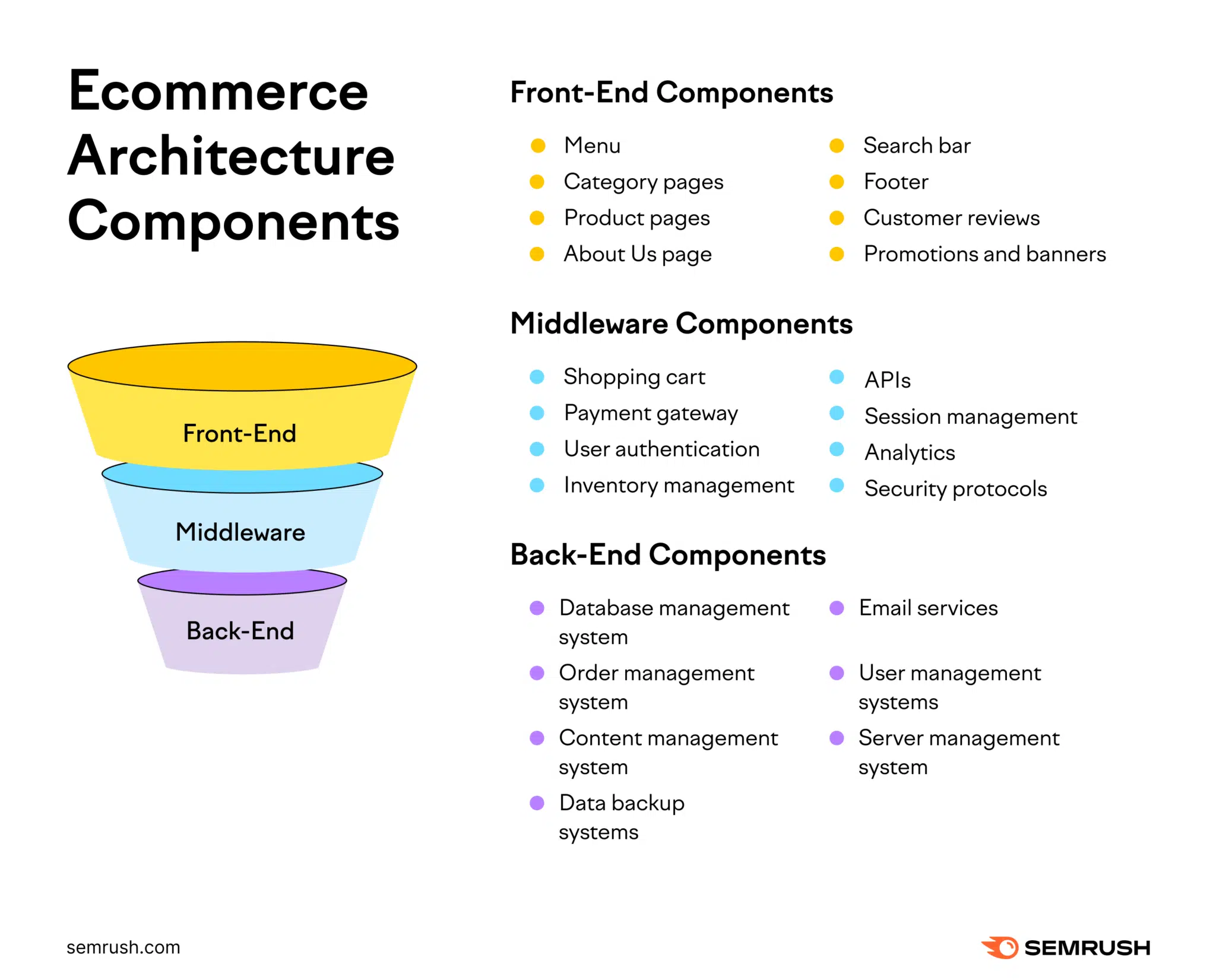
Each component in this diagram represents a development task, a potential point of failure, and an ongoing maintenance responsibility. Let's dig into the specific challenges.
1. The Development Challenge: More Than Just a Website
Building an e-commerce platform is a significant software engineering project. It's not just about creating product pages; it's about architecting a complex, integrated system.
To understand the architectural depth, please read the following article. It provides a solid overview of the layers, approaches, and models that define an e-commerce platform's foundation.
eCommerce Architecture: All You Need to Know in 2025
This article, 'eCommerce Architecture: All You Need to Know', offers a technical breakdown of what constitutes an e-commerce platform's architecture. It will give you a framework for thinking about the structural decisions involved in such a project.
Please read the sections 'What Is eCommerce Architecture?', 'What Is a Web-Based Commerce Architecture?' (including the subsections on frameworks), 'Two Fundamental eCommerce Architecture Approaches', and 'The Main Types of eCommerce Architecture Models'. Focus on understanding the differences between the 3-layer vs. 5-layer frameworks, monolithic vs. headless approaches, and SaaS vs. PaaS vs. on-premises models. These concepts are foundational for a systems-level view.
As you can see, the development challenge involves answering critical questions from the outset:
- What architecture is appropriate? A simple monolithic build, or a more flexible but complex headless architecture?
- What components are needed? A shopping cart, an inventory management system, a customer database, an order processing workflow, etc.
- How will these components integrate? A poorly designed system can lead to data silos and operational nightmares. For example, if your inventory system doesn't sync correctly with your storefront, you might sell products you don't have in stock.
Now, let's look at a more detailed list of the moving parts and the common roadblocks you'd face.
Ecommerce Infrastructure: A Guide to Revamp for Growth
The following article from BigCommerce, 'Ecommerce Infrastructure: A Guide to Revamp for Growth', lists the essential components and common roadblocks. This will help solidify your understanding of the sheer scope of the project.
Please read the sections 'Components of an ecommerce infrastructure' and 'Common ecommerce infrastructure roadblocks'. As you read, think about each item from the perspective of a developer who has to build, integrate, or solve it.
The key takeaway is that developing an online store from scratch involves orchestrating numerous specialized systems. A significant portion of this work is not on the user-facing features but on the "plumbing" that makes the business run.
2. The Hosting & Maintenance Challenge: Keeping the Lights On
Once the platform is built, it needs a place to live. Your background in IT infrastructure services will make these challenges particularly clear. This isn't just about renting server space; it's about ensuring performance, reliability, and managing ongoing updates.
- Hosting & Scalability: The server infrastructure must handle traffic fluctuations. A system that works perfectly with 10 concurrent users might crash during a Black Friday sale. This requires planning for load balancing, database optimization, and potentially using a Content Delivery Network (CDN) to serve assets quickly across the globe. Who is responsible when the site goes down at 3 AM?
- Maintenance & Updates: Software is not static. Operating systems need patching, security vulnerabilities must be addressed immediately, and third-party libraries and plugins need to be updated. This is a relentless and critical task. An outdated plugin can become a security backdoor or break functionality on the site.
The following video discusses WooCommerce, a popular self-hosted solution. Listen to the description of the responsibilities that fall on the store owner (or their developer). It perfectly encapsulates the maintenance challenge.
Forget Shopify! These Alternatives Can Save You $500/Mo
This segment from the video 'Forget Shopify! These Alternatives Can Save You $500/Mo' discusses the pros and cons of WooCommerce. Pay close attention to the 'downsides' mentioned, as they are the core challenges of any self-hosted e-commerce solution.
Watch the segment from 03:48 to 06:26. Focus on the discussion around hosting, security, updates, and plugin conflicts. This highlights the ongoing operational burden of a 'do-it-yourself' approach.
3. The Security Challenge: Building a Fortress
For an e-commerce site, security is not just a feature; it's a fundamental requirement for building trust and staying in business. A breach can be catastrophic. The key security challenges include:
- Protecting Customer Data: You are responsible for safeguarding sensitive information like names, addresses, and passwords.
- Payment Card Industry (PCI) Compliance: Any business that accepts credit card payments must adhere to the PCI Data Security Standard (PCI DSS). This is a complex set of requirements governing how you handle cardholder data. Non-compliance can result in hefty fines and the loss of the ability to process credit cards. Building a PCI-compliant system from scratch is a major undertaking.
- Defending Against Attacks: Online stores are prime targets for cyberattacks, including DDoS attacks to take the site offline, malware, and attempts to steal customer data. This requires firewalls, intrusion detection systems, and constant vigilance.
4. The Payments & Logistics Challenge: The Transaction Maze
Getting a customer to click "Buy" is only half the battle. The checkout and fulfillment process is a complex web of integrations.
This final video clip concisely explains the complexities that a platform must solve around payments, taxes, and shipping.
In this clip from 'WIX vs SHOPIFY — I tried both', the presenter explains how dedicated e-commerce platforms simplify the 'complicated' parts of selling online. This provides an excellent summary of the challenges.
Watch the segment from 03:31 to 05:28. Notice how he breaks down the issues of payment processing, tax collection, and shipping integrations—all of which are significant development hurdles in a custom build.
To summarize the payments and logistics challenge:
- Payment Gateway Integration: You need to securely connect your site to a payment processor (like Stripe or PayPal) to handle transactions. This involves API integration and handling sensitive data.
- Tax Calculation: Sales tax rules are incredibly complex and vary by country, state, and even local jurisdiction. A custom system needs to correctly calculate and apply these taxes for every order.
- Shipping & Fulfillment: The system must calculate shipping costs based on weight, dimensions, and destination. It then needs to integrate with shipping carriers (like FedEx or UPS) to print labels and track packages.
Test your understanding!
A small business owner wants to hire you to build a custom online store for their handmade jewelry. They have a limited budget and say they "just need something simple."
Based on the four core challenges discussed in this lesson, list three critical questions you would ask them to help them understand the true scope and ongoing costs of a custom-built site. Explain why each question is important.
Show answer
Here are some possible questions you could ask, rooted in the challenges we've discussed:
-
"Who will be responsible for the site's ongoing security and maintenance, such as applying security patches and updating software monthly? And what is our plan if the site goes down during a major holiday sale?"
- Why it's important: This question directly addresses the Hosting & Maintenance Challenge. It forces the client to think about the site not as a one-time purchase but as a living system that requires constant care and has an associated operational cost and risk. It highlights the need for a maintenance budget and a disaster recovery plan.
-
"How will we handle credit card processing securely to meet PCI compliance standards? Are you prepared for the costs and complexities of building and certifying a custom payment solution?"
- Why it's important: This targets the Security and Payments Challenges. It introduces the concept of PCI compliance, which is a non-negotiable legal and financial requirement. Most small business owners are unaware of this, and it immediately highlights the value of using pre-certified solutions versus building one from scratch.
-
"How will the system calculate shipping costs for different customers across the country, and how will it handle complex state and local sales taxes?"
- Why it's important: This addresses the Development and Logistics Challenge. It breaks the "simple" request down into specific, complex business logic problems (tax and shipping calculation) that need to be solved with code. It demonstrates that seemingly basic features require sophisticated development and integration.
Conclusion
As we've seen, selling online involves far more than putting up a pretty website. A business must solve immense and interconnected challenges across development, hosting, security, and payments. Building a solution from the ground up requires a massive investment in time, expertise, and ongoing maintenance. It's a significant undertaking with many hidden complexities.
Key Takeaways:
- Development: E-commerce architecture is complex, involving many integrated components for inventory, orders, customers, and more.
- Hosting & Maintenance: A store must be scalable to handle traffic spikes and requires constant maintenance to remain secure and functional.
- Security: Protecting customer data and complying with standards like PCI DSS are critical, non-negotiable responsibilities.
- Payments & Logistics: The checkout process alone involves a maze of integrations for payment gateways, tax calculation, and shipping carriers.
Now that you have a firm grasp of the problem, you're perfectly positioned for our next lesson. We will begin to explore the solutions by comparing self-hosted platforms (like WooCommerce, which we touched on) with Software-as-a-Service (SaaS) platforms like Shopify, focusing specifically on how they address these challenges and what that means for the total cost of ownership.