Hello! Welcome to your fourth lesson.
In our last session, we cataloged the specific problems Shopify solves for merchants, from handling complex technical burdens like security and hosting to providing an integrated "commerce operating system" for payments, inventory, and marketing. We established the value Shopify delivers.
Today, we transition from the value provided to the value captured. We will dissect Shopify's business model to understand precisely how the company makes money. This lesson directly addresses your curiosity about the "why" behind the platform by exploring its commercial architecture. Understanding this is not just academic; it's essential for you as a future freelance developer to identify where the economic opportunities lie within the Shopify ecosystem.
Our learning outcome is to explain Shopify's business model: subscriptions, transaction fees, and the role of the app marketplace.
A Map of the Business Model
Before we dive into the details, let's look at a high-level overview. A Business Model Canvas is a strategic management tool that provides a visual chart of a company's core components.
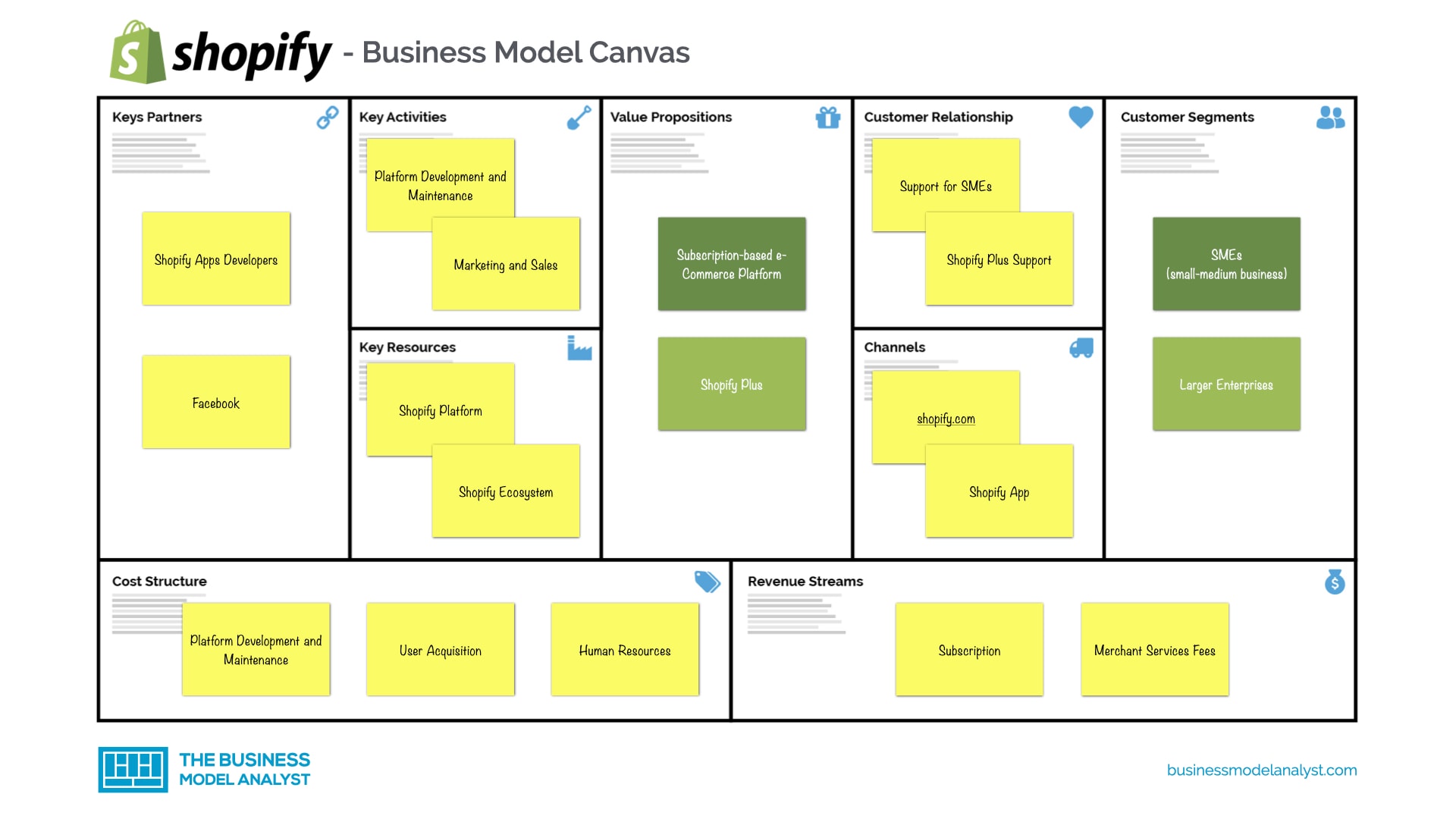
As the canvas shows, Shopify's revenue isn't from a single source. It's a carefully constructed system with multiple layers.
The Hybrid Model: Subscriptions + Usage
A common assumption is that SaaS companies like Shopify primarily make money from monthly subscriptions. However, this is only part of the story.
To get a clear picture of the revenue breakdown, let's start with a foundational article.
The article 'How Shopify Monetize' from The Growth Mind provides a concise and powerful overview of Shopify's dual revenue streams. It highlights a surprising fact that frames the entire business model.
Please read the sections titled 'Subscription + Usage-based: how Shopify aligns its revenue with its clients’ growth' and 'The more their clients generate revenue, the more Shopify revenue grows: interests are aligned'. Focus on the two main revenue streams identified: Subscription solutions and Merchant solutions.
As you just read, Shopify has two core revenue categories:
- Subscription Solutions: The fixed monthly/annual fees merchants pay for access to the platform. This is the predictable, recurring revenue stream.
- Merchant Solutions: The variable revenue generated when merchants use Shopify's services, primarily through payment processing and transaction fees. This is a usage-based stream.
Crucially, Merchant Solutions now account for the majority of Shopify's revenue.

This hybrid model creates what the article calls "aligned incentives." Because Shopify's revenue from Merchant Solutions grows as its merchants' sales grow, Shopify is financially motivated to build features that help merchants sell more. This includes optimizing checkout conversion, providing marketing tools, and ensuring high performance—every improvement that helps a merchant succeed directly benefits Shopify's bottom line.
Deconstructing the Revenue Streams
Now, let's break down each of these streams into their specific components.
1. Subscription Solutions
This is the most straightforward part of the model. Shopify offers tiered subscription plans, a classic SaaS strategy designed to lower the barrier to entry while providing a clear upgrade path as a business grows.
To get a practical sense of these plans, let's watch a quick overview.
The UGLY Truth About Shopify - My Unbiased Review
This segment from the 'MyWifeQuitHerJob Ecommerce Channel' gives a clear, consumer-focused breakdown of the various Shopify plans, their costs, and their core features.
Watch from 01:01 to 04:20. As you watch, note the different plan tiers (Basic, Shopify, Advanced) and how the features and pricing are structured to appeal to businesses at different stages of growth.
The strategy here is what's known as feature gating. Shopify strategically unlocks more powerful features at higher tiers—such as advanced reporting, more staff accounts, and lower transaction fees—that growing businesses naturally need. This makes upgrading feel like a necessary and logical step rather than an arbitrary cost increase.
For a more detailed, analytical perspective on this strategy, the following article is an excellent resource.
Shopify's SaaS E-commerce Pricing Strategy
The article 'Shopify's SaaS E-commerce Pricing Strategy' offers a deep-dive into the strategic thinking behind Shopify's pricing. It's a masterclass in SaaS monetization.
Read the sections 'Overview: Shopify's Multi-Revenue Pricing Architecture' and 'Tiered Subscription Strategy: Lowering Entry Barriers While Capturing Enterprise Value'. The table in the first section provides a perfect summary of the core plans.
2. Merchant Solutions
This is the usage-based component and the larger part of Shopify's revenue. It primarily consists of fees related to transactions.
Transaction Fees and Shopify Payments
Shopify's approach here is brilliant. As we touched on in the last lesson, getting paid is a major hurdle for merchants. Shopify simplifies this with Shopify Payments, its integrated payment processor.
Here's how it works from a revenue perspective:
- If a merchant uses Shopify Payments: Shopify does not charge them an additional transaction fee. Instead, Shopify earns revenue from the standard credit card processing fee (e.g., 2.9% + 30¢).
- If a merchant uses a third-party gateway (e.g., PayPal, Stripe, Authorize.net): Shopify charges a transaction fee on top of what the third-party gateway charges. This fee decreases on higher-tier plans (e.g., 2.0% on Basic, 1.0% on Shopify).
This structure strongly incentivizes merchants to use Shopify Payments, which simplifies their operations and, more importantly for Shopify, allows Shopify to capture the entire payment processing revenue.
Let's watch a clip that explains this distinction clearly.
The UGLY Truth About Shopify - My Unbiased Review
The same video from earlier has a concise section explaining the transaction fee structure and the pivotal role of Shopify Payments.
Now watch from 04:20 to 05:33. Focus on the difference in fees when using Shopify Payments versus a third-party payment system. This is a critical concept.
The article Shopify's SaaS E-commerce Pricing Strategy refers to this as a "revenue optimization strategy." By waiving the explicit transaction fee, Shopify makes its integrated solution more appealing and ultimately captures more revenue from the underlying payment processing.
Test your understanding!
A merchant on the Shopify Basic plan ($39/mo, 2.0% third-party transaction fee) makes a $100 sale.
- If they are using Shopify Payments, what fees does Shopify collect on this transaction?
- If they are using a third-party payment gateway like PayPal, what fees does Shopify collect on this transaction? (Ignore PayPal's own fees).
Show answer
- With Shopify Payments, Shopify collects the credit card processing fee (e.g., approximately $2.90 + $0.30 = $3.20). There is no additional Shopify transaction fee.
- With PayPal, Shopify collects a $2.00 transaction fee (2.0% of $100). The merchant would then also have to pay PayPal's separate processing fee. This demonstrates the strong financial incentive to use Shopify Payments.
3. The Ecosystem Multiplier: The App Marketplace
The third pillar of Shopify's business model is its ecosystem, particularly the App Marketplace. This isn't just a feature; it's a strategic asset and a significant revenue driver. For you, it's also the primary arena for freelance opportunities.
The App Store allows merchants to extend their store's functionality infinitely. This lets Shopify's core product remain relatively lean, while specialized needs are met by third-party developers.
How does Shopify monetize this? Revenue Sharing.
When a developer sells a paid app or an app with a subscription through the Shopify App Store, Shopify takes a commission. This rate is generally 15-20%.
To get an insider's view on the strategic importance of the app ecosystem, let's hear from Atlee Clark, the former head of Shopify's App Store.
You say you want an App Store? 5 lessons learned building Shopify’s App Ecosystem with Atlee Clark
In this video, 'You say you want an App Store?', Atlee Clark gives a masterclass on the philosophy and business strategy behind Shopify's app ecosystem. Her insights are invaluable for understanding its role.
Please watch the following three clips: The 'Why' (07:57 - 09:56): Understand the philosophy of apps as 'feature fillers' that allow Shopify to serve 'most of the people most of the time' while enabling everything else. The 'How' (32:04 - 33:39): This clip explicitly discusses the revenue share model and the concept of being 'in business together' with partners. The Strategic Moat (44:12 - 46:18): Learn why Shopify chose an 'open ecosystem' and how it creates a powerful competitive advantage.
As Atlee Clark explained, the App Store is more than a revenue stream:
- It extends the platform's value without Shopify having to build every niche feature.
- It creates a powerful "moat" or competitive advantage. A merchant deeply invested in several apps is less likely to leave the platform, increasing customer lifetime value.
- It creates a vibrant economy for partners and developers—people like you—whose success is also aligned with Shopify's success.
Conclusion
Today we've dissected Shopify's sophisticated, multi-layered business model. You now understand that Shopify's success is not just built on simple subscription fees but on a hybrid model that aligns its growth with the growth of its merchants.
Key Takeaways:
- Hybrid Revenue Model: Shopify combines predictable Subscription Solutions with scalable, usage-based Merchant Solutions.
- Aligned Incentives: Merchant Solutions (transaction fees, payment processing) make up the majority of revenue, meaning Shopify is financially motivated to help its merchants succeed.
- Strategic Pricing: Subscription tiers are designed to lower entry barriers and use feature gating to drive organic upgrades as businesses scale.
- The Ecosystem as a Moat: The App Marketplace is a critical third pillar, extending platform functionality, generating commission revenue, and creating high switching costs for merchants, which solidifies Shopify's market position.
In our next lesson, we will zoom in on the ecosystem we just discussed. We'll explore the role and opportunities for freelance developers within the Shopify Partner ecosystem. Having grasped the business model, you'll be perfectly positioned to see exactly where you fit in and how you can build a successful freelance career by creating value for merchants on the platform.