Welcome to the final lesson of this module on model adaptation. In our previous lesson, we took a deep dive into the mechanics of Low-Rank Adaptation (LoRA), understanding how it cleverly uses matrix decomposition to fine-tune massive models with remarkable efficiency. You now have the foundational knowledge of how LoRA works.
This lesson builds directly on that foundation by zooming out to address a critical question for any practitioner: When and why should you choose a Parameter-Efficient Fine-Tuning (PEFT) method like LoRA over traditional full fine-tuning? We will conduct a systematic comparison across the most important dimensions: computational cost, memory requirements, storage, and final model performance. This analysis will provide you with a mental framework for evaluating the tradeoffs inherent in different model adaptation strategies, a crucial skill for both research and production environments.
By the end of this lesson, you'll be able to articulate the precise advantages and disadvantages of each approach, moving from knowing the mechanism of LoRA to understanding its strategic place in the LLM toolkit.
The Anatomy of Cost: Memory and Computation
The most immediate and dramatic differences between full fine-tuning and PEFT emerge when we analyze the resources required for training. Let's break down why full fine-tuning is so demanding.
During training, the GPU memory must hold more than just the model weights. The three main components are:
- Model Weights: The parameters of the model itself. For a 16-bit (FP16/BF16) model, this is roughly bytes, where is the number of parameters.
- Gradients: During backpropagation, a gradient must be computed and stored for every trainable parameter. This typically takes up the same amount of memory as the weights themselves.
- Optimizer States: Modern optimizers like Adam store additional information for each parameter. Adam, for instance, stores moving averages of the gradients (the first moment) and the squared gradients (the second moment). This effectively requires storing two additional numbers for every single trainable parameter, usually in 32-bit precision, adding bytes of memory usage.
Full Fine-Tuning:
In this regime, all model parameters are trainable. This means the memory required is approximately bytes (using mixed precision as a baseline). For a 7 billion parameter model, this is around 84 GB of VRAM, already exceeding the capacity of most single GPUs.
Parameter-Efficient Fine-Tuning (LoRA):
Here's where the efficiency shines. PEFT freezes the vast majority of the model weights. Only a tiny fraction of parameters—the LoRA adapter weights—are trainable.
- The full model's weights () are still loaded into memory, but since they are frozen, we don't need to store gradients or optimizer states for them.
- Gradients and optimizer states are only required for the LoRA parameters, which might number in the millions instead of billions.
This drastically reduces the memory overhead from gradients and optimizer states, which is often the bottleneck.

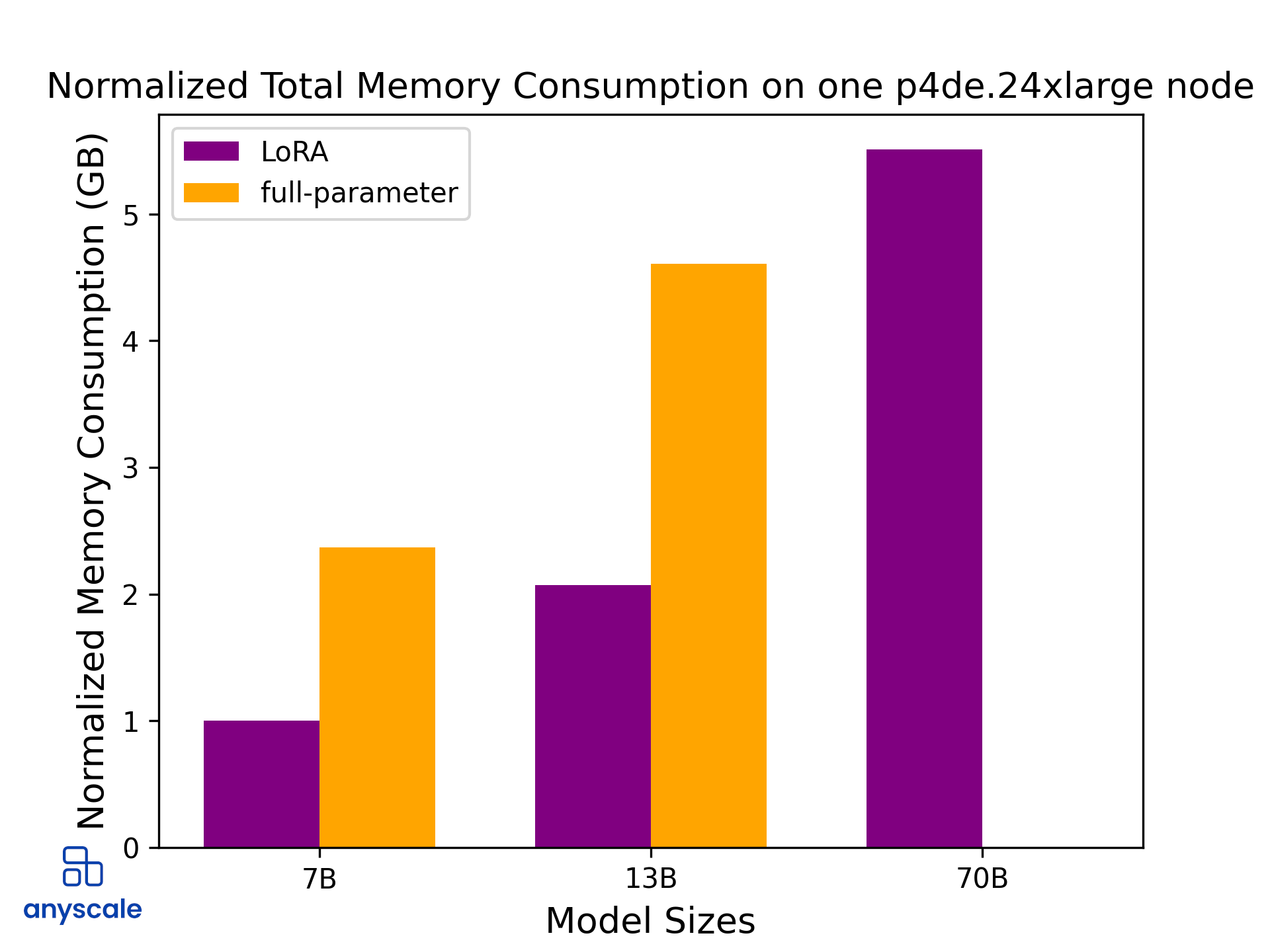
The empirical results confirm this analysis. The graph below shows the memory consumption for full fine-tuning versus LoRA for different model sizes.
Pushing Efficiency to the Limit: QLoRA
To make fine-tuning even more accessible, researchers developed Quantized LoRA (QLoRA). This technique builds on LoRA by adding another powerful optimization: quantization.
The key idea of QLoRA is to load the large, frozen base model in a lower precision format, typically 4-bit, while keeping the small, trainable LoRA adapters in a higher precision (e.g., 16-bit). This reduces the memory footprint of the base model itself by a factor of 4 (from 16-bit to 4-bit).
LoRA & QLoRA Fine-tuning Explained In-Depth
To understand how QLoRA achieves these further savings, let's watch a concise explanation.
Watch the segment from Cura [QLoRA] explained. Pay attention to how it combines quantization of the base model with the LoRA technique and the clever use of a new 4-bit data type (NF4) to maintain performance.
QLoRA introduces several key innovations to make this work without sacrificing performance:
- 4-bit NormalFloat (NF4): A special 4-bit data type that is information-theoretically optimal for weights that follow a normal distribution, which is typical for neural networks.
- Double Quantization: A technique that further saves memory by quantizing the quantization constants themselves.
- Paged Optimizers: A memory management technique that uses the CPU's regular RAM to handle occasional memory spikes, preventing out-of-memory errors during training.
The combination of these techniques in QLoRA allows for fine-tuning massive models (e.g., 70B parameters) on a single, high-end consumer GPU—a feat that was previously unimaginable.
Storage, Deployment, and Inference
The trade-offs extend beyond training into the practicalities of storing and serving models.
| Dimension | Full Fine-Tuning | LoRA (and most PEFT) |
|---|---|---|
| Checkpoint Storage | A full copy of the model weights must be saved for each task. (e.g., ~140 GB for a 70B model at BF16) | Only the small adapter weights are saved. (e.g., ~10-100 MB) |
| Task Switching | Very slow. Requires unloading and loading hundreds of gigabytes of weights from storage into VRAM. | Extremely fast. Involves swapping only a few megabytes of adapter weights, which can often be cached in RAM. |
| Inference Latency | Baseline latency. | Zero additional latency. The adapter weights are mathematically merged with the original weights into a single matrix before deployment. |
The storage and task-switching advantages of PEFT are transformative for real-world applications. It becomes feasible to create and deploy thousands of specialized models for individual customers or tasks, as each "model" is just a lightweight adapter that runs on a single, shared base model. Your DevOps background might help you appreciate this: the base model is like a large, stable container image, and the LoRA adapters are like small, hot-swappable configuration files.
The All-Important Question: What About Performance?
All these efficiency gains would be meaningless if the resulting model performed poorly. This leads to the central question: is there a performance trade-off?
The surprising answer is that PEFT methods, particularly LoRA, often match or even exceed the performance of full fine-tuning.
There are two main reasons for this:
- Implicit Regularization: By severely constraining the number of trainable parameters, PEFT acts as a strong regularizer. This helps prevent the model from overfitting to the (often small) fine-tuning dataset, leading to better generalization on unseen data.
- Mitigation of Catastrophic Forgetting: Full fine-tuning updates all model parameters, risking the erosion of the vast general knowledge learned during pre-training. This is known as catastrophic forgetting. By freezing the base model, PEFT inherently preserves this pre-trained knowledge and focuses only on learning the small, task-specific adaptation.
There are scenarios where full fine-tuning might be necessary, such as when adapting a model to a completely new language or a domain with highly specialized vocabulary that is absent from the pre-training corpus. In these cases, a low-rank update may not be expressive enough to make the required changes. However, for the vast majority of adaptation tasks, PEFT is sufficient.
What is Low-Rank Adaptation (LoRA) | explained by the inventor
Let's revisit the video from LoRA's inventor, Edward Hu, where he summarizes the practical benefits, including the crucial point about inference latency.
Watch the section discussing the specific benefits of LoRA. Focus on his explanation of how checkpoint sizes are reduced and why there is no additional inference latency.
A Broader View: The PEFT Landscape
LoRA is a powerful and popular PEFT method, but it's part of a larger family of techniques. Understanding the different categories helps to contextualize LoRA and appreciate the various approaches to parameter efficiency.
PEFT: Parameter-Efficient Fine-Tuning Methods for LLMs
This blog post from Hugging Face provides an excellent overview of the different categories of PEFT methods and includes summary tables that are perfect for comparison.
First, read the introduction to the categories: Additive, Selective, and Reparameterization-based. This will give you a clear taxonomy. Then, carefully study the two tables presented. The first table, "Comparison of PEFT methods", compares techniques across storage, memory, backpropagation cost, and inference overhead. The second table, "Trainable parameters", shows the typical percentage of parameters trained for each method.
As you review the material, you can classify the methods we've discussed:
- Reparameterization-Based: LoRA fits here, as it reparameterizes the weight update matrix into a low-rank form .
- Selective: BitFit, which fine-tunes only the bias parameters of the model, is a prime example of a selective method. It's extremely efficient but can be less expressive than LoRA.
- Additive: Methods like Adapters (which insert small new layers) or Prefix-Tuning (which adds trainable prefixes to the input sequence) fall into this category. A key difference to note is that many additive methods, unlike LoRA, do introduce inference latency because they add new computational steps that cannot be merged away.
Summary of Tradeoffs
We can now summarize the comparison in a comprehensive table.
| Aspect | Full Fine-Tuning | PEFT (LoRA as the primary example) |
|---|---|---|
| Trainable Parameters | 100% | Typically < 1% (e.g., 0.01% - 0.5%) |
| Training Memory | Very High (Requires gradients & optimizer states for all weights) | Low (Requires gradients & optimizer states only for adapters) |
| Storage Cost | Very High (One full model copy per task) | Very Low (One small adapter file per task) |
| Inference Latency | Baseline | No extra latency (weights are mergeable) |
| Task Performance | Strong, but risks overfitting and catastrophic forgetting. | Often matches or exceeds Full FT due to regularization and knowledge preservation. |
| Task-Switching | Slow and cumbersome. | Fast and easy. |
| Best For | Tasks requiring fundamental domain shifts or learning entirely new knowledge. | Most adaptation tasks, multi-task deployment, resource-constrained environments. |
This systematic comparison makes it clear why PEFT, and particularly LoRA and its variants like QLoRA, have become the de-facto standard for adapting LLMs. They democratize the ability to customize state-of-the-art models, turning an expensive, data-center-scale operation into something achievable on a single machine.
Conclusion
In this lesson, we have moved from the "how" to the "why" and "when" of PEFT. You've seen that the choice between full fine-tuning and parameter-efficient methods is not just about performance but involves a complex interplay of computational cost, memory, storage, and deployment logistics.
The key takeaways are:
- Cost: PEFT methods like LoRA dramatically reduce training memory, computation, and storage costs compared to full fine-tuning. QLoRA pushes this even further.
- Performance: LoRA often achieves performance comparable or superior to full fine-tuning, largely due to its properties as a regularizer and its robustness against catastrophic forgetting.
- Inference: A key advantage of LoRA over some other PEFT methods is its lack of additional inference latency, as the trained adapters can be merged back into the base model.
- Flexibility: The lightweight nature of PEFT adapters makes it practical to train, store, and rapidly switch between many different specialized models in a production setting.
You now possess a comprehensive framework for understanding and evaluating model adaptation strategies. This bridges the gap between the theoretical architecture of LLMs and their practical application.
In the next module, we will delve into the critical topic of model alignment. We've discussed how to adapt models; next, we will explore techniques like Reinforcement Learning from Human Feedback (RLHF) and Direct Preference Optimization (DPO) that aim to steer model behavior to be more helpful, harmless, and aligned with human values.