Hello! In our last lesson, we focused on the efficiency of running a large language model, exploring how KV caching makes autoregressive generation practical by eliminating redundant computations. We've established how to generate text quickly. Now, we pivot from inference optimization to a different, equally crucial topic: model adaptation. How do we take a massive, general-purpose model, trained on the whole internet, and make it proficient at a specific, narrow task you care about?
This lesson introduces the pre-train, then fine-tune paradigm, the fundamental strategy that underpins the success and widespread adoption of modern LLMs. You will learn what transfer learning means in this context and, more importantly, why this two-stage approach is so remarkably effective. We'll explore this from both an intuitive, systems-level perspective and a more formal, theoretical viewpoint that will appeal to your interest in the underlying mechanics.
By the end of this lesson, you will be able to describe transfer learning in the context of LLMs and explain why pre-training followed by fine-tuning is the dominant and most effective method for developing language-based AI systems today.
The Paradigm Shift: From Scratch vs. Transfer Learning
Before the current era of LLMs, building a high-performing NLP model for a task like sentiment analysis or legal document classification required training a model from scratch on a large, expensive, task-specific labeled dataset. This was inefficient, as each new task required repeating the entire resource-intensive process of teaching a model the fundamentals of language.
Transfer learning completely changed this. The core idea is to decouple the process into two distinct stages:
- Pre-training: An enormous, general-purpose "foundation model" is trained on a vast corpus of unlabeled text (e.g., a huge snapshot of the internet). This is a one-time, extremely expensive process aimed at capturing a comprehensive understanding of language, grammar, reasoning, and world knowledge.
- Fine-tuning: This pre-trained model is then taken as a starting point and further trained (or "adapted") on a much smaller, task-specific dataset. This second stage is comparatively cheap and fast.
This is analogous to a software engineering principle you're likely familiar with from your DevOps work: building a powerful, robust, and reusable core library. The initial development is costly, but once built, it can be quickly adapted and deployed for countless specialized applications, amortizing the upfront investment.
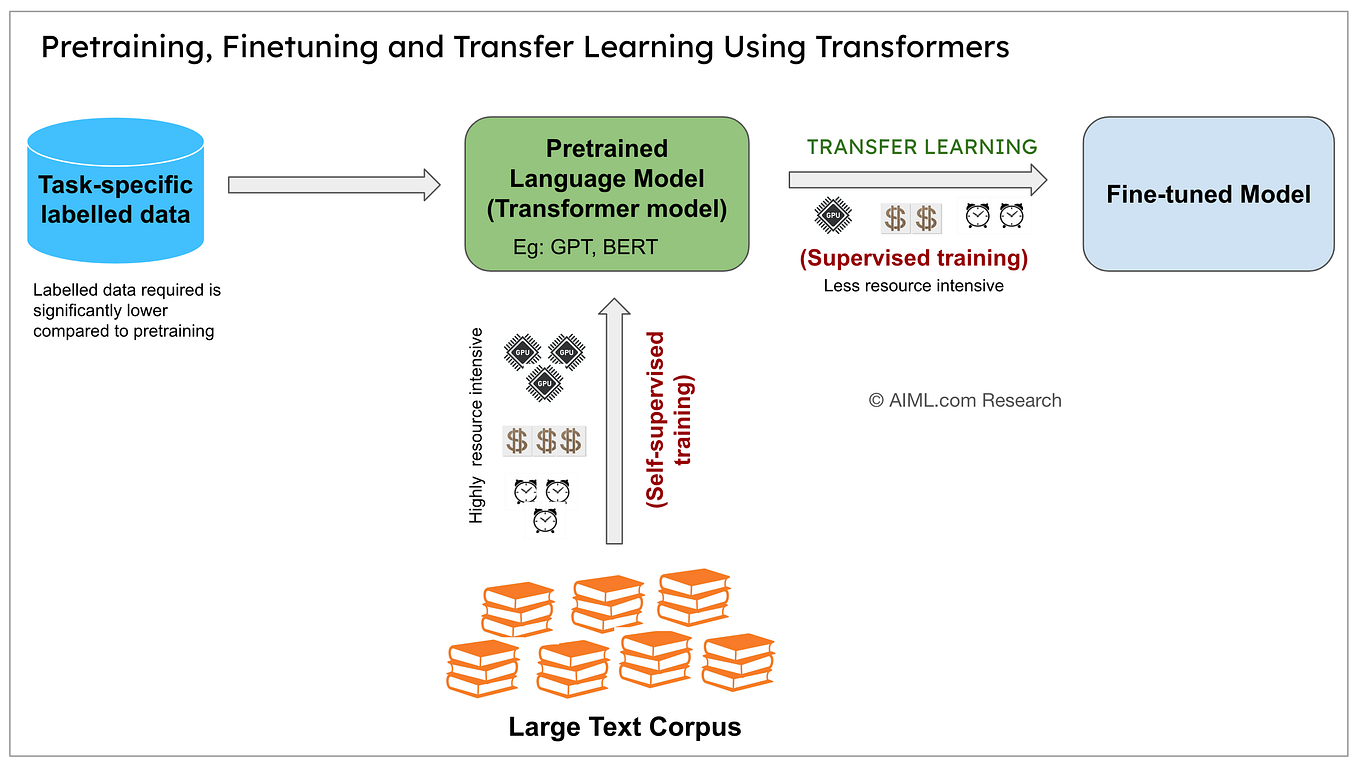
Let's look at the mechanics of each stage.
Stage 1: Pre-training — The Heavy Lift
The goal of pre-training is not to solve any particular task, but to learn a powerful, general representation of language. This is typically done using a self-supervised objective, where the data itself provides the labels. As we covered in Module 5, for decoder-only models like GPT, the objective is autoregressive language modeling: predicting the next word in a sequence.
Stanford CS229 I Machine Learning I Building Large Language Models (LLMs)
This lecture from Stanford's CS229 course provides an excellent overview of the pre-training process.
Watch the segment from the beginning of the overview to the end of the loss function explanation. The speaker clearly defines the autoregressive task and the cross-entropy loss function used to train the model to maximize the likelihood of the text it sees.
The key takeaway is that to become good at predicting the next word in any context, the model is forced to learn grammar, syntax, semantics, factual associations, and even rudimentary reasoning. This process is performed at an immense scale, involving trillions of tokens of data and costing millions of dollars in compute. This massive upfront investment is justified by the power of the resulting model.
Stage 2: Fine-tuning — Task-Specific Adaptation
Once pre-trained, the model possesses a vast repository of knowledge. The fine-tuning stage leverages this. We now take a small, labeled dataset specific to our goal—for instance, pairs of customer reviews and their sentiment (positive/negative)—and continue training the model.
Because the model already understands language, it doesn't need to learn what words mean from scratch. It only needs to learn how to map its existing rich representations to the specific outputs required by the new task. This makes fine-tuning incredibly efficient.
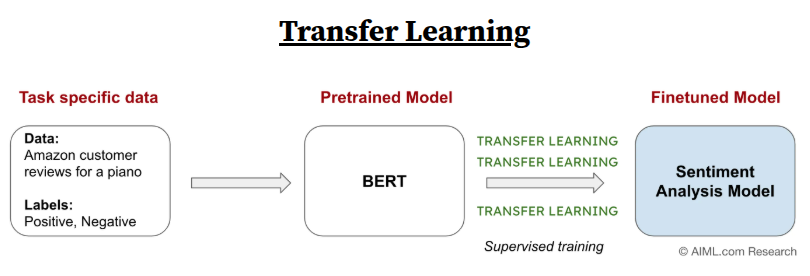
The following video segment explains this adaptation process, which is often called Supervised Fine-Tuning (SFT).
Stanford CS229 I Machine Learning I Building Large Language Models (LLMs)
Let's return to the Stanford lecture to see how fine-tuning works in practice.
Watch the section on Supervised Fine-Tuning from the introduction of post-training to the end of the explanation of SFT. Notice the emphasis on how little data is needed because the knowledge is already embedded in the pre-trained model.
Why is Transfer Learning so Effective?
We've established the "what" of the pre-train/fine-tune paradigm. Now let's delve into the "why." The effectiveness stems from a combination of representational power, optimization advantages, and resource efficiency.
1. Learning a Rich, Hierarchical Representation Space
Pre-training is not about memorizing sentences; it's about learning a function that maps text into a high-dimensional vector space where semantic relationships are preserved. The model learns to place similar concepts near each other. This is far more powerful than older methods like Word2Vec, which assigned a single, context-independent vector to each word. Transformers, by contrast, learn to generate contextualized representations.
Transfer Learning: Pre-training and Fine-tuning for NLP - Interactive
This article from mbrenndoerfer.com provides an excellent conceptual breakdown of what knowledge gets transferred.
First, read the sections "The Pre-training/Fine-tuning Paradigm" and "Why This Works". This will give you the core intuition. Next, read the section "What Transfers: A Layer-by-Layer Analysis". This part is fascinating. It shows that different layers of the model specialize in capturing different levels of linguistic structure, from surface patterns in lower layers to abstract semantics in upper layers. The interactive visualization showing how the model disambiguates the word "bank" is a perfect, concrete example of this hierarchical representation in action.
This layered acquisition of knowledge—from morphology and syntax to semantics and world knowledge—is the foundation of transfer learning's power. Fine-tuning doesn't need to learn these fundamentals; it simply leverages the rich, pre-organized "library" of knowledge the model has already built.
2. An Optimization Advantage
From a mathematical perspective, which will appeal to your background, you can think of the parameters of a neural network as defining a point in a very high-dimensional loss landscape. Training from scratch means starting at a random point and trying to find a good minimum through gradient descent.
Pre-training does the hard work of navigating this vast landscape to find a region that is generally good for modeling language. Fine-tuning then starts from this excellent initial point () and only needs to perform a small, local search to find a nearby minimum that is optimal for the specific downstream task.
Stanford CS224N NLP with Deep Learning | Winter 2021 | Lecture 10 - Transformers and Pretraining
This classic Stanford NLP lecture explains this optimization perspective very clearly.
Watch the segment from the explanation of the pre-train/fine-tune paradigm through the technical note on optimization. The speaker formalizes the idea of initializing the fine-tuning optimization process at the parameter set \theta_{hat} found during pre-training.
This is why fine-tuning can use a much smaller learning rate and converge in just a few epochs. The optimization problem is simply much easier.
3. Sample and Compute Efficiency
The practical consequences of these representational and optimization advantages are enormous efficiency gains.
- Sample Efficiency: As the model already understands language, it can learn a new task from a surprisingly small number of labeled examples—sometimes just hundreds or a few thousand, compared to the tens or hundreds of thousands needed for training from scratch.
- Compute Efficiency: Fine-tuning requires drastically less computation. While pre-training a foundation model might take months on thousands of GPUs, fine-tuning can often be done in hours on a single GPU.
This economic reality has shaped the entire field, allowing researchers and companies without massive compute clusters to build state-of-the-art systems by fine-tuning publicly available foundation models.
Transfer Learning: Pre-training and Fine-tuning for NLP - Interactive
Let's conclude our reading of this article by focusing on the practical efficiencies.
Read the sections on "Transfer Learning Efficiency" and "The Economics of Transfer Learning." The code simulation provides a clear demonstration of sample efficiency, and the discussion connects directly to the resource-optimization mindset of a DevOps professional.
A Formal Framework for Understanding Effectiveness
To tie these intuitions together, we can look at a formal theoretical framework. Researchers analyze the effectiveness of the pre-train/fine-tune paradigm by decomposing the final estimation error of a model into distinct components. This gives us a precise language for discussing the trade-offs.
This research paper provides a rigorous, mathematical perspective on why this paradigm works. While the whole paper is dense, the high-level error decomposition is very insightful.
Read Section 5.1, "High-Level Insights." Focus on understanding the three sources of error: Approximation Error: The inherent limitation of the model's architecture. Can the model even represent the perfect solution? Finetuning Generalization Error: Error from having a limited amount of task-specific fine-tuning data. Domain Gap: Error from the mismatch between the pre-training data distribution (e.g., general web text) and the fine-tuning task distribution (e.g., legal contracts). The key insight is in Proposition 5.1, which shows the final error is bounded by the minimum of the generalization error and the domain gap. This elegantly formalizes the idea that you can succeed with either very good pre-training (small domain gap) or a lot of fine-tuning data (small generalization error).
This formalization provides a principled way to understand that the pre-train/fine-tune paradigm allows the model to leverage whichever source of information is stronger: the prior knowledge from pre-training or the new evidence from fine-tuning data.
Conclusion
In this lesson, we explored the pre-train, then fine-tune paradigm, the engine driving the modern LLM revolution. We moved beyond simply stating the process to understanding the principles that make it so effective.
Here are the essential takeaways:
- Transfer learning in LLMs involves two stages: a resource-intensive pre-training phase on massive unlabeled data to learn general language understanding, followed by a resource-efficient fine-tuning phase on small labeled data to adapt to a specific task.
- This paradigm is effective because pre-training creates a rich, hierarchical representation space where linguistic, semantic, and world knowledge are encoded, providing a powerful foundation for downstream tasks.
- From an optimization perspective, pre-training finds a highly advantageous region in the parameter space, making the subsequent fine-tuning search faster and easier.
- The practical benefits are immense sample efficiency (requiring far less labeled data) and compute efficiency (requiring far less training time and hardware).
- The trade-offs can be formally analyzed by decomposing the model's error into approximation error, finetuning generalization error, and the domain gap, which clarifies how pre-training and fine-tuning jointly contribute to final performance.
You now have a solid conceptual and theoretical grounding in why we don't train LLMs from scratch for every new problem. In our next lesson, we will build directly on this foundation to examine the mechanics of Supervised Fine-Tuning (SFT) in more detail, before moving on to even more efficient adaptation techniques like LoRA.