Hello! Let's continue our journey into the fundamentals of electrochemistry.
In our last lesson, we explored the rich mechanistic information encoded in Tafel slopes, linking experimental data to the elementary steps of the HER and OER. However, we ended with a crucial caution: these interpretations are only valid if our measurements reflect pure kinetics, free from the influence of mass transport. This lesson addresses that very point. To confidently design experiments and interpret your data for catalysts like your Ni-Fe/MXene system, you must first understand how reactants get to the catalyst surface and how products get away.
Today, we will identify the three fundamental modes of mass transport—diffusion, migration, and convection. Understanding these processes is the first step toward controlling them, ensuring that what you measure is the intrinsic activity of your catalyst, not just the speed at which your reactants can travel through the solution.
Why Mass Transport Matters in Electrolysis
An electrochemical reaction, by its very nature, occurs at the interface between the electrode and the electrolyte. This means that for a reaction to proceed, reactants from the bulk solution must be continuously supplied to the electrode surface, and products must be removed. Mass transport is the umbrella term for the physical processes that govern this movement.
If your catalyst is highly active, it can consume reactants faster than they can be supplied. In this scenario, the overall rate of your reaction (and thus the current you measure) is no longer limited by the catalyst's kinetics but by the rate of mass transport. This is known as being under mass transport control.
Mass Transport | Department of Chemical Engineering and Biotechnology
This introductory text from the University of Cambridge explains why mass transport can become the rate-limiting factor in an electrolysis reaction.
Please read the first few paragraphs, from the beginning down to the list of the three transport forms. Focus on the central idea presented: the current is a function of both the kinetic rate constant (k_{red}) and the surface concentration. When kinetics are fast, this surface concentration, which is replenished by mass transport, becomes the bottleneck.
Let's consider the alkaline water electrolyzer you're familiar with.
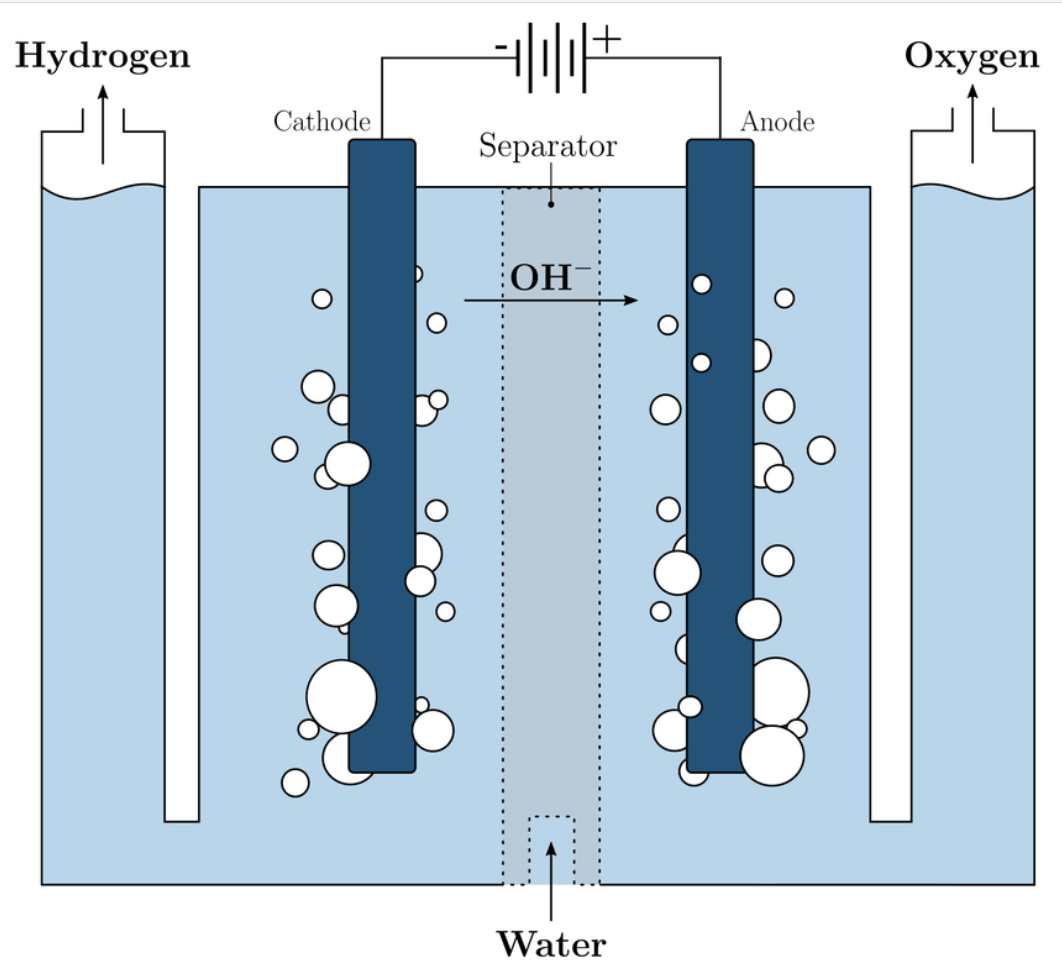
Given your background in chemical engineering, you're likely familiar with the transport of momentum and energy, which are driven by gradients in velocity and temperature, respectively. Mass transport follows the same core principle, but the driving forces are different.
Mass Transport lecture 1 (20-Mar-2020): Molecular and convective mass transport fluxes
This lecture from a chemical engineering perspective provides an excellent analogy that should resonate with your prior studies in transport phenomena.
Watch the first few minutes, from the beginning, where the lecturer frames mass transport alongside momentum and energy transport. Then, continue watching as he introduces the primary driving force for molecular mass transport (diffusion) from the most familiar terms.
As the video highlights, the most intuitive driving force is a concentration difference. This brings us to the first, and most fundamental, mode of mass transport.
The Three Modes of Mass Transport
Any movement of species in your electrochemical cell can be attributed to one or more of the following three mechanisms.
1. Diffusion
Diffusion is the net movement of molecules from a region of higher concentration to a region of lower concentration. This process is driven by the random thermal motion of molecules (an entropic effect) that naturally acts to smooth out concentration gradients.
In an electrochemical experiment, diffusion is almost always at play because the reaction itself creates a concentration gradient. At the surface of the working electrode, reactants are consumed, lowering their local concentration. Conversely, products are generated, increasing their local concentration. This difference between the surface and the bulk solution drives the diffusion of reactants towards the electrode and products away from it.
3: Mass Transport Mechanisms - Chemistry LibreTexts
This page from Chemistry LibreTexts provides a concise definition and illustration of diffusion.
Read the section titled "Diffusion". Pay attention to the equation for Fick's first law, J_i = -D_i \frac{\partial C_i}{\partial x}. Conceptually, this states that the flux (J, the amount of material moving per unit area per unit time) is directly proportional to the steepness of the concentration gradient (\frac{\partial C_i}{\partial x}). We will explore this equation quantitatively in our next lesson.
2. Convection
Convection is the transport of species due to the bulk movement of the fluid, such as stirring or flowing the electrolyte. It's helpful to distinguish between two types:
- Natural Convection: This refers to random fluid motion caused by small, unavoidable gradients in density or temperature within the cell. It's generally undesirable because it's unpredictable and can introduce noise into sensitive measurements, especially those lasting more than about 20-30 seconds.
- Forced Convection: This is the deliberate, controlled movement of the electrolyte. In the lab, this is achieved by stirring the solution with a stir bar or, more precisely, by using a rotating disk electrode (RDE). The goal of forced convection is to overwhelm the random natural convection and establish a well-defined, predictable rate of mass transport to the electrode.
Mass Transport lecture 1 (20-Mar-2020): Molecular and convective mass transport fluxes
The same lecture provides a very clear analogy for understanding convective transport.
Watch the segment from for convective transport. The image of a plastic bead being carried along by the flow of water perfectly illustrates the essence of convection: the species of interest is passively carried by the bulk fluid's velocity.
Forced convection is a powerful tool. By controlling it, we can ensure reactants are supplied to the electrode so quickly that the reaction rate is once again limited only by the catalyst's intrinsic kinetics. In later lessons, we will see how techniques like RDE use forced convection to do exactly this.
3. Migration
Migration is the movement of charged species (ions) in response to an electric field. When you apply a potential between the anode and cathode of your cell, you create an electric field throughout the electrolyte. This field exerts an electrostatic force on any ions in the solution, causing positive ions (cations) to move toward the negative electrode (cathode) and negative ions (anions) to move toward the positive electrode (anode).
In the diagram of the alkaline electrolyzer shown earlier, the movement of the negatively charged hydroxide ions (OH⁻) towards the positive anode is a clear example of migration.
For kinetic studies, migration is often an unwanted complication. We want the current to be a function of the applied potential's effect on the reaction rate, not its effect on moving ions through the solution. Fortunately, there is a standard and highly effective way to eliminate it.
Mass Transport | Department of Chemical Engineering and Biotechnology
Let's return to the Cambridge resource to see how migration is handled in practice.
Read the section on Migration. The key takeaway here is the use of a background electrolyte or supporting electrolyte. This is an inert salt (like KCl or NaClO₄) added to the solution at a much higher concentration (typically ~100x) than your electroactive species. These abundant inert ions carry almost all of the ionic current, effectively shielding your reactant ions from the electric field and suppressing their migratory transport.
Your work in alkaline seawater electrolysis is a perfect example. The high concentration of salts like NaCl in seawater naturally acts as a supporting electrolyte, meaning migration of your primary reactants (H₂O and OH⁻) is less of a concern compared to diffusion and convection.
Putting It All Together: Experimental Control
The total flux of a species to an electrode is the sum of contributions from diffusion, convection, and migration. This relationship is formally described by the Nernst-Planck equation. While we won't delve into the mathematics today, it's important to recognize that these three processes occur simultaneously.
The goal in designing a good electroanalytical experiment is not to solve this complex equation, but to simplify the situation by eliminating or controlling the modes of transport.
3: Mass Transport Mechanisms - Chemistry LibreTexts
This final section from LibreTexts summarizes the Nernst-Planck equation and the strategies for experimental simplification.
Start by looking at the Nernst-Planck equation to see how the three modes are combined. Then, read the final two paragraphs, which explain the practical strategies for achieving a diffusion-controlled experiment: adding a supporting electrolyte to eliminate migration and working in a quiet, unstirred solution to eliminate convection.
Conclusion
Today, we've broken down the complex process of mass transport into its three constituent parts. This foundational knowledge is the key to designing experiments that yield clean, interpretable kinetic data.
Key Takeaways:
- Mass transport can limit the overall rate of an electrochemical reaction, masking the true kinetic performance of your catalyst.
- The three modes of mass transport are diffusion (driven by concentration gradients), convection (driven by bulk fluid motion), and migration (driven by an electric field acting on ions).
- In the lab, we can control these phenomena: migration is suppressed with a supporting electrolyte, and convection is either eliminated (quiescent solution) or controlled with precision (e.g., using an RDE).
Preview of the Next Lesson:
Now that we have a conceptual map of the three transport modes, our next step is to begin quantifying them. In the next lesson, we will take a closer look at diffusion, learning how to apply Fick's first law to estimate the steady-state diffusion flux to an electrode surface. This will be our first step in moving from identifying these processes to calculating their impact on your measurements.