Welcome back to our series on electrochemistry. In the previous lesson, we established two fundamental concepts: the overpotential (), which acts as the driving force for an electrochemical reaction, and the exchange current density (), which quantifies the intrinsic kinetic speed of a reaction on a given catalyst surface. You learned that your goal as a catalyst developer is to create materials with high to minimize the required .
This lesson will unite these two concepts. We will explore the celebrated Butler-Volmer equation, the cornerstone of modern electrode kinetics. You will learn how this equation provides a complete mathematical description of the current-overpotential relationship at an electrode. This is not just a theoretical exercise; the Butler-Volmer equation is the model that underpins the polarization curves you generate in the lab for your Ni-Fe/MXene catalysts, allowing you to extract key performance metrics.
1. The Net Current: A Tug-of-War Between Oxidation and Reduction
As we discussed, the electrode interface at equilibrium is a dynamic place where anodic (oxidation) and cathodic (reduction) reactions occur at the same, balanced rate, . When you apply an overpotential, you disrupt this balance. A positive overpotential (anodic polarization) preferentially accelerates the oxidation reaction, while a negative overpotential (cathodic polarization) accelerates the reduction reaction.
The net current density () that you measure with a potentiostat is simply the sum of the anodic partial current density () and the cathodic partial current density (). By convention, anodic current is positive and cathodic current is negative, so we can write:
The Butler-Volmer equation gives us the explicit form of these partial currents. The image below provides a perfect visual representation of this principle.

The core idea is that both and are exponentially dependent on the overpotential. Let's see how this dependence arises.
2. Formulating the Butler-Volmer Equation
The derivation of the Butler-Volmer equation stems from transition state theory. It models how the applied electrical potential modifies the activation energy barrier of the forward and backward reactions. While we won't derive it from first principles here, understanding the key components is crucial.
A key new parameter that emerges is the transfer coefficient, or symmetry factor, denoted by .
- Transfer Coefficient (): This dimensionless factor, typically between 0 and 1, describes the symmetry of the activation energy barrier. It represents the fraction of the applied overpotential that assists the cathodic reaction. Consequently, the remaining fraction, , assists the anodic reaction. A value of implies a perfectly symmetric barrier, where the applied potential helps and hinders the cathodic and anodic reactions equally.
With these concepts, the partial currents are expressed as:
- Anodic current:
- Cathodic current:
Combining these gives the full Butler-Volmer equation:
Where:
- is the net current density (A/m²).
- is the exchange current density (A/m²).
- is the transfer coefficient.
- is the number of electrons transferred in the reaction.
- is the Faraday constant (~96485 C/mol).
- is the universal gas constant (~8.314 J/(mol·K)).
- is the absolute temperature (K).
- is the activation overpotential (V), defined as .
The following document provides a formal derivation of this equation. As you read, focus not on memorizing the steps, but on seeing how the concepts of potential-dependent activation energy and the transfer coefficient () are used to build the final expression.
[PDF] Electrode Kinetics - Significance of Overpotentials
This chapter from a set of lecture notes provides a clear, step-by-step derivation of the Butler-Volmer equation.
Please read the chapter titled "KINETICS OF ELECTRODE REACTIONS: BUTLER – VOLMER EQUATION AND MARCUS THEORY". Start from the beginning of the chapter and follow the derivation. Pay attention to how the rates of the forward and backward reactions, v_f and v_b, are first defined. Then, see how the Gibbs free energy of activation is made potential-dependent in equations (7) and (8), which is where the transfer coefficient \alpha is introduced. Finally, trace how these components are combined to yield the final form in equation (20).
This equation is the fundamental link between the applied potential and the resulting current for a reaction limited by charge transfer kinetics. For your work in water electrolysis, this equation is used to model the polarization curves (like those from LSV) you measure for the Hydrogen Evolution Reaction (HER) and Oxygen Evolution Reaction (OER).
3. Application in Electrocatalysis Research
The Butler-Volmer equation isn't just an abstract formula; it's a working tool in catalysis research. Scientists fit their experimental current-potential data to this equation (or its simplified forms) to extract the fundamental kinetic parameters, and , which are used to benchmark catalyst performance. The following research article on the Hydrogen Oxidation/Evolution Reaction (HOR/HER) demonstrates this perfectly.
[PDF] Pressure and Temperature Dependence of the Hydrogen Oxidation ...
This article shows the Butler-Volmer equation being used to analyze real experimental data for the HOR/HER, a reaction central to your research.
First, read the introduction. Notice how the authors present the Butler-Volmer equation in Equation 5 as the standard model for describing HOR/HER kinetics. Then, look at Figure 3 and the accompanying text. The authors explicitly state that "Both the anodic and cathodic branches of the Tafel plots follow the Butler-Volmer equation at low overpotentials" and describe their process of fitting the experimental data to the model.
This shows how the theory directly connects to the data analysis you perform with software like OriginPro. When you fit your polarization curves, you are implicitly using the principles of the Butler-Volmer equation.
4. Important Limiting Cases
The full Butler-Volmer equation can be simplified under certain conditions, leading to expressions that are often more practical for data analysis.
A. Low Overpotential (Micropolarization Region)
When the overpotential is very small (typically , or about < 10-20 mV), the exponential terms can be linearized using the approximation . Applying this to the Butler-Volmer equation yields a simple, linear relationship between current and overpotential:
This is essentially Ohm's law for the interface. The term is known as the charge transfer resistance (). A high-activity catalyst (large ) will have a low charge transfer resistance, a concept we will revisit in detail when we discuss Electrochemical Impedance Spectroscopy (EIS).
B. High Overpotential (Tafel Region)
When the overpotential is large and positive (), the second exponential term (representing the cathodic reaction) becomes negligible. The Butler-Volmer equation simplifies to the anodic branch:
Conversely, when the overpotential is large and negative (), the first exponential term (anodic) becomes negligible, and the equation simplifies to the cathodic branch:
The following video provides an excellent conceptual summary of how one process begins to dominate at high overpotentials.
Further Physical Chemistry: Electrochemistry session 8
This video intuitively explains why the Butler-Volmer equation simplifies at high overpotentials.
Watch the section from "as we get to extreme values", which explains how one component dominates. Then, see the result of this simplification in the next segment from "let's consider what happens", where the simplified expressions for high positive and high negative overpotentials are shown.
These high-overpotential expressions are known as the Tafel equations. They form the basis of Tafel analysis, a powerful technique you use to extract and from your experimental data, which will be the topic of a forthcoming lesson.
5. Putting It to Practice: A Calculation
Let's apply this knowledge to a practical problem. The image below presents a typical exam-style question relevant to your field.
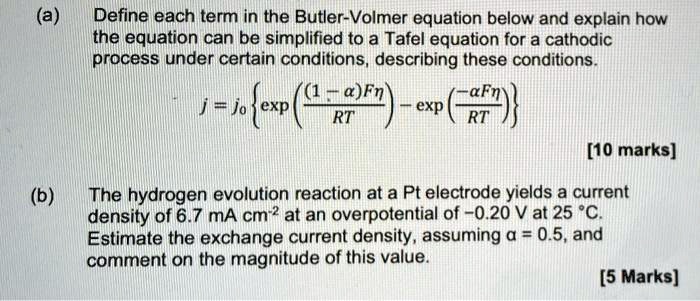
Consider the problem in part (b):
"The hydrogen evolution reaction at a Pt electrode yields a current density of 6.7 mA cm⁻² at an overpotential of -0.20 V at 25 °C. Estimate the exchange current density, assuming ."
Your Task:
Before reading the solution, try to solve this yourself.
- Identify which form of the Butler-Volmer equation is appropriate here. (Hint: Is the overpotential large or small? Is the reaction anodic or cathodic?)
- Rearrange the equation to solve for .
- Plug in the given values to find the answer. Remember to use consistent units!
Solution:
- The overpotential is . This is large and negative, so we can use the cathodic Tafel equation: .
- Rearranging for , we get: .
- Now, let's plug in the values:
- = 6.7 mA/cm² = 0.0067 A/cm²
- = 0.5
- = 1 (for the Volmer step of HER: H⁺ + e⁻ → H_ads)
- = 96485 C/mol
- = -0.20 V
- = 8.314 J/(mol·K)
- = 25 °C = 298.15 K
The exponential term is:
Now, we calculate :
So, the estimated exchange current density is mA/cm². This is a typical value for HER on platinum, which is known to be an excellent catalyst with a high .
Conclusion
In this lesson, we have dissected the Butler-Volmer equation, the master equation of electrode kinetics. You now have a quantitative framework for understanding the relationship between current density, overpotential, and the intrinsic activity of your catalysts.
Key Takeaways:
- The Butler-Volmer equation models the net current density as the sum of competing anodic and cathodic partial currents, which are exponentially dependent on overpotential.
- It combines the concepts of exchange current density () and overpotential () into a single framework.
- The transfer coefficient () is a new parameter that describes the symmetry of the reaction's activation energy barrier.
- At low overpotentials, the equation linearizes, defining the charge transfer resistance ().
- At high overpotentials, the equation simplifies to the Tafel equations, which are fundamental to experimental data analysis.
Preview of the Next Lesson:
We have introduced the transfer coefficient as a measure of barrier symmetry. In our next session, we will take a deeper dive into the physical meaning of . We will explore how its value is related to the shape of the potential energy surface for the reaction and what it tells us about the location of the transition state, providing a more profound understanding of the charge transfer process itself.