Welcome back. In our last lesson, we focused on the importance of a positive angle of attack, establishing that hitting up on the ball is the foundation for maximizing driver distance. You learned that this ascending blow is the key to achieving the ideal flight combination: high launch and low spin.
Today, we will dissect that "high launch, low spin" formula in greater detail. Think of this as an optimization problem, much like you might encounter when analyzing business data to maximize performance. We will explore the three interdependent variables that determine your carry distance: driver loft, launch angle, and spin rate. By understanding how these factors interact, you can begin to diagnose your own ball flight and understand the physics behind a powerful, efficient drive.
The Three Pillars of Driver Distance
To begin, let's clearly define the three key metrics that govern how far your golf ball flies.
- Launch Angle: This is the initial vertical angle at which the ball leaves the clubface, measured relative to the horizon.
- Spin Rate: This is the amount of backspin on the ball immediately after impact, measured in revolutions per minute (rpm). This backspin creates aerodynamic lift, helping the ball stay in the air.
- Driver Loft: This is the static, engineered angle of your driver's face relative to the shaft. It's the most direct tool you have to influence launch and spin.
The goal isn't to simply maximize or minimize any single one of these. Too much spin causes the ball to "balloon" up and fall short. Too little spin, and the ball acts like a "knuckleball," becoming unstable and dropping out of the sky prematurely. Similarly, a launch angle that's too low won't keep the ball airborne long enough, while one that's too high sends it upward instead of forward. The key is finding the optimal window for both launch and spin.

Finding Your Optimal Launch Window
What constitutes an "optimal" launch and spin depends heavily on your swing speed. Since your background is in analyzing data, you'll appreciate that these are not universal magic numbers but rather target ranges that shift based on the initial conditions.
The following article provides excellent charts that correlate swing speed with target launch and spin rates. As a beginner, your swing speed will likely fall into the 85-95 mph range, so pay special attention to those figures.
Driver Launch Angle Chart: 10-17° Ideal Range by Speed
This article from upyourclub.com provides clear, data-driven benchmarks for optimizing driver performance.
First, read the introduction to understand the general optimal windows and the two common, distance-killing mismatches. Next, scroll down to the section "Optimal driver launch angle and spin by swing speed." Study the first table, focusing on the row for 85-95 mph. These are the numbers that define an efficient drive for your current speed range.
As you can see from the chart, a golfer swinging at 90 mph should target a launch angle of 14-17 degrees and a spin rate of 2,400-3,000 rpm. A faster-swinging tour pro, in contrast, optimizes distance with a lower launch and less spin. This is a perfect example of a system where the optimal parameters change based on a primary input (swing speed).
The Connecting Piece: Spin Loft
How can a golfer achieve a high launch without also creating excessive, distance-robbing spin? The answer lies in the relationship between your club's loft and your angle of attack. This relationship is quantified by a critical concept: spin loft.
Given your experience with data models, think of spin loft as the hidden variable that explains the relationship between the inputs and the output.
Spin Loft = Dynamic Loft at Impact – Angle of Attack
"Dynamic Loft" is the actual loft you deliver to the ball at impact. A smaller spin loft creates less spin. This is where the positive angle of attack from our last lesson becomes so powerful. By hitting up on the ball (a positive angle of attack), you decrease the difference between your dynamic loft and your attack angle. This narrows the spin loft, which reduces backspin.
This allows you to use a driver with enough loft to achieve a high launch angle, while the positive angle of attack simultaneously keeps the spin in the optimal low-spin window. This is the mechanical secret to "high launch, low spin."
This short video from Titleist provides a great conceptual explanation of spin loft.
Unlock Longer Drives by Understanding Spin Loft | Titleist Tips
This video concisely explains how spin is generated and how managing 'spin loft' is the key to unlocking more distance.
Watch the entire clip. Pay close attention to the definition of spin loft around the one-minute mark and the explanation of how a positive attack angle reduces it.
Visualizing the Optimization Problem
For a BI Analyst, there is no better way to understand a two-variable relationship than a heatmap. The chart below shows carry distance as a function of launch angle and backspin for a high-speed player.
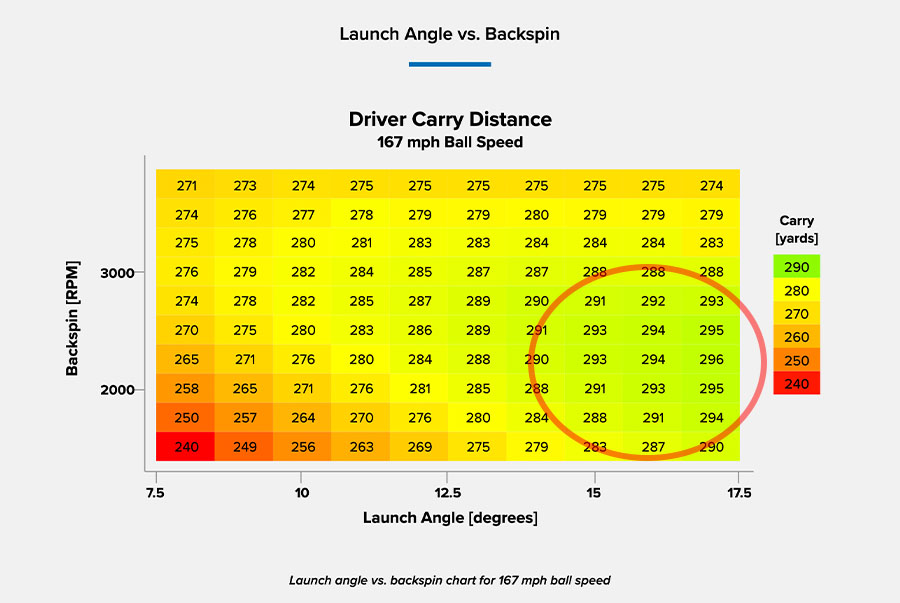
Notice the "hot zone" in the bottom right, where the longest distances are found. This corresponds to a combination of a relatively high launch angle (14-17 degrees) and a relatively low spin rate (2000-2800 rpm). Moving away from this window in any direction—too much spin, not enough launch, or vice-versa—results in a measurable loss of distance. Your goal is to deliver the club in a way that gets your ball's data points into that optimal zone.
A Data-Driven Experiment
Now, let's see this system in action. The following video is a fantastic experiment that demonstrates how changing your delivery (specifically, the angle of attack) alters the launch and spin, with dramatic effects on distance. The presenters test three scenarios for a 90-mph swing speed:
- Optimal: A positive angle of attack, creating high launch and low spin.
- Sub-optimal: A level angle of attack, creating low launch and low spin.
- The "Logical" but Wrong Fix: Hitting down but using a higher-lofted driver to try and increase launch.
This third scenario is particularly insightful. It shows that simply adding static loft to fix a poor launch is counterproductive if the root cause—a negative or level angle of attack—isn't addressed. It increases the spin loft, causing the ball to spin excessively and lose even more distance.
DRIVER...How Far SHOULD You Hit It?! (Based on Swing Speed) Gain 20 Yards By Optimizing Delivery...
This video from Elite Performance Golf Studios is a deep dive into driver optimization. We'll focus on the 90 mph swing speed section, which is most relevant to you.
Watch the following segments carefully, paying attention to the launch monitor data (Angle of Attack, Launch, Spin, and Carry): First, watch the optimal shot demonstration from the beginning of the 90 mph segment. Note the ~5° positive AoA, ~15° launch, and ~2300 rpm spin, resulting in a 220-yard carry. Next, see what happens with a level (0°) angle of attack from this section. The launch drops to 8°, and the carry distance falls by 14 yards, even though spin is also low. This shows that launch is just as important. Finally, watch the most crucial part: the attempt to "fix" the bad launch by adding loft from this experiment. Notice that while launch improves to 13°, the spin skyrockets to 3500 rpm because the spin loft is now huge. The result is a carry distance of only 198 yards—the worst of the three.
This experiment powerfully demonstrates that these variables are part of a connected system. You cannot simply tweak one in isolation. The key is to first fix the delivery—the angle of attack—to create the conditions for an efficient launch.
Conclusion
You now have a framework for thinking about driver performance as a system to be optimized. By understanding the interplay of loft, launch, and spin, you've moved beyond simple swing thoughts to the underlying physics of distance.
Key Takeaways:
- Maximizing driver distance is an optimization problem: you must find the ideal launch angle and spin rate for your swing speed.
- For most amateur golfers, the target is a "high launch, low spin" window, typically around 14-17° of launch and 2400-3000 rpm of spin.
- The critical link between these variables is Spin Loft (Dynamic Loft - Angle of Attack).
- A positive angle of attack is the most effective way to achieve a high launch angle without creating excessive spin, as it narrows the spin loft.
- Simply adding club loft to compensate for a poor angle of attack is often counterproductive, as it widens the spin loft and creates too much spin.
In our next lesson, we will apply this knowledge to diagnose common driver faults like the slice, hook, and sky ball, identifying their root causes within the framework of these impact dynamics.