In our previous lesson, we treated driver distance as an optimization problem, focusing on how to achieve the ideal "high launch, low spin" combination through a positive angle of attack. You now understand the key variables—launch angle, spin rate, and spin loft—that produce an efficient, powerful drive.
This lesson addresses the inevitable next question: what happens when the drive is not efficient? Think of this as moving from system design to system diagnostics. We will identify the most common driver faults—the slice, the hook, the sky ball, and the topped shot—and, most importantly, diagnose their root causes. By understanding the underlying physics, which are governed by a clear set of rules, you'll be able to interpret your ball flight not as a random error, but as direct feedback on your swing's input parameters.
The Diagnostic Framework: Ball Flight Laws
Before we can diagnose specific faults, we must understand the fundamental rules that govern a golf ball's flight. In golf, these are known as the Ball Flight Laws. For someone with your background in data and systems, you can think of these as the core logic of the program: the club's delivery at impact provides the inputs, and the ball's flight is the predictable output.
There are two primary inputs you need to understand:
- Clubface Angle: The direction the clubface is pointing at the moment of impact, relative to the target line. This predominantly determines the ball's initial starting direction.
- Swing Path: The horizontal direction the clubhead is traveling at impact, relative to the target line (e.g., in-to-out or out-to-in).
The relationship between these two variables creates the ball's curvature (i.e., sidespin).
The following article provides a superb, data-centric explanation of these laws. It uses the language of launch monitors (e.g., measuring path and face in degrees), which provides the kind of precise, analytical framework you'll appreciate.
Ball Flight Laws: Face Angle, Path and Shot Shape
This article from upyourclub.com breaks down the modern ball flight laws into their component parts, explaining how they combine to create every possible shot shape.
Please read the following sections to build your diagnostic foundation: Start with the section "What Are the Modern Ball Flight Laws?" to get the high-level summary. Next, read "The Importance of Club Path" to understand how an in-to-out or out-to-in swing influences the potential curve. Then, read "Clubface Angle", which explains its dominant role in determining where the ball starts. Finally, read the most critical section, "The Face-to-Path Relationship," which explains how the difference between face and path is what actually creates a draw, fade, hook, or slice.
The key takeaway is this: the ball doesn't curve randomly. It curves based on a measurable, mathematical relationship between where the club is going (path) and where the face is pointing (face angle).
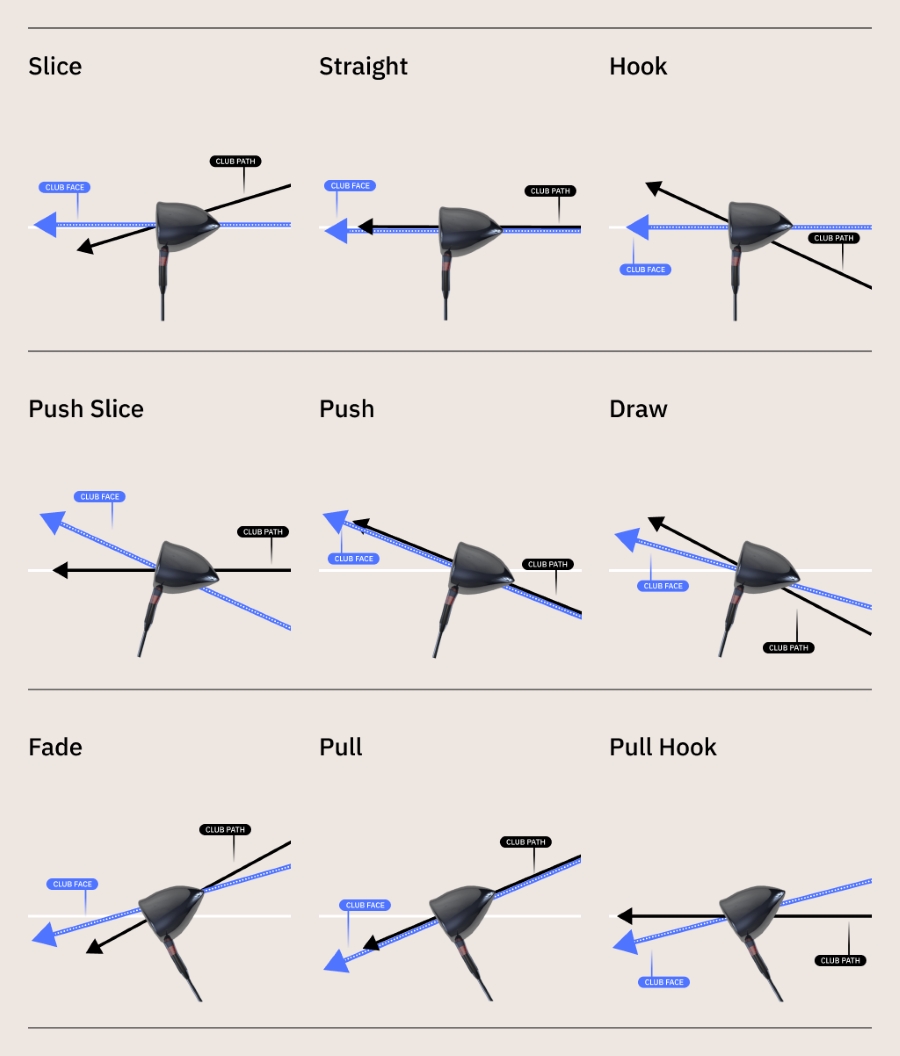
This image provides a helpful visual summary of the nine primary ball flights that result from different combinations of club path and club face.
Diagnosing Directional Faults: Slice and Hook
The slice and hook are the most common and frustrating directional misses. They are mirror images of each other, caused by a significant mismatch between the swing path and the clubface angle.
1. The Slice
- Description: For a right-handed golfer, the ball starts left of the target (or straight) and curves sharply to the right. This is the most common miss for beginner and amateur golfers.
- Root Cause: A slice is caused by an out-to-in swing path combined with a clubface that is open relative to that path.
- The out-to-in path (swinging from outside the target line to inside it) moves the clubhead across the ball from right to left.
- The clubface, while open to the path, might actually be pointing left of the target at impact, which causes the ball to start left. The large difference between the "leftward" path and the "rightward-pointing" face (relative to the path) imparts significant clockwise spin, causing the ball to slice.
2. The Hook
- Description: The ball starts right of the target and curves sharply to the left.
- Root Cause: A hook is the opposite of a slice. It's caused by an in-to-out swing path combined with a clubface that is closed relative to that path.
- The in-to-out path moves the clubhead from inside the target line to outside it.
- The face is "looking" to the left of this path, imparting counter-clockwise spin that makes the ball curve left.
The following short video provides a great visual overview of these shot shapes, including pushes and pulls (which we'll cover next).
Golf Ball Flights Explained - Draw, Fade, Hook, Slice, Push, Pull
This video from Golf Distillery offers a quick, clear explanation of the different ball flight trajectories.
Watch the entire video (full video). As you watch, try to connect each shot shape described (slice, hook, push, pull) back to the concepts of club path and face angle you just read about.
Diagnosing Contact Faults: Sky Ball and Topped Shot
While slices and hooks are about directional control (the X-axis, if you will), sky balls and topped shots are about vertical control (the Y-axis). They are caused by incorrect contact with the ball, which relates directly back to your angle of attack and the low point of your swing arc.
3. The Sky Ball (or "Pop-up")
- Description: The ball shoots almost straight up into the air with very little forward distance. It often leaves a "sky mark" on the top edge (crown) of your driver.
- Root Cause: A sky ball occurs when the clubhead strikes the ball too much on the upswing after having already passed underneath the ball's equator. This usually happens when the angle of attack is too steep (i.e., downward). The clubhead travels down and under the ball, and the top of the clubface then strikes the ball high on its face or even on the crown. This imparts massive backspin and sends the ball upwards, not forwards.

4. The Topped Shot
- Description: The ball travels very low to the ground, often just rolling or hopping, and goes nowhere near its potential distance.
- Root Cause: A topped shot is the opposite of a fat or skyed shot. It occurs when the clubhead's swing arc is too high, causing the leading edge or sole of the club to strike the top half of the ball. This can be caused by several things, including lifting your body up during the swing or having the low point of your swing occur too far behind the ball. The club essentially misses the bottom half of the ball where the mass is, resulting in a weak, low shot.
To solidify your understanding of these four key faults, let's turn to a concise resource that defines them clearly.
Golf Shot Errors - Illustrated Guides on How to Fix Shot Errors in Golf
This page from Golf Distillery provides simple, fundamental definitions for all major golf shot errors.
Read the short definitions for the four faults we are focusing on today: Slice Hook Topped Shot Skied Shot
A Diagnostic Reference Table
As a BI Analyst, you know the value of having structured data for quick reference. Here is a table summarizing the common driver faults and their underlying causes, based on the principles we've discussed. When you're at the range, you can use your ball flight as the primary data point to work backward and diagnose the likely input error.
| Fault Name | Ball Flight Description | Primary Cause (Path & Face Relationship) | Common Secondary Cause (Setup/Swing) |
|---|---|---|---|
| Slice | Starts straight or left, curves sharply right. | Out-to-in path with a face open to the path. | Steep downswing ("over the top"), weak grip, open alignment. |
| Hook | Starts straight or right, curves sharply left. | In-to-out path with a face closed to the path. | Swing path too far from the inside, overly strong grip, hands "flipping" at impact. |
| Sky Ball | Flies very high but short, with excessive backspin. | N/A - Contact Issue | Steep/negative angle of attack. Teeing the ball too high for a steep swing. |
| Topped Shot | Bounces or rolls on the ground with very low flight. | N/A - Contact Issue | Swing arc is too high, or bottom of the arc is behind the ball. Lifting the chest during the swing. |
Conclusion
You have now built a foundational diagnostic model for your golf swing. Instead of seeing a bad shot as a mystery, you can now interpret it as data. By observing whether the ball curved, where it started, and how high it flew, you can deduce the likely relationship between your clubface and swing path, as well as the quality of your vertical strike.
Key Takeaways:
- Common driver faults are not random; they are predictable outputs based on the inputs at impact.
- Clubface angle primarily dictates the ball's starting direction.
- The relationship between face and path dictates the ball's curvature. A slice is caused by a face open to the path; a hook is caused by a face closed to the path.
- Sky balls are typically caused by a steep (downward) angle of attack with a driver.
- Topped shots are caused by striking the top half of the ball, often because the swing arc is too high.
In our next lesson, we will shift our focus from the driver to another crucial club: the fairway wood. We will discuss the "sweeping" motion required to hit a fairway wood cleanly off the turf, which presents a different challenge compared to hitting a driver off a tee.