Following our last lesson on the geometric architecture of the swing plane, we're now ready to zoom in on the most critical moment of that entire motion: impact. You've learned the difference between the swing's overall plane and the club's specific path through the ball. Now, we'll see how that path, combined with the club's face angle, dictates everything about where the ball goes.
This lesson directly addresses the core physics of ball flight. Your goal is to explain the "ball flight laws"—the systematic rules that show how clubface angle and swing path at impact combine to create all nine possible ball flight patterns. For someone with your background in data analysis and system logic, this should be a particularly satisfying topic. You're about to learn the algorithm that governs every shot in golf.
The Old Laws vs. The New Reality
For decades, golf instruction was based on a flawed premise: that the swing path determined the ball's starting direction, and the clubface angle determined its curve. Thanks to modern launch monitors and high-speed cameras, we now know this is incorrect. The modern, data-verified ball flight laws provide a much more accurate model.
Ball Flight Laws: Face Angle, Path and Shot Shape
This article from upyourclub.com gives a concise, data-driven overview of the modern laws. It cuts through the old myths and presents the core principles confirmed by launch monitor technology.
Start by reading the introduction, the quick summary, and the section titled "What Are the Modern Ball Flight Laws?". This will establish the foundational rules we'll be working with for the rest of the lesson.
As the article makes clear, the two fundamental rules are:
- Clubface angle at impact is the primary driver of the ball's initial starting direction.
- The relationship between the clubface and the swing path determines the ball's curvature (spin).
Let's break down exactly what this means.
Rule 1: The Face Starts the Ball
The most important concept to internalize is that the ball predominantly launches in the direction the clubface is pointing at the moment of impact. For a driver, the face angle accounts for about 80-85% of the initial start line; for an iron, it's around 70-75%. The swing path has a minor influence, but the face is the king.
This is the single most powerful diagnostic tool you have. If you hit a shot and it starts to the left of your target, your clubface was, by definition, pointing to the left of your target at impact.
The Nine Ball Flights - Dave Tutelman
Dave Tutelman's article provides a great rebuttal to the outdated ball flight rules and includes a very intuitive analogy to prove the point.
First, read the bullet points that explain the basics of what happens at impact, starting from the first bullet. Then, skip down to the section criticizing the old rules and read the argument that begins with the wedge shot analogy.
The wedge analogy is perfect. When you hit a wedge, the face has a high loft (e.g., 56 degrees). The ball doesn't start flying horizontally (in the direction of the swing path) and then curve upwards. It launches immediately on a high trajectory, very close to the 56-degree loft of the face. The same principle applies horizontally: the ball starts close to where the face is pointing.
Rule 2: The Path (Relative to the Face) Curves the Ball
If the face starts the ball, what creates the curve? The curve, or sidespin, is created by the difference between where the clubface is pointing and the direction the clubhead is traveling (the path).
- To curve the ball right (a fade or slice): The clubface must be open relative to the swing path.
- To curve the ball left (a draw or hook): The clubface must be closed relative to the swing path.
Think of it as a glancing blow. If the club is moving in one direction but the face is pointing in another, the ball will "spin off" the face. The greater the difference between the path and the face, the more the ball will spin and the more it will curve.
This video from Golf Distillery explains these two core principles well.
How to Shape Golf Shots - 'New' Golf Ball Flight Laws Explained
This video, "How to Shape Golf Shots - 'New' Golf Ball Flight Laws Explained," clearly defines the two key variables and how they interact.
Watch from this section where the instructor defines clubface and path, then explains how the face dictates the start line and the path-to-face relationship creates the curve. The idea that "the bigger the difference between the path and the face, the bigger the amount of curve" is the key takeaway here.
The 9 Ball Flights: A Systematic Combination
Now, let's put these two rules together. By combining the three possible swing paths (in-to-out, straight, out-to-in) with the three possible face orientations (open, square, closed), we can produce a predictable matrix of nine different ball flights.
The following resource provides an excellent, data-oriented breakdown of each shot type. We will walk through them one by one.
Ball Flight Laws: Face Angle, Path and Shot Shape
Let's return to the upyourclub.com article. It contains a table defining the "face-to-path" relationship and then gives the launch monitor "signature" for each of the primary shot shapes. This is the logical core of the ball flight laws.
First, read the section The Face-to-Path Relationship. The formula Face-to-Path = Face Angle − Club Path is the mathematical expression of Rule #2. Then, read the entire section Common Shot Shapes, which breaks down the 7 most common of the 9 flights.
Let's visualize this system. These two images illustrate the nine possible results of combining path and face. The first shows the resulting trajectories, and the second shows the clubhead orientation that creates them.
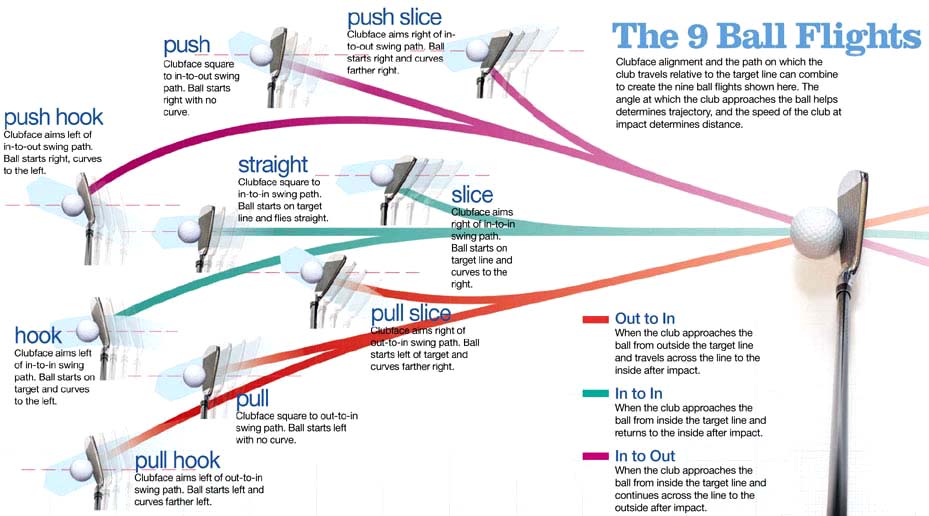
Based on the article you just read and these diagrams, we can build a complete table. For a right-handed golfer:
1. Straight Path (Path = 0°)
- Face Square to Path (0°): STRAIGHT. Starts straight, flies straight. The "perfect" shot.
- Face Open to Path (>0°): FADE. Starts right of target (face is open) and curves further right. This is often called a Push-Slice.
- Face Closed to Path (<0°): DRAW. Starts left of target (face is closed) and curves further left. This is often called a Pull-Hook.
2. In-to-Out Path (Path > 0°)
- Face Square to Path: PUSH. Face is aimed where the path is going (right of target). Starts right and flies straight.
- Face Open to Path: PUSH-SLICE. Face is even more open than the path. Starts right and curves further right.
- Face Closed to Path: HOOK / DRAW. The face is closed relative to the path.
- If the face is also closed to the target line, it's a Pull-Hook.
- If the face is square to the target line, it's a Hook. (Starts straight, curves hard left).
- If the face is open to the target line (but still closed to the path), it's a Push-Draw. (Starts right, curves back to target). This is a classic "pro" shot shape.
3. Out-to-In Path (Path < 0°)
- Face Square to Path: PULL. Face is aimed where the path is going (left of target). Starts left and flies straight.
- Face Open to Path: SLICE / FADE. The face is open relative to the path.
- If the face is open to the target line, it's a Push-Slice.
- If the face is square to the target line, it's a Slice. (Starts straight, curves hard right). This is the most common amateur miss.
- If the face is closed to the target line (but still open to the path), it's a Pull-Fade. (Starts left, curves back to target). This is another common "pro" shape.
- Face Closed to Path: PULL-HOOK. Face is even more closed than the path. Starts left and curves further left.
To consolidate your understanding of these terms, watch this final video which provides a verbal description of each shot type.
Golf Ball Flights Explained - Draw, Fade, Hook, Slice, Push, Pull
This Golf Distillery video, "Golf Ball Flights Explained," serves as a great review, naming and describing all the different shots we've just broken down.
Watch the entire video from start to finish. As you watch, try to connect the instructor's description of each shot (e.g., "starts right and stays right") to the face and path combination you now know is responsible for it.
Conclusion
You have now learned the fundamental physics that govern where a golf ball goes. This knowledge transforms you from a passive participant into an active diagnostician. Instead of wondering why a shot went wrong, you can begin to deduce the root cause based on observable data—the ball's flight.
Key Takeaways:
- Modern ball flight laws are based on launch monitor data: face angle controls the start line, and the face-to-path relationship controls the curve.
- The old law (path starts, face curves) is incorrect. The wedge shot analogy is a simple way to remember this.
- Every shot can be diagnosed. A ball that starts left and curves right (a pull-fade) was unequivocally struck with a clubface that was closed to the target line but open to the swing path.
- The nine primary ball flights are the predictable, logical outcomes of combining the three main swing paths with the three main face-to-path relationships.
In our next lesson, we will put this new diagnostic framework into practice. We will focus on how to use your own observed ball flight patterns to identify the most common swing faults and, more importantly, what to do about them.